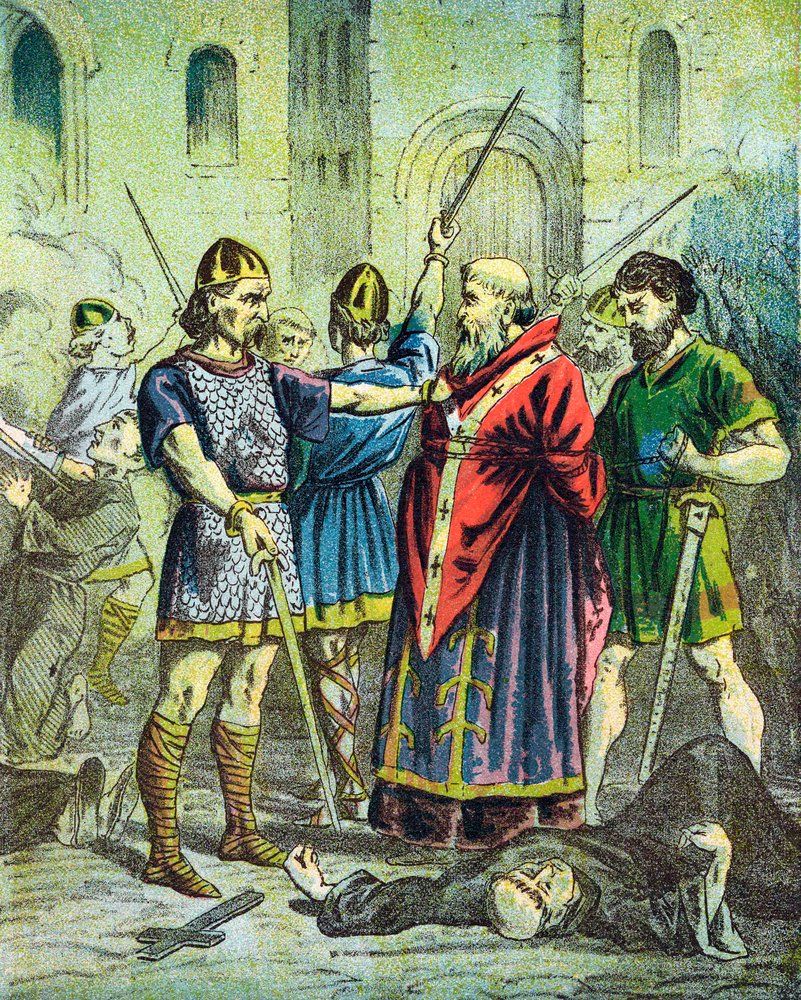
Saint Alphege - Archbishop of Canterbury and Martyr (1012)
Ælfheah, known as Alphege, was an Anglo-Saxon archbishop of Canterbury who became a martyr by refusing ransom payment to the Danish invaders in 1012, prioritizing the well-being of his people over his own life.
Life and Formation
Ælfheah, more commonly known as Alphege, was born around 953 or 954 in the village of Weston, near Bath, during the second great period of Viking attacks against England. Coming from a wealthy family, he abandoned his inheritance to pursue religious life, entering the Benedictine monastery of Deerhurst, in Gloucestershire, where he became a monk.
After some years in the monastery, Alphege withdrew to a life as a hermit (anchorite), dedicating himself to contemplation and asceticism. His reputation for piety and holiness soon led him to positions of greater responsibility in the Church. He was appointed Abbot of Bath by the renowned Saint Dunstan, and in 984 he was promoted to Bishop of Winchester, a role he held with distinction for twenty years.
Ministry and Pastoral Work
In 1005 or 1006, Alphege was elevated to the position of Archbishop of Canterbury, receiving the pallium in Rome. During his episcopate in Winchester and his archbishopric in Canterbury, Alphege was known for his dedication to learning and ecclesiastical reform. He actively promoted the cult of Saint Dunstan and encouraged intellectual development within the Church.
In 1006, Alphege actively participated in the decrees of the Synod of Enham, which addressed significant issues caused by Viking attacks. His spiritual leadership was particularly important during a turbulent period of Scandinavian invasions in England.
Earlier, in 994, King Æthelred the Unready had sent Alphege as an ambassador to negotiate with the Norwegian king Olaf, whom he encouraged to convert to Christianity and confirmed in the faith.
Capture and Martyrdom
In September 1011, the Danes invaded much of southern England. Despite the payment of the Danegeld tribute that had been agreed upon, the invaders did not cease their attacks. They besieged Canterbury and captured it through the betrayal of an English archdeacon named Ælfmaer.
Alphege was captured along with other magnates and taken to Greenwich, where he was held prisoner by the Danish fleet for seven months. The invaders demanded an enormously high ransom of 3,000 pounds (an amount that would be worth much more in modern currency). Ransoms were paid for the other prisoners, who were released, but the sum demanded for the archbishop was so exorbitant that it would have reduced his people to misery.
Alphege, aware of his people's poverty and moved by deep Christian compassion, categorically refused to pay his own ransom and forbade any of his subjects to do so. His refusal was an act of Christian justice and personal sacrifice.
Enraged by the refusal, the Danes, during a drunken feast on Easter Day, 19 April 1012, brought Alphege forward and repeated their demands. When he again refused, the invaders brutally attacked him, throwing ox bones from the feast and stones at him. Finally, an axe was brought down on his head, killing him. According to historical accounts, Thorkell the Tall, the Viking commander, tried to save him by offering all his possessions except his ship in exchange for the archbishop's life, but it was in vain.
"They attacked him with ox bones and horns; and one of them struck him on the head with an axe; so that he fell with the blow. And his holy blood fell to the earth, while his holy soul was sent to the kingdom of God."
Legacy and Canonization
Alphege immediately became a national hero among the English for his death. His body was initially buried in St. Paul's Cathedral in London, where the monks venerated him at the beginning and end of each day.
In 1023, after the final victory of the Danes and the accession of the Danish king Cnut to the English throne, the new monarch adopted a policy of conciliation. As an act of reparation, Cnut ordered that Alphege's remains be transferred from London to Canterbury, where he is remembered as a martyr and saint.
Alphege was canonized in 1078, although there were some early theological doubts about whether he had died properly for the Christian faith or to avoid the payment of a ransom. However, the Church recognized that he died exercising the Christian virtue of justice, refusing to impose an impossible burden on his people.
Saint Thomas Becket, a later archbishop of Canterbury, prayed to Saint Alphege in 1170, shortly before his own martyrdom in Canterbury Cathedral. In his final sermon, Becket alluded to Alphege as the first martyr of Canterbury, and before his death entrusted his cause to God and to Saint Alphege.
Accounts of conversions among the soldiers who killed Saint Alphege soon appeared after his death, suggesting the spiritual impact of his martyrdom.
Veneration and Representation
The site of his death in Greenwich is marked by the Church of St. Alfege, which still stands today. A stone in Canterbury marks his burial place beside the cathedral's high altar.
In Christian art, Saint Alphege is often depicted with an axe, the instrument of his death, or as a shepherd defending his flock from wolves, symbolizing his dedication to the pastoral care of his people.
Birth
Date: c. 953-954
Place: Weston, near Bath, England
Death
Date: 19 April 1012
Place: Greenwich, England
Liturgical Feast
19 April
Recommended Books
To deepen your knowledge about this person, we recommend:
- The Anglo-Saxon Chronicle - Various authors (modern translation and commentary) (Original: 11th century; modern editions: various)
Primary source containing contemporary accounts of Alphege's death and the events of 1011-1012
Sources and References
This article was prepared based on the following sources:
- St Alphege (953-1012) - Archbishop of Canterbury, Martyr & Saint - Canterbury Archaeology (website)
Official Canterbury Archaeology biography with verified information about life, death, and canonization - Ælfheah of Canterbury - Wikipedia - Wikipedia (website)
Encyclopedic article with detailed chronology and references to primary sources - Alphege, Archbishop of Canterbury, Martyr - Anglican Resources (website)
Anglican resource biography with details about his life, ministry, and death - CATHOLIC ENCYCLOPEDIA: St. Elphege - New Advent Catholic Encyclopedia (website)
Catholic encyclopedia entry with information about his life, death, and veneration - The Simple Valor of the Other Martyred Archbishop of Canterbury - Our Sunday Visitor (website)
Article about Saint Alphege with emphasis on his virtue and Christian sacrifice - Alphege, Archbishop of Canterbury and Martyr, 1012 - For All Saints (website)
Detailed biography with quotations from the Anglo-Saxon Chronicle about his death - The Story of Archbishop Alphege - A Clerk of Oxford (website)
Historical narrative with translation of excerpts from the Anglo-Saxon Chronicle