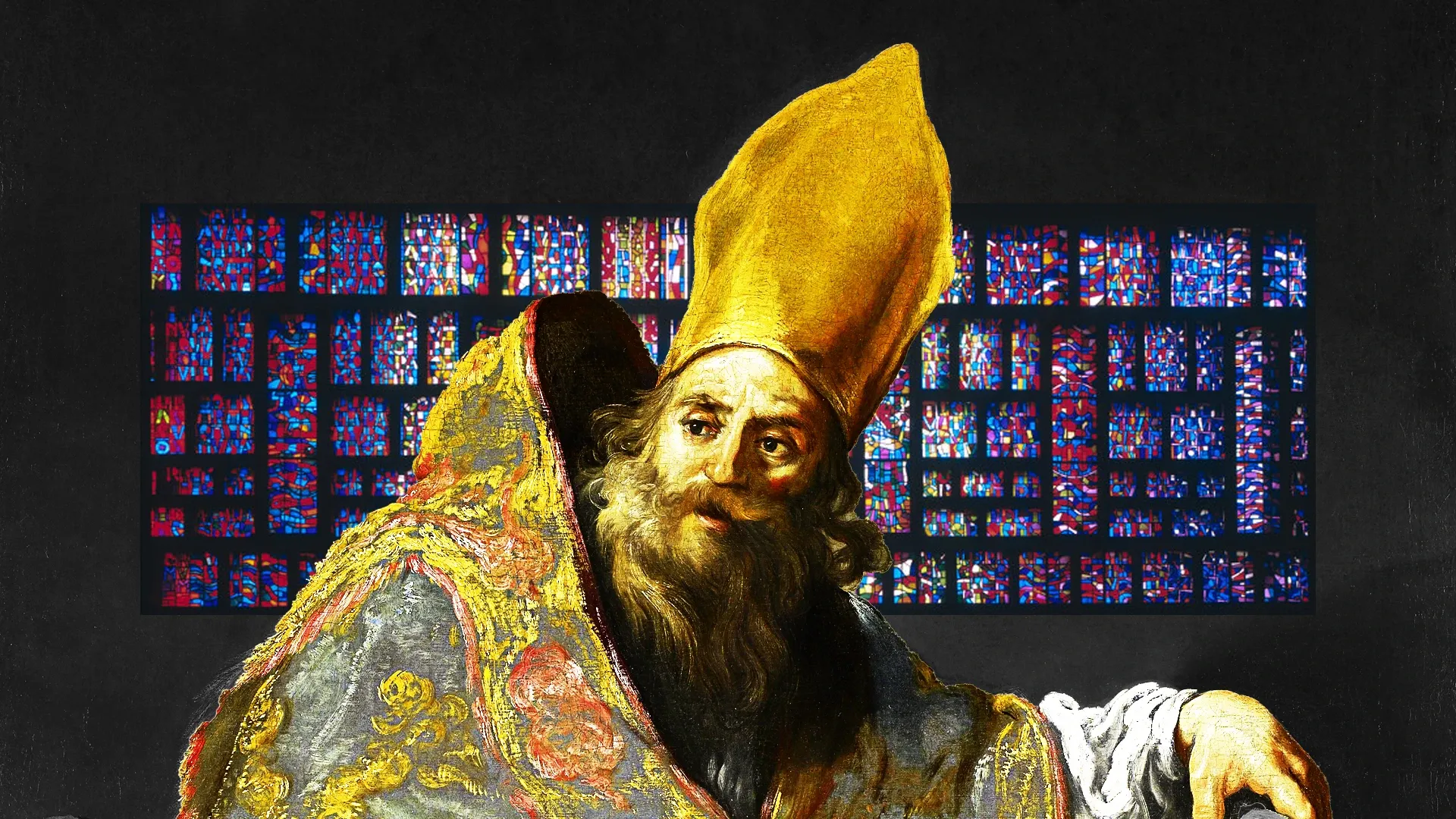
Saint Ambrose - Bishop of Milan, Doctor of the Church, and Defender of the Catholic Faith
Saint Ambrose (c. 340-397) was one of the most eminent bishops and theologians of the 4th century, recognized as one of the four great Doctors of the Latin Church. Elected Bishop of Milan by popular acclamation in 374, even though he had not yet been baptized, he stood out for his unwavering defense of Catholic orthodoxy against Arianism and for his influence over Roman emperors.
Life and Formation
Aurelius Ambrose, better known as Saint Ambrose, was born around the year 340 AD in Augusta Treverorum (present-day Trier, in Germania), into an influential Roman family that had converted to Christianity. From a young age, he displayed notable civic and moral gifts, which led him to a career in administration in the Roman Empire.
Before his religious life, Ambrose attained the position of consular prefect of Liguria and Aemilia, whose capital was Mediolanum (Milan), then the political center of the Western Roman Empire. He carried out this role with competence and integrity, earning respect from both the population and the imperial authorities.
Unexpected Election as Bishop
Ambrose's life took a completely unexpected turn on December 7, 374, during the election of the new bishop of Milan. At that time, the city faced deep social divisions between Catholics and Arians— the latter denied the divinity of Christ. Choosing a new pastor was extremely delicate, since he had to represent both factions.
During the assembly in the Milanese church, Ambrose was acclaimed by the people as shepherd of the diocese, despite still being a catechumen (unbaptized). This choice surprised Ambrose himself, who felt unworthy of the office and tried to رفض it, appealing to Emperor Valentinian to avoid the appointment. However, the emperor confirmed the popular will, and Pope Damasus also considered him fit for the episcopal dignity.
Understanding that it was God's will, Ambrose accepted the call. In an extraordinary week, he was baptized, ordained a priest, and appointed Bishop of Milan, all in the year 374, at the age of 34. Although the First Council of Nicaea (325) forbade neophytes from being raised to the episcopate, both the Pope and the Emperor approved this exception.
Ministry and Pastoral Work
As bishop of Milan, Ambrose devoted himself intensely to the study of the Sacred Scriptures and theological formation, compensating for his previous lack of preparation with tireless dedication. He used his qualities as an organizer and administrator for the good of the Church, acting in the pastoral, political, doctrinal, and liturgical fields.
His main priorities were to ensure peace and harmony for the people, but he never tolerated doctrinal errors. Artistic iconography portrays him with a whip in hand against heretics, symbolizing his uncompromising struggle for orthodoxy.
Fight Against Arianism
Ambrose's great battle was against Arianism, a doctrine that threatened the unity of the Christian faith. He confronted emperors and entire courts, preserving the integrity of the Church and the confession of Christ's divinity. This struggle led him to disagree even with rulers and sovereigns, reaffirming the independence of spiritual power from temporal power.
In 385, Empress Justina (mother of Valentinian II), who sympathized with Arianism, demanded that the Basilica Porcia be handed over for use by Arian troops. Ambrose, supported by the population, firmly refused to comply. The following year, 386, when Justina and Valentinian again ordered that a church in Milan be handed over to the Arians, Ambrose and his congregation barricaded themselves inside the church, preparing to resist. The order was eventually revoked, demonstrating the bishop's spiritual power over temporal authority.
Influence on Emperor Theodosius
One of the most significant episodes of Ambrose's ministry occurred in 390 AD, when the Eastern emperor, Theodosius I, ordered a brutal massacre in Thessalonica as retaliation for a revolt against the Gothic garrison. Approximately seven thousand people were killed in this action.
Considering the act a grave sin, Ambrose excommunicated the emperor, an extraordinary gesture that demonstrated the spiritual authority of the Church over secular power. After some months, Theodosius was forced to undergo public penance, only after which Ambrose allowed the emperor to receive communion. This event marked a crucial moment in the history of the relationship between Church and State, establishing that no temporal power stood above the Christian moral law.
Ambrose played an important role in the conversion and spiritual formation of Emperor Theodosius I to Christianity, deeply influencing the religious policy of the Roman Empire.
Liturgical and Intellectual Contributions
In addition to his pastoral and political actions, Ambrose was a builder of basilicas and a composer of hymns that revolutionized the way people prayed in the Church. His liturgical hymns left a lasting legacy in the Western Christian tradition.
As an intellectual, Ambrose left many theological and exegetical writings that contributed significantly to the formation of Christian doctrine in the West. His intellectual work, combined with his pastoral action, made him one of the pillars of Latin Christendom.
Legacy and Canonization
Saint Ambrose died on April 4, 397 AD, in Milan, at approximately 57 years of age. According to tradition, he died on Holy Saturday in 397, crowning a life of devoted service to the Church.
Ambrose was recognized as one of the four great Doctors of the Latin Church, together with Saint Augustine, Saint Jerome, and Saint Gregory the Great. His title of Doctor of the Church reflects his exceptional contribution to theology and Christian spirituality.
His liturgical feast is celebrated on December 7, the date of his election as bishop. Saint Ambrose is venerated as the patron of various causes and is considered a model of moral integrity, spiritual courage, and dedication to the common good.
Ambrose's legacy transcends his era: he established important precedents for the Church's independence from secular power, demonstrated that spiritual authority could confront and correct even emperors, and left an indelible mark on the liturgy, theology, and spirituality of the Western Church.
Birth
Date: c. 340 AD
Place: Augusta Treverorum (present-day Trier, Germania) or Trier, in Gaul
Death
Date: April 4, 397 AD
Place: Mediolanum (Milan), Italy
Liturgical Feast
December 7
Patronage
- Beekeepers
- Candles
- Domestic servants
- Apprentices
- Weavers
- Wax merchants
Written Works
- Various theological and exegetical writings (374-397 AD) - Ambrose left numerous writings on theology, biblical exegesis, and spirituality that contributed significantly to the formation of Western Christian doctrine. His works include commentaries on Scripture and theological treatises.
- Liturgical hymns (374-397 AD) - Musical compositions that revolutionized Christian liturgy and the way people prayed in the Church, leaving a lasting legacy in the Western Christian musical tradition.
Recommended Books
To deepen your knowledge about this person, we recommend:
- Complete Works of Saint Ambrose - Saint Ambrose (Modern compilations of his original writings)
Direct reading of the works of Saint Ambrose himself to understand his theological and spiritual thought.
Sources and References
This article was prepared based on the following sources:
- S. Ambrose, bishop of Milan and doctor of the Church - Vatican News (website)
Official Vatican source with information on the life, election, and fight against Arianism of Saint Ambrose. - Ambrose of Milan - Wikipedia - Wikipedia (website)
Encyclopedia with biographical data, precise dates, and information about his work as bishop and theologian. - Saint Ambrose - A bishop feared even by emperors - Roman Stories (website)
Detailed analysis of Saint Ambrose's political and spiritual influence, including the episode of Theodosius and Thessalonica. - Saint Ambrose, the great bishop of Milan - Canção Nova (website)
Religious source with information on the life, virtues, election, and legacy of Saint Ambrose. - Memory of Saint Ambrose, Bishop and Doctor of the Church - Archdiocese of Pará (website)
Ecclesiastical source with biographical data and information about his role in the conversion of Theodosius I. - Saint Ambrose and the controversial relationship between philosophy and Christianity - Conhecer e Pensar (website)
Analysis of Saint Ambrose's life and work as archbishop of Mediolanum and his influence in the 4th century. - December 7: Saint Ambrose, Bishop of Milan and Doctor of the Church - Convento da Penha (website)
Religious source with information on the life, election, civic gifts, and legacy of Saint Ambrose. - Saint of the Day - Irmãs PJC (website)
Information about the context of Ambrose's election as bishop of Milan. - Saint Ambrose - Christian Life - Franciscanos (website)
Source on the family origin and birth of Saint Ambrose.