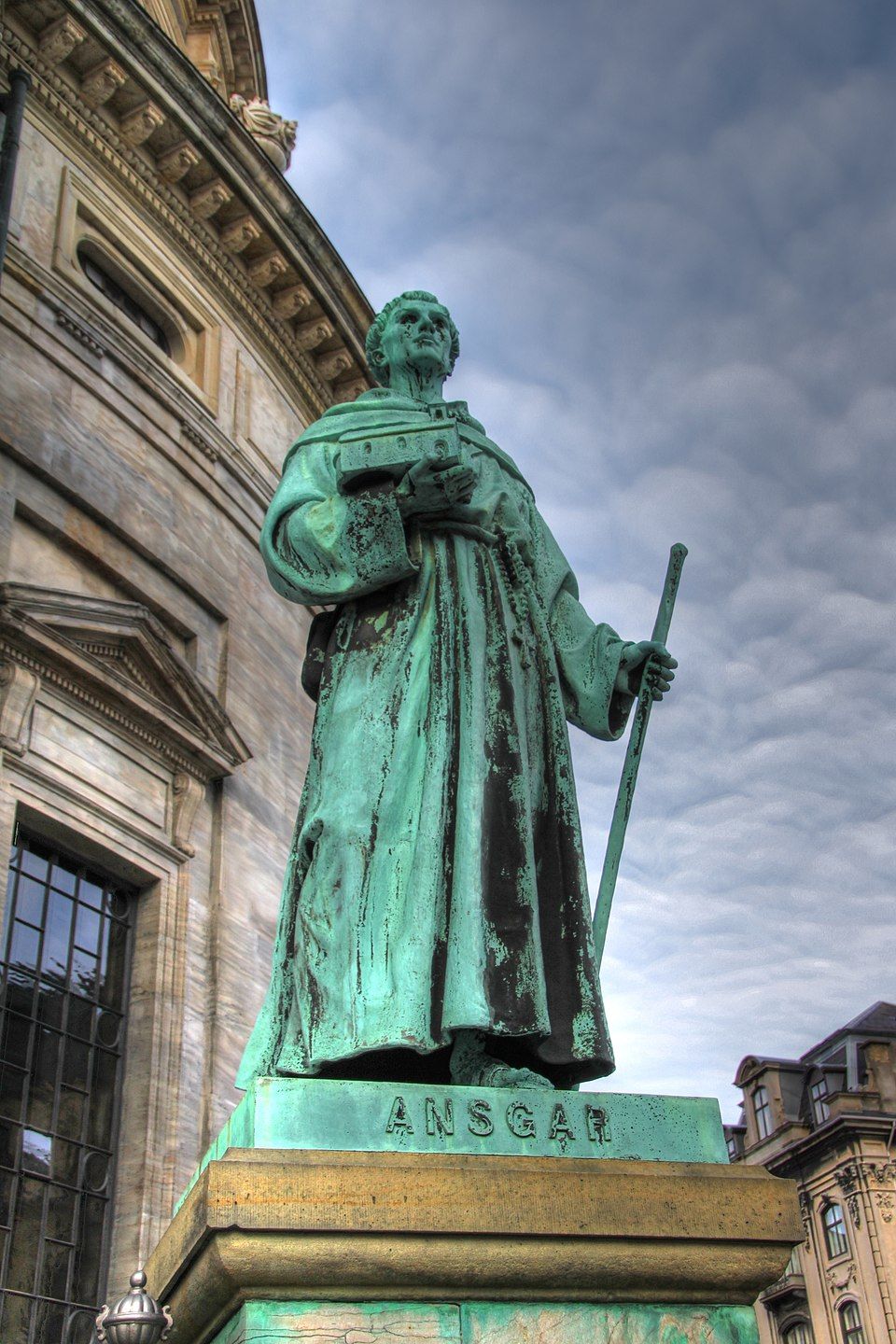
Saint Ansgar of Hamburg - Apostle of the North and Missionary to the Scandinavians
Ansgar of Hamburg (801-865), known as the Apostle of the North, was a Frankish Benedictine monk who evangelized Denmark and Sweden in the 9th century. Appointed bishop of Hamburg-Bremen, he devoted his life to converting the Nordic peoples, facing Viking and pagan challenges.[1]
Life and Formation
Ansgar of Hamburg, born on September 8, 801 in Amiens, France, was a Frankish Benedictine monk who stood out as a missionary in Northern Europe. Educated in Benedictine monasteries, he showed an early vocation for religious life and evangelization. His monastic formation prepared him for the rigors of mission in hostile lands marked by Norse paganism.[1]
Orphaned of his mother at a young age, Ansgar found refuge at the abbey of Corvey, where he deepened his spirituality and learned the languages and customs needed for the apostolate. His devotion and humility caught the attention of superiors, who sent him as a missionary to the Scandinavian peoples.[1][2]
Ministry and Missionary Work
First Mission to Denmark (826)
In 826, Ansgar was sent as a missionary to Denmark, evangelizing in the Viking cities of Hedeby and Ribe. Despite the difficulties, he built the first church in Ribe and baptized several converts, with the support of the Danish king Harold. This journey marked the beginning of his work as the Apostle of the North.[1]
Mission to Sweden and Birka (830)
In 830, Ansgar arrived in Sweden, settling in the Viking city of Birka. Warmly received by King Björn, he celebrated Mass, preached the Gospel, and built a church. Authorized by the local monarch, he baptized nobles and slaves, planting the seeds of Christianity in pagan soil.[1]
After returning in 831, he was appointed bishop of the Archdiocese of Hamburg-Bremen in 834, with the mission of evangelizing Danes, Swedes, Slavs, and Balts. Pope Gregory IV appointed him papal legate for Denmark and Sweden, broadening his reach.[1]
Challenges and Second Journey (851)
Ansgar faced Viking destruction in Hamburg (845), losing his see, but persevered by moving to Bremen. In 851, he returned to Birka under King Olaf, rekindling the Christian faith. Despite initial successes, after his departure, the Swedes returned to Norse paganism, as noted by Archbishop Unni in 935.[1]
His work included building churches, rescuing Christian slaves, and diplomacy with Viking kings, always emphasizing charity and patience.[2][3]
Legacy and Canonization
Ansgar died on February 3, 865 in Bremen, leaving a legacy of missionary perseverance. Canonized by Pope Nicholas I, he is venerated as a saint and called the Apostle of the North. His biography, Life of Ansgar, written by Rimbert of Hamburg (his successor) between 865-876, is a primary source on the Viking Age and its missions.[2]
'Mission leaves no lasting traces without the grace of God and the patience of the missionary.'
His pioneering work opened paths for Scandinavian Christianization, influencing centuries of religious history. Despite setbacks, Ansgar symbolizes tireless faith amid Viking dangers.[1][4]
- First church in Danish territory: Ribe (826).
- Christian establishment in Birka, Sweden (830).
- Papal legacy for evangelization of Northern Europe.
Birth
Date: September 8, 801
Place: Amiens
Death
Date: February 3, 865
Place: Bremen
Liturgical Feast
February 3
Patronage
- Denmark
- Sweden
- Hamburg-Bremen
- Missionaries of the North
Recommended Books
To deepen your knowledge about this person, we recommend:
- Life of Ansgar (Vita Ansgari) - Rimbert of Hamburg (c. 865-876)
Contemporary biography written by Ansgar's successor, the main primary source on his missions in Denmark and Sweden.
Sources and References
This article was prepared based on the following sources:
- Ansgar of Hamburg – Wikipedia (website)
Encyclopedic article detailing Ansgar's life, missions, and canonization. - Life of Ansgar – Wikipedia (website)
Page about the biography written by Rimbert, a key historical source. - Saint Olaf, the first Viking saint - Following History's Footsteps (website)
Historical blog mentioning Ansgar as a key missionary in the Nordic countries. - RELIGION, VIKINGS AND ART (article)
Academic article referencing Ansgar's evangelizing missions in Denmark and Sweden.