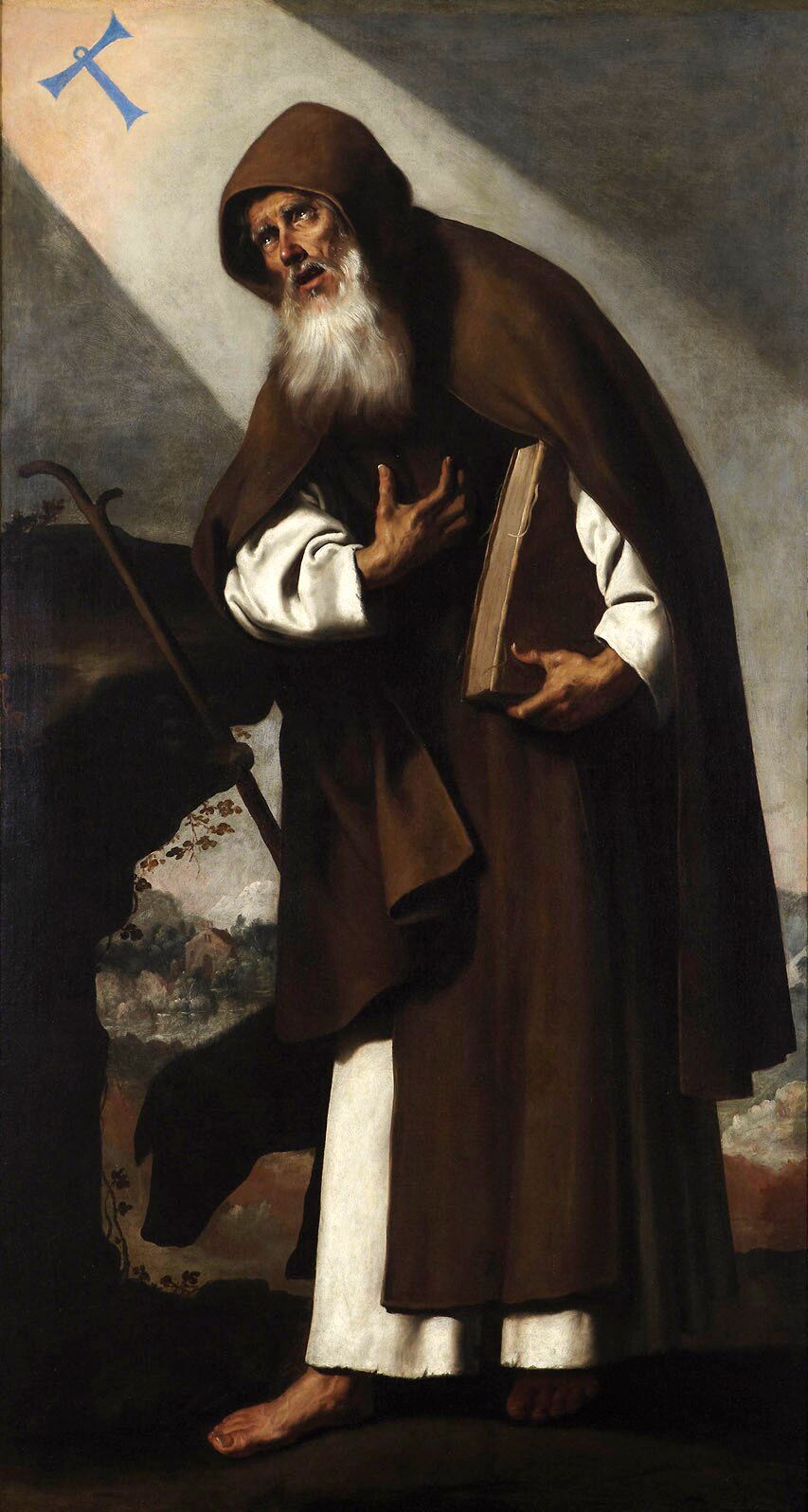
Saint Anthony - Father of Christian Monasticism and Hermit of the Egyptian Desert
Saint Anthony (251-356) was an early Egyptian Christian monk who renounced wealth at the age of 20 to live as a hermit in the desert. He became a pioneer of Christian monasticism, organizing communities of hermits, and is venerated as the Father of Monks and defender of the faith against Arian heresy.
Life and Formation
Saint Anthony was born around 251 in Conam, in the heart of Upper Egypt, near Heracleopolis Magna, into a wealthy rural family. He received a solid Christian education from his parents, who left him not only material goods but above all a deep spiritual formation.
At twenty years old, after the death of his parents, Anthony inherited considerable wealth. However, his life would change radically during a Eucharistic celebration. Upon hearing the proclamation of the Gospel about the rich young man, Jesus' words touched his heart deeply:
"Go, sell all that you have, give to the poor, and you will have treasure in heaven; then come and follow me."Inspired by this message, Anthony made a revolutionary decision for his time.
Renunciation and Ascetic Life
Anthony sold all his possessions and distributed them to the poor, also ensuring his sister's religious formation, and she entered a community of consecrated virgins. This decision marked the beginning of his extraordinary spiritual journey.
Gradually, Anthony intensified his ascetic life. He performed manual labor, but donated practically everything he earned to those in need. He felt, however, that God demanded even more of him. Meditating on the words of the Gospel -
"Therefore do not worry about tomorrow, for tomorrow will worry about itself. Each day has enough trouble of its own."- he decided to abandon social life completely and live as a hermit in the desert.
Anthony withdrew to the Egyptian desert, where he lived a life of extreme austerity dedicated to continuous prayer and meditation. According to the accounts of Saint Athanasius of Alexandria, his biographer, Anthony was tempted by the Devil in an intense and prolonged way, far more than the forty days of Jesus' temptation. Despite the tempting visions and demonic attacks, Anthony stood firm, refusing to be seduced.
A notable feature of his hermit life was his choice to live near a cemetery, where he deepened his meditation on death defeated by Christ, seeking to understand more deeply the mystery of the resurrection.
Pioneer of Christian Monasticism
Anthony's fame as a holy and wise man spread quickly. Numerous visitors and pilgrims sought him out in the desert, seeking his counsel and spiritual comfort. His reputation for being excellent at the art of shepherding souls attracted many disciples who wished to follow his spiritual path.
At fifty-five years old, responding to the persistent request of his disciples, Anthony abandoned complete isolation and organized an innovative form of communal life. His followers lived alone, each in his own hut, but kept in contact with one another and received centralized spiritual direction from Anthony. This revolutionary structure made him one of the pioneers of Christian monasticism, and for this reason he is also known as Saint Anthony the Abbot.
His influence was so significant that he became the model of the secluded monk and is still called today the Father of Christian Monks. The organization he created laid the foundations for the later development of Christian monastic communities.
Defense of the Faith and Fight Against Arianism
Beyond his contemplative life, Anthony played a role of great historical importance in defending the Christian faith. He worked closely with Saint Athanasius of Alexandria, bishop and his close friend, in fighting the heresy of Arianism, which denied the divinity of Christ.
Anthony realized that Arianism had infiltrated not only lay Christians, but also the desert monks themselves. Concerned about this threat to Christian orthodoxy, he traveled to Alexandria on two important occasions:
- In 311, to encourage and comfort Christians persecuted by Maximinus Daia
- In 335, to defend his disciple Athanasius, who was bishop and was being persecuted and slandered by the Arians, and to urge Christians to remain faithful to the doctrine of the Council of Nicaea of 325
His spiritual influence was so great that even Emperor Constantine and his sons sought his guidance and advice.
Virtues and Charisms
Saint Athanasius left us a vivid portrait of Anthony's character:
"He prayed constantly, for he had learned that we must pray in private without ceasing. He was so attentive to the reading of Holy Scripture that nothing escaped him: he retained everything, and thus his memory served him in place of books. All the villagers and monks with whom he lived saw what kind of man he was and called him a 'friend of God,' loving him as a son or as a brother"."
Anthony was considered holy in life, being able to perform miracles and leading many to conversion. He lived in joy, mercy, and truth, becoming a living example of the virtues of chastity, obedience, and poverty.
Death and Legacy
Anthony foretold his own death. After a final mystical vision of God with his saints, he died at one hundred and five years old, on January 17, 356, in the city of Coltzum, Egypt.
His extraordinary life was recorded by Saint Athanasius in the work Vita Antonii (The Life of Anthony), written around 360, which became one of the most influential texts of early Christian literature and served as a model for future biographies of saints.
Saint Anthony was entered in the Book of Saints to be venerated on the day of his death, and his influence in the history of Christianity is immense. He established the foundations of Christian monasticism, demonstrated the possibility of a life radically dedicated to God in the desert, and courageously defended the orthodox faith against heresies. His legacy endures as an inspiration for generations of Christians who seek to deepen their spiritual life and overcome the temptations of the world.
Birth
Date: c. 251
Place: Conam (or Fayum), Upper Egypt, near Heracleopolis Magna
Death
Date: January 17, 356
Place: Coltzum, Egypt
Liturgical Feast
January 17
Patronage
- Monks
- Hermits
- Monastic life
- Defense against temptations
Recommended Books
To deepen your knowledge about this person, we recommend:
- Vita Antonii (The Life of Anthony) - Saint Athanasius of Alexandria (c. 360)
Official biography and the main historical source on Saint Anthony, written by his disciple and close friend Saint Athanasius. A fundamental document that records the character, customs, works, and thought of the most illustrious monk of the ancient Catholic Church.
Sources and References
This article was prepared based on the following sources:
- Who is Saint Anthony, the abbot of the desert? - Aleteia (website)
Informative article about Saint Anthony with information about his life, renunciation of possessions, hermit life, and role in defending the faith against Arianism. - Anthony the Great - Wikipedia (website)
Encyclopedia with information about the life of Saint Anthony, his temptations in the desert, trips to Alexandria, and fight against Arianism. - Saint Anthony of the Desert or Anthony of Egypt - Comece o Dia Feliz (website)
Detailed biography with information about birth, ascetic life, organization of communities of hermits, trips to Alexandria, and death. - Saint Anthony, the saint who lived in the Cemetery - Canção Nova (website)
Article about Saint Anthony with sections on his origins, renunciation of possessions, hermit life, and fight against Arianism. - The life of Saint Anthony - Minha Biblioteca Católica (website)
Article about the history of Saint Anthony, his meditation on surrender to God, ascetic life in the desert, and victory over temptations. - Saint Anthony - Projeto Santa Teresa - Projeto Santa Teresa (website)
Information about Saint Anthony as founder of the monastery, birth in Fayum, and geographic location.