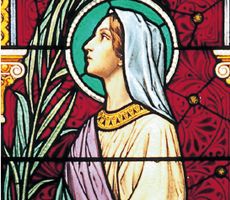
Saint Blandina - Martyr of Lyon and Symbol of Unwavering Faith
Blandina was a young Christian slave who lived in the 2nd century and died as a martyr in Lyon in 177, during the persecution of Emperor Marcus Aurelius. Despite her physical frailty, she showed extraordinary spiritual courage by resisting torture and inspiring her fellow Christians until their final martyrdom.
Life and Historical Context
Blandina was born around 162 in Lyon (Lugdunum), in Gaul, during the reign of Emperor Marcus Aurelius. She was a young Christian slave, belonging to the lowest class of Roman society, but possessed a deep and unwavering faith in Jesus Christ. She lived in community with other Christians, including her mistress, also a Christian, whose name was not preserved by history.
In the year 177, Lyon was an important city with approximately 40,000 inhabitants, functioning as the administrative and economic metropolis of Gaul. In this context of urban growth and social tensions, the local Christian community would face one of the most violent and merciless persecutions of the period.
The Persecution of 177
During the month of June 177, Governor Tacitus ordered a raid against the Christians of Lyon. The accused faced unfounded charges of incest and cannibalism, crimes commonly attributed to Christians by the distrustful pagan population. Among those detained was Blandina, then about 15 years old, together with her mistress and dozens of other believers.
The persecution was systematic and brutal. According to accounts from the time, preserved in the letter that the Church of Lyon sent to the Churches of Asia and Phrygia, the Christians were subjected to continuous torture in the city's amphitheater. The executioners took turns tormenting the prisoners from dawn until dusk.
The Martyrdom of Blandina
Extraordinary Resistance
What makes Blandina's story particularly remarkable is the contrast between her fragile appearance and her unwavering spiritual strength. All her companions, including her own mistress, doubted that such a weak young woman could withstand torture and keep her faith. However, Blandina surprised everyone with a courage her tormentors described as manly.
During the interrogations, when asked to renounce her Christian faith, Blandina replied firmly:
I am a Christian and nothing evil is done among usHer simple but resolute answer reflected the depth of her conviction.
Cycle of Tortures
Blandina was subjected to a continuous cycle of varied tortures:
- Severe flogging by the executioners
- Exposure to wild beasts in the amphitheater
- Hanging on a stake, as a form of crucifixion, to be devoured by animals
- Forced confrontation with the sufferings of her fellow martyrs
Miraculously, when she was suspended on a stake and exposed to the beasts, the animals respected her and did not attack her, returning her to prison for further torment. Her resistance was so remarkable that the executioners themselves grew weary of torturing her.
Inspiration to Her Companions
Beyond her own endurance, Blandina played a crucial role of spiritual encouragement. While being tortured, she raised her prayers to heaven and inspired her fellow Christians with her unwavering faith. One of her companions, Ponticus, a young man of only 15 years, was particularly encouraged by her. When both were taken to the amphitheater together, Blandina infused bravery into the boy, who preceded her in death and liberation.
The other Christians saw in Blandina a living image of the crucified Christ. Her form suspended on the stake, her acceptance of suffering, and her constant prayer persuaded them that one who suffers for the glory of Christ has eternal communion with God.
Final Death
After days of continuous torture, Blandina was reserved for an even crueler final combat. As the last among all the martyrs, she was taken again to the amphitheater. This time, she was handed over to a fierce bull that gored her repeatedly until her death. According to the accounts, she was finally beheaded, bringing her martyrdom to an end.
Blandina died in 177, at approximately 15 years of age, being the last of her companions to complete martyrdom. Her death was described as a joyful and eager departure for heaven, after she had fulfilled her mission of strengthening the faith of her brothers.
Legacy and Veneration
Fate of the Relics
The bodies of the martyrs of Lyon did not receive a dignified burial. They remained unburied for six days in the amphitheater. Later, Governor Tacitus, knowing the reverence Christians had for the martyrs, ordered that all the bodies be burned and the ashes scattered in the Rhône River, thus preventing any cult of the relics.
Despite the deliberate destruction of their mortal remains, the memory of the place of martyrdom remained alive in Christian memory. Centuries later, a beautiful basilica was built on the site, the Basilica of Saint Blandina, which can still be visited in Lyon.
Canonization and Liturgical Feast
Blandina was canonized as a saint by the Catholic Church. Her liturgical feast is celebrated on June 2 of each year, a date that marks her memory among the faithful.
Patronage
Saint Blandina is venerated as patron saint of Lyon, her city of martyrdom. Her intercession is invoked by those who face persecution for their faith and by those who seek spiritual strength in the face of suffering.
Historical and Spiritual Significance
The story of Blandina transcends the historical account of a martyrdom. She represents a powerful witness to the early Christian faith and to the human spirit's ability to transcend physical limitations. A young slave, considered weak and insignificant by Roman society, became a symbol of unwavering spiritual strength.
Her fellow Christians recognized in her suffering a mystical participation in the suffering of Christ. Her courage was not based on physical strength, but on a deep conviction that suffering for the glory of Christ meant participating in God's eternal life.
The accounts of Blandina were preserved in the Ecclesiastical History of Eusebius of Caesarea and in the letter of the Church of Lyon, making her one of the best-documented Christian figures of the 2nd century. Her life continues to inspire Christians to this day as an example of faith, courage, and dedication to religious principles.
Birth
Date: c. 162
Place: Lyon (Lugdunum), Gaul (present-day France)
Death
Date: 177
Place: Lyon (Lugdunum), Gaul
Liturgical Feast
June 2
Patronage
- Lyon
- Persecuted martyrs
- Those who suffer for their faith
Recommended Books
To deepen your knowledge about this person, we recommend:
- Ecclesiastical History - Eusebius of Caesarea (c. 325)
Primary source preserving the detailed account of Blandina's martyrdom and that of her companions through the letter of the Church of Lyon
Sources and References
This article was prepared based on the following sources:
- Saints Potinus, Blandina and 46 companions. M. 177 (website)
Detailed hagiography with information about the martyrdom of Blandina and her companions - Blandina, the Strength of Faith (website)
Historical analysis of Blandina's life and martyrdom with dates and period context - Martyrs of Lyon (†177) (website)
Information about the martyrs of Lyon with details of the martyrdom of Blandina and Ponticus - Blandina - Wikipedia (website)
Encyclopedia with basic biographical information and reference to Eusebius of Caesarea - Saint Blandina and the Holy Martyrs of Lyon (website)
Detailed analysis of the historical context of Lyon in 177 and of Blandina's martyrdom - Saint Blandina and the Martyrs of Lyon (website)
Information about the Basilica of Saint Blandina and the fate of the martyrs' relics - To Die for Christ: Blandina and the Martyrs of Lyon (website)
Spiritual analysis of Blandina's martyrdom and its meaning for the Christian community - June 2. Saint Blandina (…-177) - Raúl Mayoral (website)
Information about the accusations against the Christians of Lyon during the persecution - Saints Blandina, Potinus and companion martyrs (website)
Reference to the letter of the Church of Lyon and context of the persecution of Marcus Aurelius