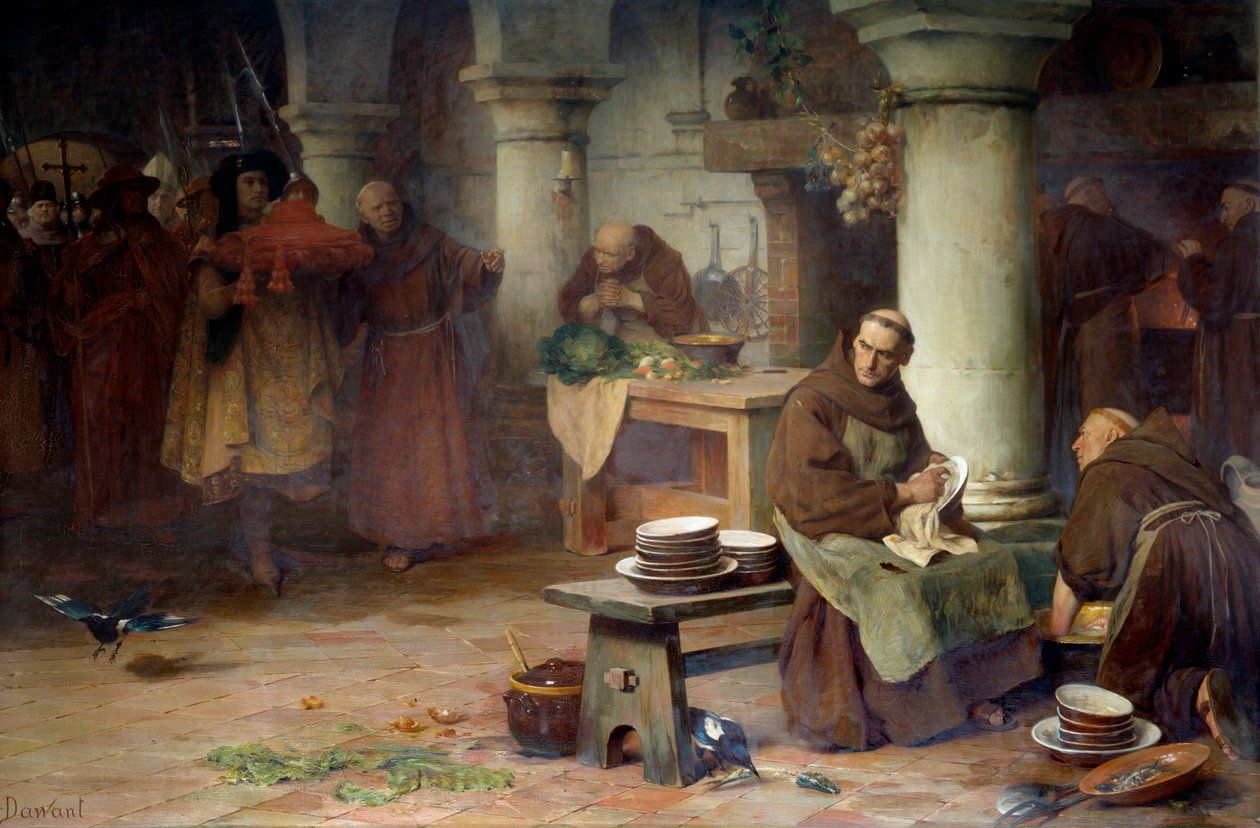
Saint Bonaventure - Franciscan Friar, Bishop, Cardinal, and Seraphic Doctor of the Church
Bonaventure (c. 1217-1274) was a medieval scholastic theologian and philosopher, the seventh minister general of the Order of Friars Minor, cardinal-bishop of Albano, and Doctor of the Church. Canonized in 1482 and declared the Seraphic Doctor in 1588, he devoted his life to integrating faith and reason, leading the Franciscan order, and promoting unity between the Latin and Greek churches.
Life and Formation
Giovanni di Fidanza, better known as Bonaventure of Bagnoregio, was born between 1217 and 1221 in the town of Bagnoregio, Italy. At 18, he went to Paris, where he joined the Order of Friars Minor (Franciscans), beginning a path that would make him one of the most influential figures in the medieval Church.
In 1253, after completing his theology studies, Bonaventure earned the title of magister (teacher) at the University of Paris, obtaining the license to teach theology. His intellectual formation was marked by the effort to harmonize philosophy in the service of theology, an approach that would characterize all of his academic and spiritual work.
Academic and Intellectual Ministry
As a professor in Paris, Bonaventure became renowned for his scholarly interventions and his vigorous defense of the Franciscan Order against criticism from groups opposed to the mendicants. Three years before his election as minister general, his reputation had already earned him the position of lecturer on The Four Books of Sentences, a fundamental theological work written by Peter Lombard in the 12th century.
In 1257, he was officially recognized as a doctor and master of the University of Paris, consolidating his reputation as one of the great intellectuals of his time. That same year, however, his life would take a new direction.
Leadership of the Franciscan Order
In 1257, at the age of 36, Bonaventure was elected Minister General of the Order of Friars Minor, a role that required him to leave teaching in Paris and dedicate himself entirely to the leadership of the order. This was a crucial moment of transition: he left academic life to assume administrative and spiritual responsibilities of great scope.
During his term, Bonaventure faced the challenge of governing approximately 30,000 to 35,000 friars spread across Europe, England, and beyond. It is estimated that he spent one quarter of his entire ministry traveling the roads of Europe, visiting communities, encouraging, and guiding the order. His journeys as animator and guide of the Order ended on 23 May 1273, when Pope Gregory X assigned him new duties.
In 1260, Bonaventure wrote the Legenda Maior, a new biography of Saint Francis that replaced all previous biographies. This work aimed to strengthen the unity of the Order, which was threatened by both radical spiritual currents and worldly tendencies. The importance of this work was such that it inspired the famous painter Giotto to create his series of Stories of Saint Francis.
Elevation to the Episcopate and Cardinalate
In 1271, upon returning to Viterbo, Bonaventure contributed to the resolution of the famous Conclave, described as the longest in history, which elected his friend Gregory X as Pope. Recognizing Bonaventure’s merits and wisdom, this pontiff consecrated him Bishop of Albano and Cardinal in 1273.
As cardinal, Bonaventure received the important task of organizing the Second Ecumenical Council of Lyon, whose main objective was to restore communion between the Latin and Greek Churches, a division that had marked Christendom since the Great Schism of 1054.
The Council of Lyon and Death
At the 1274 Council of Lyon, Bonaventure made two important interventions that contributed to the approval of a brief union between the Latin and Greek churches. However, soon after his contributions to the council, Bonaventure died suddenly on 15 July 1274, under circumstances that historians describe as suspicious. The union he helped negotiate, though historically significant, proved fragile and did not last.
Spiritual and Intellectual Legacy
Bonaventure was canonized on 14 April 1482 by Pope Sixtus IV and declared a Doctor of the Church in 1588 by Pope Sixtus V, receiving the title of Doctor Seraphicus (Seraphic Doctor), in reference to his deep spirituality and his ability to integrate faith and reason.
His legacy remains significant in the history of the Church and medieval thought. As a theologian and philosopher, Bonaventure is remembered for his attempt to harmonize Aristotelian philosophy with Christian theology, contributing to the development of scholastic thought. As a religious leader, he is recognized for consolidating and strengthening the Franciscan Order during a critical period in its history, earning the designation of second founder of the Order, although some historians consider this title somewhat exaggerated.
Several works that were believed during the Middle Ages to have been written by Bonaventure were later attributed to the so-called Pseudo-Bonaventure, demonstrating the importance and influence of his name in medieval thought.
Birth
Date: c. 1217-1221
Place: Bagnoregio, Italy
Death
Date: 15 July 1274
Place: Lyon, France
Liturgical Feast
15 July
Patronage
- Order of Friars Minor
- Theologians
- Philosophers
Written Works
- Legenda Maior (Life of Saint Francis) (1260) - Official biography of Saint Francis that replaced all earlier biographies, with the aim of strengthening the unity of the Franciscan Order. It inspired the painter Giotto in his series Stories of Saint Francis.
- Commentaries on The Four Books of Sentences (c. 1250-1257) - A fundamental theology work based on Peter Lombard's text, consolidating his reputation as a major medieval intellectual.
Recommended Books
To deepen your knowledge about this person, we recommend:
- Bonaventure: An Introduction - Various authors
Academic studies on Bonaventure's life, work, and legacy as a theologian, philosopher, and religious leader.
Sources and References
This article was prepared based on the following sources:
- Saint Bonaventure, Doctor of the Church - Saint of the Day - Canção Nova (website)
Information on Bonaventure's life, formation, ministry, and death, with details about his role at the Council of Lyon. - Saint Bonaventure of Bagnoregio - Charism - Franciscans of Brazil (website)
Official biography with precise dates of canonization (1482) and declaration as Doctor of the Church (1587/1588), as well as information about his ministry. - Bonaventure - Wikipedia - Wikipedia (website)
Encyclopedia with biographical information, titles, canonization dates, and declaration as Doctor of the Church, as well as references to Pseudo-Bonaventure. - The Life of Saint Bonaventure - My Catholic Library - My Catholic Library (website)
Narrative about Bonaventure's dedication to faith, scholarship, and leadership, with emphasis on his role in the Council of Lyon. - 1274 750° - Bonaventura - Capuchin Franciscan Order (document)
Official document on Bonaventure as the 'second founder of the Order,' with information about his governance of 30,000-35,000 friars and travels across Europe. - St. Bonaventure of Bagnoregio - Saint of the Day - Vatican News (website)
Official Vatican information on Bonaventure's life, ministry, death, and legacy as cardinal and Doctor of the Church. - Saint Bonaventure, Franciscan Bishop, Doctor of the Church (1221-1274) - SlideShare (website)
Presentation on Bonaventure as a theologian, philosopher, and his attempt to integrate faith and reason. - Saint Bonaventure of Bagnoregio, Bishop, is celebrated on 15 July - O Clarim (website)
Information on Bonaventure's birth date (between 1217-1221) and death date (15 July 1274).