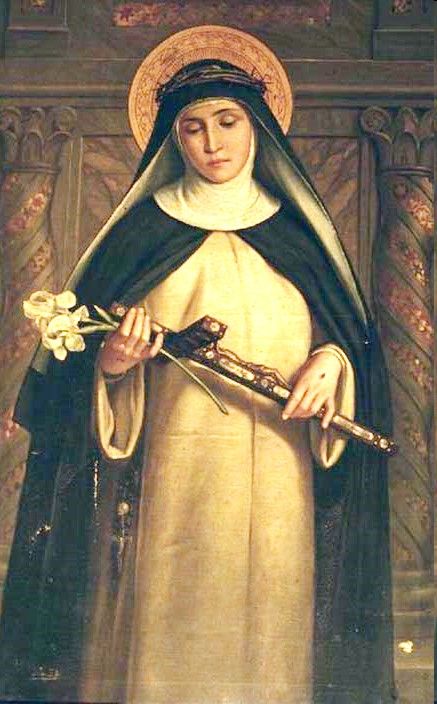
Catherine of Siena - Church Reformer in 1380
Saint Catherine of Siena was a mystic, writer, and ecclesial activist who influenced the return of the papacy to Rome and defended the reform of the Church during the Western Schism, dying exhausted in 1380 after years of preaching and penances.
Life and Formation
Born on March 25, 1347 into the humble Benincasa family in Siena, Catherine of Siena was the 23rd child of a dyer. From the age of six, she had mystical visions, such as that of Christ flanked by Saint Peter, Paul, and John, which deeply marked her[1][3]. Despite family pressure for an arranged marriage, she refused and, at 16, after a vision of Saint Dominic, entered the Third Order of Dominicans as a mantellata, living secluded at home with vows of virginity, intense prayer, and service to the sick[1][2][3].
In 1363, she took the Dominican habit and formed the 'Beautiful Brigade', a group of devout followers. She overcame regional plagues, giving spiritual counsel that reached Pope Gregory XI in Avignon[2]. At 21, in 1368, she had a vision of mystical marriage with Christ, who sent her to works of charity and the conversion of sinners[4].
Ministry and Work
Catherine emerged as a prophetic voice in the 14th century, marked by the papal exile in Avignon. She traveled through northern and central Italy defending clerical reform and preaching total love of God as the path to renewal[1]. In 1375, in Pisa, she used her influence to prevent alliances against the pope[1].
Her correspondence with princes, cardinals, and popes was bold: she urged Gregory XI to return to Rome and reform the Church, removing 'rotting flowers' from the clergy[3][4]. In 1376, she traveled to Avignon with followers, rebuking the pope in person for ecclesial purity and the pontifical return, which decisively contributed to his return in 1377[1][4][5][7].
During the Great Schism
With the election of Urban VI in 1378, the schism broke out: French cardinals elected Clement VII in Avignon. Catherine defended Urban VI, sending letters and going to Rome, where she lived in the Casa di Santa Caterina in Piazza di Santa Chiara, convincing nobles of papal legitimacy[1][2]. She founded a monastery in Belcaro in 1377 and wrote her Dialogue after mystical experiences[1].
'Parting from the body, indeed, I consumed myself and gave my life to the Church and for Holy Church, which is for me a most singular grace.'[5]
Legacy
Exhausted by penances, Catherine died on April 29, 1380, at the age of 33, in the Basilica of Santa Maria sopra Minerva in Rome, where Urban VI celebrated her funeral[1][5]. Canonized on June 29, 1461 by Pius II, she was declared a Doctor of the Church by Paul VI in 1970, patroness of Italy by Pius XII in 1939 and of Europe by John Paul II in 1999[1][2][4]. Her body is in the aforementioned basilica; her head is in San Domenico, Siena[5]. She left more than 380 letters and the Dialogue, influencing unity and ecclesial reform[5][7].
- Defender of the papal return to Rome.
- Moral reformer of the clergy.
- Mystic with visions and profound writings.
- Advisor to popes in a historical crisis.
Her courage in rebuking popes out of love for the Church still inspires today[3].
Birth
Date: March 25, 1347
Place: Siena, Italy
Death
Date: April 29, 1380
Place: Rome, Italy
Liturgical Feast
April 29
Patronage
- Italy
- Europe
- nurses
- the sick
- people with Saint Anthony's fire
Written Works
- The Dialogue (1378) - Mystical work written after visions, presenting spiritual doctrine and calls for Church reform.
Recommended Books
To deepen your knowledge about this person, we recommend:
- Legenda Maior - Raymond of Capua
Official biography written by her confessor, a basis for canonization and the study of her life. - Catherine of Siena - Sigrid Undset
Detailed biography highlighting her role in reform and mysticism.
Sources and References
This article was prepared based on the following sources:
- Catherine of Siena – Wikipedia (website)
Encyclopedia with detailed biography, dates, and historical context. - Today in History: 1380 - Catherine of Siena dies (website)
Article about her death and role in the schism. - The Saint Who Rebuked Popes and Changed Church History (website)
Focus on courage against popes and visions. - Saint Catherine of Siena, intercessor of Opus Dei (website)
Details on canonization and trips to Avignon. - Saint Catherine of Siena: a life of faith and service to the Church (website)
Emphasis on writings and papal return. - St. Catherine of Siena, virgin, Doctor of the Church (website)
Official Vatican site with liturgical data and contributions.