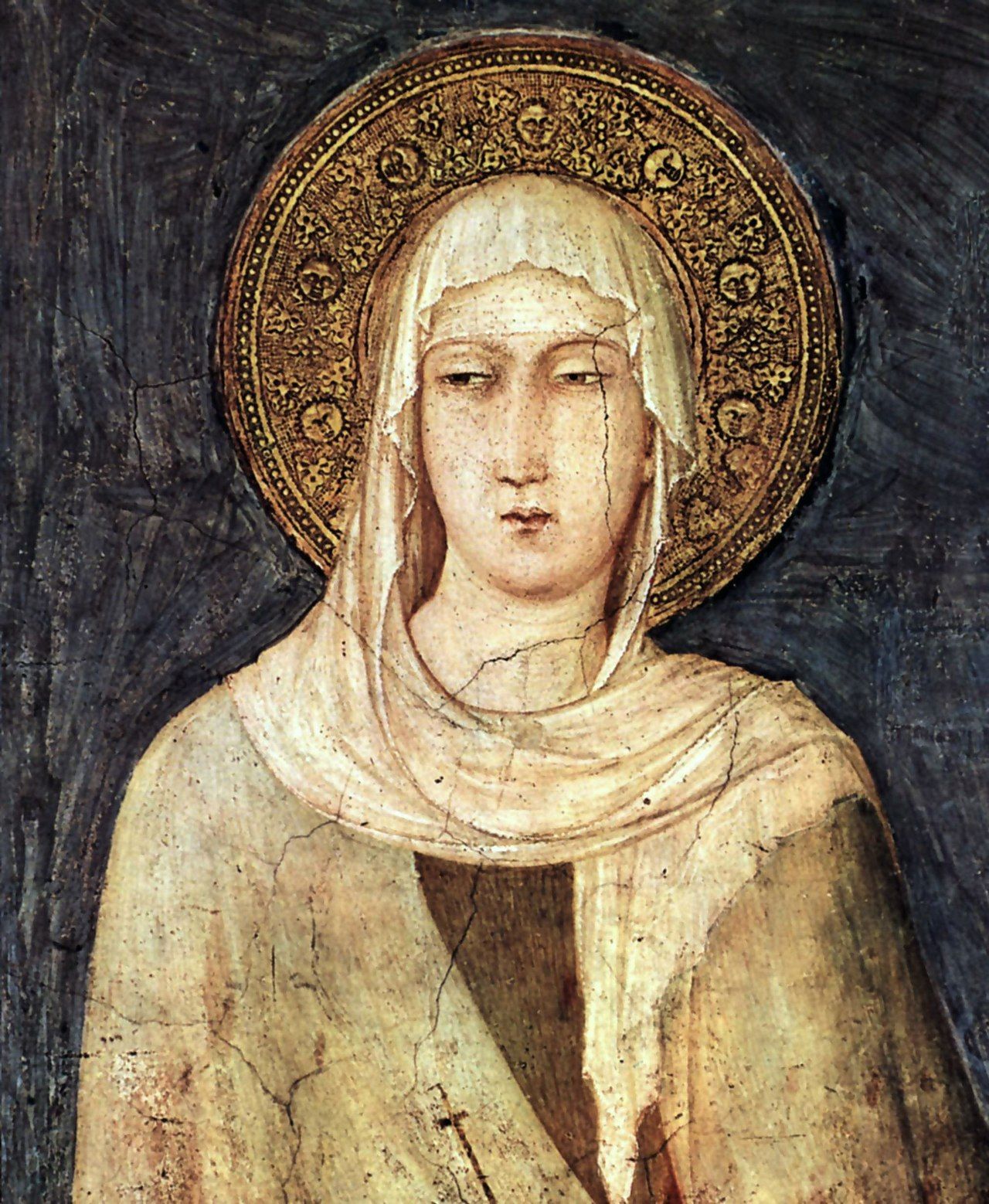
Saint Clare of Assisi - Founder of the Order of Poor Clares and Follower of Saint Francis
Saint Clare of Assisi (1194-1253) was an Italian religious woman who abandoned her life of luxury in a noble family to follow the teachings of Saint Francis of Assisi. Founder and abbess of the Order of Poor Clares, she dedicated her life to absolute poverty, contemplative prayer, and the spiritual reform of the Church, leaving a lasting legacy in Christianity.
Life and Formation
Clara Offreduccio was born on July 16, 1194 in Assisi, Italy, into a noble and wealthy family. From childhood, she received a refined education, learning to read, write, spin wool, and do needlework - skills typical of a young woman of her social standing. Raised in an environment of comfort and privilege, Clara showed from an early age a sensitive, pious, and deeply devout nature.
The Encounter with Saint Francis and the Religious Vocation
The decisive moment in Clara's life came when she was 18 years old. Saint Francis of Assisi came to preach at the Church of San Giorgio in Assisi, and his words deeply touched the young woman's heart. Inspired by Francis's message of devotion to God and a life of evangelical poverty, Clara sought out the saint and asked for his help in consecrating her life to God.
Her parents, however, had other plans. The following year, in 1211, the family chose a wealthy young man to be her husband. Clara, however, categorically refused the marriage. On the night of March 20, 1212, on the eve of Palm Sunday, with the consent of Bishop Guido II of Assisi, Clara fled her father's house. Accompanied by her aunt Bianca and another companion, she went to the humble Porziuncola Chapel, where Saint Francis and his disciples received her with torches lit in their hands.
At that sacred moment, Clara took off her rich garments. Saint Francis cut her long hair with his own hands and dressed her in a rough wool habit and a thick veil. Thus, the young noblewoman made her vows, dedicating herself entirely to the service of Jesus Christ. This act marked the beginning of the Second Order of Saint Francis, also known as the Order of the Poor Clares.
Family Resistance and First Steps
Clara's escape did not go unnoticed. Her father and uncles, enraged by the young woman's decision, immediately invaded the Benedictine convent where Francis had placed her. But Clara remained steadfast in her vocation. When her relatives tried to take her back, she clung to the church altar, removed her veil to show her cut hair, and refused to leave, demonstrating a determination that would mark her entire religious life.
Sixteen days later, her sister Agnes also left the family to join Clara. Other women soon followed, drawn by the authenticity and radicalism of her vocation. Together, they lived a life of extreme poverty, austerity, and complete isolation from the world, following a Rule that Saint Francis had given them.
Abbess of San Damiano
In 1216, at the age of 21, Saint Francis compelled Clara, under obedience, to accept the position of abbess of San Damiano - a responsibility she would hold until her death, nearly forty years later. Although reluctant to accept authority, Clara proved to be an extraordinary spiritual leader and a dedicated administrator.
As abbess, Clara spent her days in manual labor and continuous prayer. Her great concern was to obtain a Rule that truly reflected the spirit of Saint Francis, replacing the Benedictine Rule that Cardinal Ugolino (later Pope Gregory IX) had adapted for her order. For decades, Clara worked tirelessly to reform the governance of her order, seeking to ensure that absolute poverty and contemplative life were the fundamental pillars of her community.
Her mother and sisters eventually joined the community, and the Order of the Poor Clares grew significantly. The community became known for its life of absolute poverty, devotion to prayer, and exemplary holiness.
Miracles and Spiritual Power
Tradition attributes to Clara and her sisters the power to save Assisi from invaders on two separate occasions through fervent prayer:
- On the first occasion, Clara ordered the convent chaplain to raise the Blessed Host at the refectory window. The Moorish allies of Emperor Frederick II, who were attacking the city walls, mysteriously retreated.
- On the second occasion, when a larger force led by General Vitale d'Aversa laid siege to Assisi, Clara and her nuns prayed fervently for the people of Assisi. A great storm dispersed the attackers.
Near the end of her life, on December 24, 1252, Clara was so ill that she could not attend Mass in the new Basilica of Saint Francis. At that moment, she received a miraculous vision: she was able to see and hear Mass being celebrated on her wall, several kilometers away. For this miracle, Clara was later proclaimed patroness of television and patroness of the sick eyes.
Clara's Rule and Her Spiritual Legacy
Clara's great work was the composition of her own Rule, based on the teachings of Saint Francis. She wanted to create a document that her sisters could follow long after her death, ensuring the continuity of her spiritual vision. Her Rule especially emphasized absolute non-possession of property and a life of joyful poverty in imitation of Christ.
Clara obtained approval of her Rule from both Cardinal Rainaldo and Pope Innocent IV. Two days before her death, on August 9, 1253, Pope Innocent IV issued the papal bull Solet Annuere, definitively confirming Clara's Rule as the official governance of the Order of the Poor Clares, securing for them the precious treasure of poverty that Clara had won.
Death and Canonization
Clara died on August 11, 1253, at the age of 59, one day after having her Rule approved by the Pope. Her last recorded words were:
"Blessed are You, O God, for having created me."
Her remains were initially buried in the Chapel of San Giorgio while a church was being built to house them. Clara was quickly canonized by the Church - on September 26, 1255, only two years after her death - by Pope Alexander IV. Her liturgical feast is celebrated on August 11.
Enduring Legacy
Clara's 41 years of religious life represent a setting of holiness and unwavering determination. She not only founded a religious order that persists to this day with thousands of members, but also left a model of spirituality centered on radical poverty, contemplative prayer, and fidelity to evangelical teachings. Her correspondence with Agnes of Prague reveals the depth of her Franciscan theology and her spiritual influence beyond the walls of San Damiano. Clara remains an inspiring figure for Catholics and Christians in general, exemplifying how a life dedicated to simplicity, prayer, and service can transform not only a community, but an entire spiritual tradition.
Birth
Date: July 16, 1194
Place: Assisi, Italy
Death
Date: August 11, 1253
Place: Assisi, Italy
Liturgical Feast
August 11
Patronage
- Television
- Sick eyes
- Order of the Poor Clares
- Assisi
Writings
- The Rule of Saint Clare (1253) - Fundamental document establishing the rules of life for the Order of the Poor Clares, emphasizing absolute poverty and contemplative life
- Letters to Agnes of Prague (c. 1235-1253) - Spiritual correspondence with the Bohemian princess Agnes, revealing Clara's Franciscan theology and spiritual guidance
Recommended Books
To deepen your knowledge of this person, we recommend:
- Clare of Assisi: A Biographical Study - Regis J. Armstrong (2006)
Comprehensive and well-documented biographical study of the life and work of Saint Clare - The Life and Spirituality of Saint Clare - Ingrid J. Peterson (1993)
In-depth analysis of Clare's spirituality and influence in the Franciscan tradition
Sources and References
This article was prepared based on the following sources:
- Saint Clare of Assisi - Facts, Miracles & Nun - Biography.com (website)
Detailed biography with information about Saint Clare's life, miracles, and influence - Clare of Assisi - Wikipedia - Wikipedia (website)
Encyclopedic article with complete chronology, religious life, and legacy of Clare - Our Patron Saint - St. Clare of Assisi Catholic School - St. Clare Catholic School (website)
Information about Saint Clare as patron saint, including dates of birth, death, and canonization - CATHOLIC ENCYCLOPEDIA: St. Clare of Assisi - New Advent - Catholic Encyclopedia (website)
Catholic encyclopedia with details about Clara's life, work, and approval of her Rule - St. Clare of Assisi | Feast Day, Patron Saint Of - Britannica (website)
Reference biography with information about life, death, miracles, and patronages - St. Clare Biography - St. Clare Community Center (website)
Biography emphasizing religious life, miraculous vision, and canonization - Saint Clare of Assisi - Franciscan Media (website)
Franciscan perspective on Saint Clare's life, vocation, and spiritual legacy