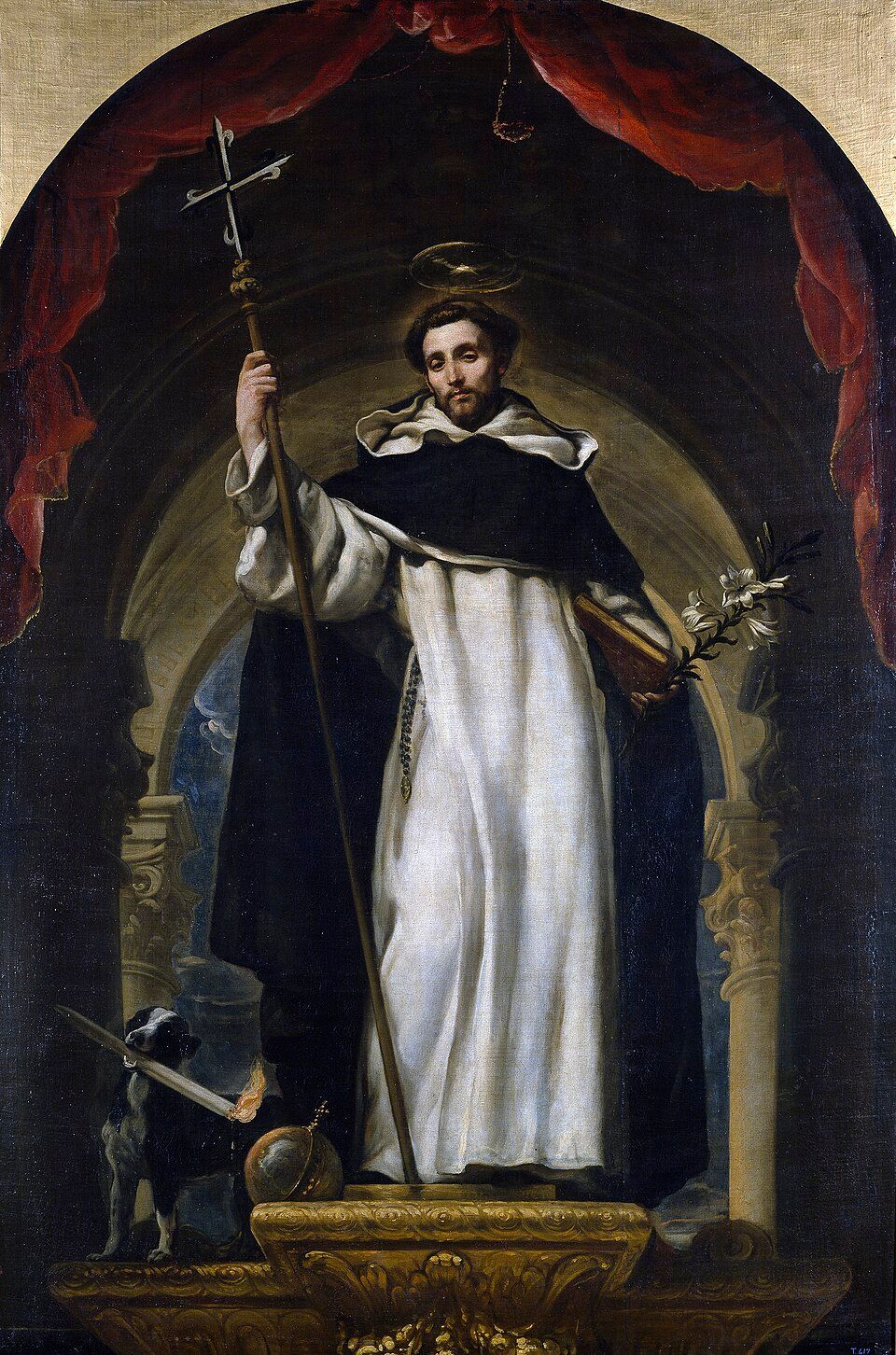
Saint Dominic of Guzmán - Priest and Founder of the Order of Preachers
Saint Dominic of Guzmán was a Spanish priest, founder of the Order of Preachers (Dominicans), dedicated to preaching and combating heresies. Born in 1170, he stood out for his learning, poverty, and apostolic zeal, dying in 1221 and being canonized in 1234.
Life and Formation
Dominic of Guzmán was born on 24 June 1170, in the village of Caleruega, in the diocese of Osma, in Old Castile, present-day Spain. Coming from a noble and Catholic family, from a young age he showed extraordinary virtues, dedicating himself to theological studies with brilliance.[1][2]
At 24 years old, he received priestly ordination and was appointed canon of the cathedral of Osma, where he stood out for his competence and intelligence. He sold his belongings to help the poor and the sick, uniting learning with charity.[3][4]
Initial Missions
In 1203, he accompanied Bishop Diego of Acebes on a diplomatic mission to Denmark, at the request of the king of Castile. Struck by the lack of knowledge of the Christian faith in northern Europe, Dominic realized the urgent need for evangelization.[1][9]
In 1205, he made a new journey to the north, passing through Rome and Cîteaux, and meeting papal legates fighting the Albigensians (Cathars) in southern France.[1]
Ministry and Work
In southern France, Dominic preached against Cathar heresies, adopting a life of poverty and itinerant preaching. In 1206, with Bishop Diego, he founded a female community in Prouilhe, a base for the conversion of heretics.[1][9]
After Diego's death in 1207, Dominic continued alone, gathering companions. In 1214, he became parish priest of Fanjeaux and saw battles against heretics in Carcassonne.[1]
In 1215, he presented to Pope Innocent III, at the Fourth Lateran Council, the project of the Order of the Preaching Brothers, which was provisionally approved. In 1217, he received final approval from Honorius III, with an emphasis on study, preaching, and poverty.[3][6]
- He founded convents in university cities such as Paris and Bologna to attract young scholars.
- In 1220-1221, he presided over general chapters, organizing the Order into provinces with a democratic model.[1]
- He sent friars to England, Scandinavia, Poland, Hungary, and Germany.[1]
Dominic promoted devotion to the Marian rosary, making the Dominicans its guardians. He carried with him the Gospel of Matthew and the letters of Paul, meditating on them intensely. He refused bishoprics in order to live simply.[2][4]
Final Years and Death
In 1221, he founded a convent of nuns in San Sisto, Rome. Ill, he returned to Bologna, where he died on 6 August 1221, at the age of 51, surrounded by friars. Buried in the cathedral of Bologna, he is the city's perpetual patron.[3][8]
Legacy
Canonized on 3 July 1234 by Gregory IX, who knew him personally, Dominic is invoked as a model preacher. His Order combined science, piety, and preaching, influencing the Church against heresies and in theological formation.[2][9]
"Dominic dedicated his whole life to talking with Jesus or speaking about Jesus."
(Vatican News)[9]
His life united the study of the Word of God with evangelical preaching, leaving a legacy of enlightened faith and itinerant apostolate. Posthumous miracles accelerated his canonization.[5]
Birth
Date: 24 June 1170
Place: Caleruega, diocese of Osma, Castile (present-day Spain)
Death
Date: 6 August 1221
Place: Bologna, Italy
Liturgical Feast
8 August
Patronage
- Bologna (Perpetual Patron)
- Dominicans
Recommended Books
To deepen your knowledge about this person, we recommend:
- Franciscan Saints for Each Day
Compilation of saints' lives with details about the formation and virtues of Saint Dominic.
Sources and References
This article was prepared based on the following sources:
- Domingos de Gusmão – Wikipédia (website)
Detailed biography with a chronology of missions and the founding of the Order. - São Domingos de Gusmão - Franciscanos OFM (website)
Information about birth, priesthood, and canonization. - São Domingos de Gusmão (1170-1221) – Diocese of Blumenau (website)
Details about family, the founding of the Order, and general chapters. - São Domingos de Gusmão, founder of the Order of Preachers - Vatican News (website)
Emphasis on apostolate and preaching against Cathars.