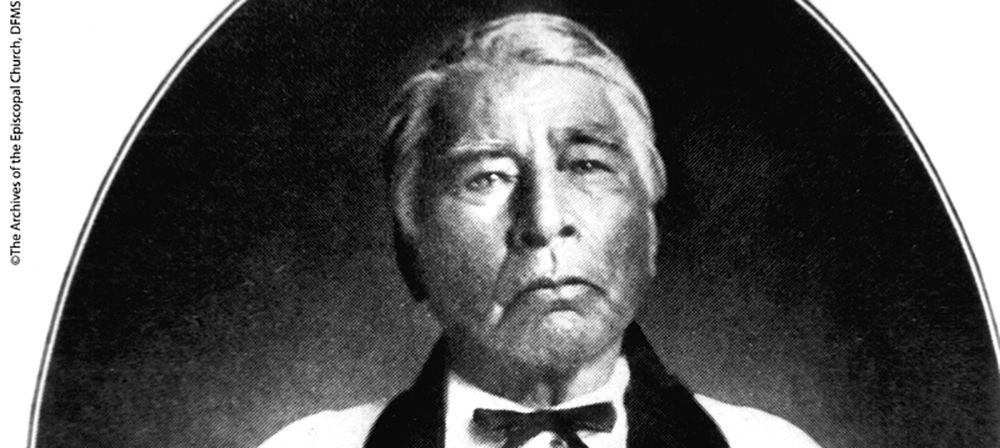
Enmegahbowh - First Indigenous Priest Ordained in the Episcopal Church
Enmegahbowh (c. 1820-1902) was the first Native American ordained as a priest in the Episcopal Church in the United States. A member of the Ojibwe nation, he devoted his life to Christian ministry, peace mediation among tribes, and the inculturation of Christianity into the language and traditions of his people.
Life and Formation
Enmegahbowh, whose name means "The one who prays for his people while standing", was born around 1820 on the north shore of Rice Lake, near Peterborough, Ontario, Canada. He was the only child of the chief of an Ojibwe band and was raised in a Christian village affiliated with the Methodists.
His early education was marked by tension between two cultures. An Episcopal clergyman named Mr. Armour persuaded his reluctant parents to send the young Enmegahbowh to be educated alongside the clergyman's children. Although he learned to read and speak English, after only three months the homesick boy fled during the night, walking for two days to return to his people.
Around 1831, Enmegahbowh's grandfather, a highly respected medicine man, initiated him into the tribal religious organization Midewiwin. Thus, Enmegahbowh grew up with a deep understanding of both Christian tradition and the spiritual practices of his people.
On July 4, 1841, Enmegahbowh married Biwabikogeshigequay (also known as Iron Sky Woman and baptized as Charlotte), niece of Chief Hole-in-the-Day.
Path to the Priesthood
Before 1850, Enmegahbowh received a Book of Common Prayer and, through the influence of James Lloyd Breck, became a candidate for ordination in the Episcopal Church. On July 3, 1859, Bishop Jackson Kemper ordained him deacon and assigned him to Crow Wing, Minnesota, to assist in founding St. Columba Mission.
His ordination as a priest came later, on June 2, 1867, when Bishop Henry Benjamin Whipple of Minnesota ordained him, making him the first Native American ordained as a priest in the Episcopal Church in the United States.
Ministry and Missionary Work
Enmegahbowh devoted his life to ministry among the Indigenous peoples of Minnesota and beyond. His unique understanding of Native traditions allowed him to inculturate Christianity into the Ojibwe language and traditions, creating an authentic bridge between the Christian faith and the cultural identity of his people.
During the 1862 Dakota War, which began when treaty payments were overdue for distribution to starving Sioux at Fort Ridgely, the Gull Lake Band of the Mississippi Chippewa rose to attack nearby Fort Ripley. Enmegahbowh, showing his commitment to peace, prevented other Ojibwa bands from joining the rebels. For his efforts, he was imprisoned by the rebels, but managed to escape and traveled thirty miles overnight to warn Fort Ripley, thereby discouraging an attack on the fort.
Although he was temporarily rejected by some Ojibway groups for warning the community at Fort Ripley about the 1862 uprising, Enmegahbowh remained steadfast as a man of peace. In 1869, he encouraged the mission of Chief White Cloud (Waubanaquot), which resulted in lasting peace between the Ojibwe and Dakota peoples.
He traveled tirelessly throughout Minnesota and beyond, actively participating in the development of the Episcopal Church's missionary strategy and policy. He worked closely with Bishop Whipple and was described by historians as "the implementer" while Whipple was "the intermediary" in the arrival of Christianity among the Ojibwa of northern Minnesota.
Legacy and Death
Enmegahbowh died on the White Earth Indian Reservation in Minnesota on June 12, 1902, at the age of 95. He was buried in the cemetery of St. Columba Church, where his ministry had begun decades earlier.
His legacy remains alive in the memory of his people. Members of St. Columba honor him annually in June during the White Earth Pow-Wow. The Episcopal Church's calendar of saints remembers him on June 12, recognizing his foundational contribution to the history of Indigenous ministry in the Anglican communion.
Church historians, such as Owanah Anderson in her work Jamestown Commitment: The Episcopal Church and the American Indian, note that church historians overlooked Enmegahbowh's crucial role in documenting the arrival of Christianity among the Ojibwa of northern Minnesota, highlighting his importance as a transformative figure in American religious history.
Birth
Date: c. 1820
Place: North shore of Rice Lake, Ontario, Canada
Death
Date: June 12, 1902
Place: White Earth Indian Reservation, Minnesota, United States
Liturgical Feast
June 12
Patronage
- Indigenous ministry
- Peace mediation among peoples
Recommended Books
To deepen your knowledge about this person, we recommend:
- Jamestown Commitment: The Episcopal Church and the American Indian - Owanah Anderson
Work documenting Enmegahbowh's crucial role in the history of Christianity among the Ojibwa, correcting earlier historiographical oversights
Sources and References
This article was prepared based on the following sources:
- Enmegahbowh - Wikipedia (website)
Encyclopedic article with complete biographical information, ordination dates, and legacy - Enmegahbowh - The Episcopal Church (website)
Official Episcopal Church definition with precise ordination dates and biographical information - Enmegahbowh, Priest and Missionary - The Episcopal Church (website)
Official Episcopal Church liturgical page with collect prayer and information about his ministry - Enmegahbowh - satucket.com (website)
Liturgical resource with details about his life, ordination, and role during the 1862 Dakota War - Enmegahbowh, Priest and Missionary (June 12) (website)
PDF document with detailed biography, information about his death, and liturgical commemoration - Enmegahbowh, Priest and Missionary, 1902 (website)
Parish page recognizing Enmegahbowh as the first Native American priest recognized in the Episcopal Church - Enmegahbowh: charting the course toward understanding (website)
Reflective article on the meaning of the name and the historical importance of Enmegahbowh