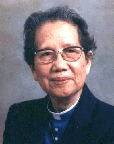
Florence Li Tim-Oi - The First Woman Priest of the Anglican Communion and Witness of Faith
Florence Li Tim-Oi (1907-1992) was an Anglican priest born in Hong Kong, the first woman ordained to the priesthood in the Anglican Communion on January 25, 1944. Her life was marked by dedicated service to refugees, persecution during the Chinese Cultural Revolution, and a prophetic witness of unwavering faith.
Life and Formation
Florence Li Tim-Oi was born on May 5, 1907 in the fishing village of Aberdeen, on Hong Kong Island. Her name, Li Tim-Oi, means "much beloved daughter" in Chinese, given by her father, who was principal of a local school. She chose the name Florence at her Christian confirmation, in honor of Florence Nightingale, the famous British nurse known as "The Lady with the Lamp".
Due to her family's poverty, her formal education was interrupted. She attended her father's school until the age of fourteen, and was only able to continue her studies at twenty-one, when she enrolled at Belilios Public School for Girls in Hong Kong. She graduated in 1934, at the age of twenty-seven, with distinction in her examinations.
After a brief career as a teacher lasting only nine months, Florence responded to a call to religious ministry. In 1931, during the ordination of a deaconess at Hong Kong Cathedral, she felt and answered the call to ministry. She then enrolled at Union Theological College in Guangzhou (Canton), where she completed a four-year course in theological education.
Ministry in Wartime
When Guangzhou was bombed in 1937, at the start of the Second Sino-Japanese War, Florence and her seminary colleagues responded immediately. She led the students' first aid team in rescue operations, often while bombs fell around her. When the seminary was forced to close, she returned to Hong Kong, where she provided spiritual support to refugees from the occupied areas.
At the request of Bishop Ronald Hall, Bishop of Victoria, Hong Kong, Florence moved to Macau, a Portuguese colony that was filled with refugees from war-torn China. There, she was ordained deaconess on May 22, 1941 (Ascension Day). As a deaconess, she was given responsibility for an Anglican congregation in Macau.
For three years, when male priests could not travel from the Japanese-occupied territory in Hong Kong to celebrate the Eucharist, Florence was licensed by her Chinese bishop, Gilbert Mok, to preside at the Eucharist. She baptized, married, and buried the faithful, offered counseling and friendship to the grieving, organized food for the hungry, and kept hope and faith alive among people struggling desperately during wartime.
Historic Ordination to the Priesthood
Concerned that a deaconess was assuming a role reserved for priests, Bishop Ronald Hall asked Florence to meet him in Free China. On January 25, 1944 (St. Paul's Day), at the Anglican Church in Zhaoqing, Guangdong, Bishop Hall ordained her "priest in the Church of God". She became the first woman ordained to the priesthood in the Anglican Communion in all of history.
Bishop Hall regarded this act as as momentous as when the Apostle Peter baptized the Gentile Cornelius. Just as Saint Peter recognized that God had already given Cornelius the gift of baptism in the Holy Spirit, Bishop Hall felt he was merely confirming what God had already done in giving Florence the gift of priestly ministry.
Controversy and Temporary Resignation
After the end of World War II, Florence's ordination became highly controversial within the Anglican Church. Concerned about the difficulties her status might cause Bishop Hall and considering his position more important than her own, Florence agreed to surrender her license. Although she stopped functioning as a priest, she never renounced her Holy Orders.
She continued serving another congregation, this time in Hepu, until the rise of Communism. In 1947, her bishop called her to be rector of a church in Hepu. When the church was closed on January 25, 1951 — exactly seven years after her ordination — she sought further education at Yenching University in Beijing, where she studied the Three-Self Movement and Christianity in the context of the "new China".
Persecution During the Cultural Revolution
In 1958, with the Great Leap Forward, a program of forced agricultural labor and rural industrialization instituted by the Chinese Communist Party, Florence was sent first to the fields and then to a factory. The Communist government in China closed all churches from 1958 to 1974, during which Florence was compelled to work on a farm and then in a factory.
She was forced to undergo political reeducation because she was designated as a counter-revolutionary. During these years of persecution, Florence would go into the mountains to pray because she was afraid of being seen with her Christian friends. She confessed that she nearly committed suicide during those long years of suffering. The Red Guard even forced her to cut her own church vestments with scissors.
In 1974, Florence was allowed to retire from factory work. From 1974 until her death in 1992, she exercised her priesthood with faithfulness and quiet dignity, earning tremendous respect for herself and growing support for other women seeking ordination.
Ministry in Toronto and Recognition
Florence was able to visit family members in Canada in 1981, where the Dioceses of Toronto and Montreal licensed her as a priest. She served the Chinese community at St. Johns and St. Matthews until her death, and also officiated at the Cathedral Church of St. James in Toronto for several years.
In 1984, she was at Westminster Abbey for a celebration marking 40 years since her ordination as a priest. She was awarded Doctorates in Divinity by Trinity College, Toronto and by the General Theological Seminary, New York.
Legacy and Historical Significance
Florence Li Tim-Oi died on February 26, 1992 in Toronto, leaving an extraordinary legacy. Her ordination in 1944 preceded by 50 years the Church of England's decision to ordain women priests in March 1994.
Her life bears witness to unwavering Christian faithfulness in the face of extraordinary circumstances. As a deaconess and priest, she served the needy, ministered to refugees, faced political persecution with spiritual courage, and never abandoned her faith, even when forced into silence. Her example paved the way for future generations of women in the ordained ministry of the Anglican Communion.
"She exercised her priesthood with faithfulness and quiet dignity, earning tremendous respect for herself and growing support for other women seeking ordination."
Birth
Date: May 5, 1907
Place: Aberdeen fishing village, Hong Kong Island
Death
Date: February 26, 1992
Place: Toronto, Canada
Liturgical Feast
January 25 (date of her ordination to the priesthood)
Patronage
- Women in ordained ministry
- Anglican priestesses
- Persecuted Christians
- Ministry among refugees
Recommended Books
To deepen your knowledge of this person, we recommend:
- Information about Florence Li Tim-Oi available in Episcopal Church archives - Episcopal Church Archives
Official historical documentation on the life and ministry of Florence Li Tim-Oi
Sources and References
This article was prepared based on the following sources:
- Florence Li Tim-Oi - Wikipedia (website)
Complete biographical article with dates, places, and details of her life and ministry - Rev. Florence Li Tim-Oi -- First Woman Ordained in Anglican Communion (website)
Information about her historic ordination and the context of the time - Florence Li Tim Oi: Much-Beloved Daughter and Priest - Rev. Susan E. Hill (website)
Liturgical reflection on her life and the meaning of her name - Florence Li Tim-Oi - Episcopal Church Women (website)
Documentation from the Episcopal Church archives with chronological details of her life - About Li Tim-Oi - LTOF (website)
Biographical information and context for her ordination and ministry - Florence Li Tim-Oi: The First Woman Priest in the Anglican Church (website)
Christianity Today article on her historical significance