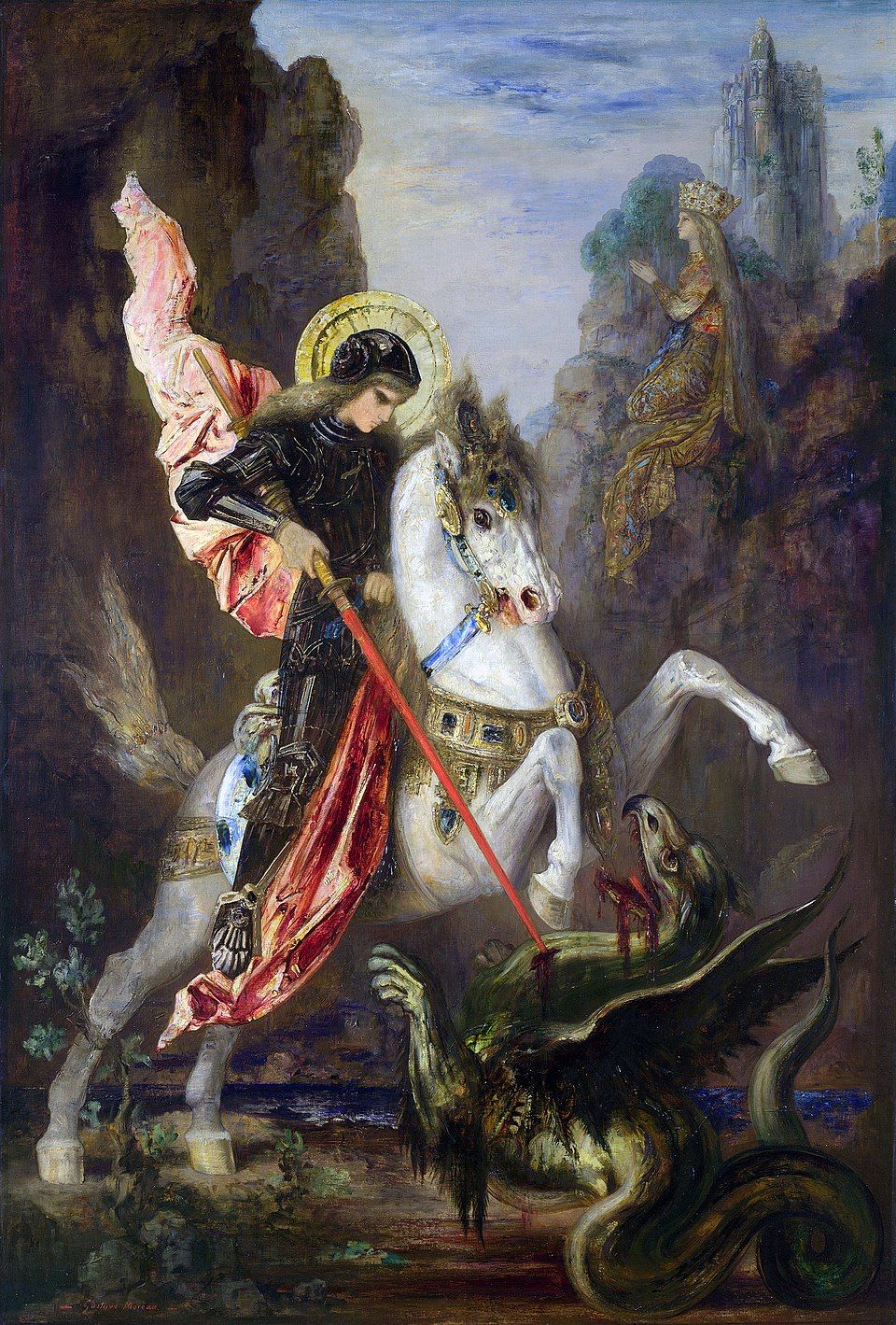
Saint George - Martyr of the Faith and Protector of the Oppressed
Saint George was a Roman soldier of Greek origin who became one of the most venerated military saints in Christianity. Martyred in 303 A.D. for refusing to renounce his Christian faith during the persecutions of Emperor Diocletian, his life and legend inspired millions of believers over the centuries.
Life and Formation
George, whose name of Greek origin means "farmer," was born in Cappadocia, in the central area of Anatolia (present-day Turkey), probably in the year 275 A.D., during the reign of Emperor Diocletian. Born into a Christian family, George lost his father, a military man who died in battle, and moved with his mother to Palestine, his maternal homeland, where he was raised.
Still young, George enlisted in Diocletian's army, where his dedication and military abilities quickly set him apart. Before turning thirty, he had risen to the ranks of military tribune and count, being appointed as the emperor's personal guard in Nicomedia.
Conversion and Christian Faith
Despite his privileged position at the imperial court, George kept his Christian faith secret. When his mother died, he inherited a vast fortune, but he surprised the entire imperial court by giving all his possessions to the poor and needy, thus revealing his true identity as a Christian.
Martyrdom and Persecution
In 303 A.D., Emperor Diocletian, influenced by Caesar Galerius, issued an edict ordering the arrest of all Christian Roman soldiers and requiring all others to offer sacrifices to the Roman gods. This was a crucial moment for George.
Faced with this order, George appeared before the emperor and, bravely, publicly tore up the edict document and declared himself a Christian before the entire court. His action was an act of defiance and profession of faith that could not be ignored.
Unwilling to lose one of his best tribunes, Diocletian tried to persuade George to change his mind, offering him money, land, and slaves. However, George remained steadfast in his faith, refusing all offers and privileges.
Unable to succeed, the emperor subjected George to terrible tortures. Despite the trials, George remained firm in his conviction. His martyrdom gained notoriety among the Romans, with many sympathizing with the young soldier, including the emperor's own wife, who converted to Christianity after witnessing his steadfastness.
Finally, Diocletian, failing to make him renounce the faith, ordered George to be beheaded on April 23, 303 A.D. in Nicomedia. His body was later taken by Christians to Diospolis (present-day Lod, in Israel), where he was buried.
The Dragon Legend
Although the only verifiable historical element is his martyrdom, Christian tradition preserved the famous legend of Saint George and the dragon, which became widely popular during the Crusades.
According to the legend, in the city of Seleem, in Libya, there was a large swamp where a terrible dragon lived, terrorizing the population. To appease the beast, the inhabitants offered it two goats per day and, occasionally, a young person chosen by lot.
One day, the lot fell on Sabra, the king's daughter, a fourteen-year-old girl. Dressed as if she were going to her own wedding, the young woman left the city wall and waited for the creature. When George heard the story, he decided to put an end to the episode. Mounted on his white horse, he went to the kingdom to rescue her, but first he demanded a promise from the king: if he brought his daughter back, the king and all his subjects would convert to Christianity and receive baptism.
The king agreed to the promise. George then faced the dragon in an epic battle. After much combat, George struck the dragon's head with his sword and pinned it beneath his wing. The dragon was mortally wounded and fell lifeless. George tied up the beast and dragged it into the city, accompanied by the rescued young woman.
With the promise fulfilled, approximately fifteen thousand people (not counting women and children) were baptized and converted to Christianity. The king offered George treasures, but he ordered them to be given to the poor. Before taking his leave, he left four recommendations to the king: that he take care of the preservation of the churches, honor the priests, attend religious services assiduously, and show compassion toward the poor.
Symbolic Meaning
Saint George's victory over the dragon is purely symbolic and represents the victory over evil and the devil through his generous profession of faith. The princess represents Alexandra, who was won over to the Christian faith by the martyr's steadfastness. During the Crusades, victory over the dragon came to symbolize victory over the Islamic armies.
His image, usually depicting him mounted on a white horse and confronting the dragon with a lance, became one of the most recognized icons of Christian iconography and is venerated in churches and homes throughout the world.
Legacy and Veneration
Saint George is considered one of the most prominent military saints in Christianity. His story, marked by faith, bravery, and justice, has inspired millions of people over the centuries. He is known as the "megalomartyr" (great martyr) in the East and became a symbol of strength and faith in confronting evil.
During the Middle Ages, his veneration expanded significantly. Richard the Lionheart invoked him as protector of soldiers. The Synod of Oxford ordered in 1222 that his feast become a national holiday. Edward III made him patron of the British Isles and instituted the Order of the Knights of Saint George.
His veneration spread across various cultures and religions, including Christianity and Islam, making him a truly universal saint. The liturgical rite of Saint George is officialized by the Catholic Church, and his memory is celebrated on April 23 (the date of his martyrdom) and November 3.
Birth
Date: c. 275 A.D.
Place: Cappadocia, Central Anatolia (present-day Turkey)
Death
Date: April 23, 303 A.D.
Place: Nicomedia
Liturgical Feast
April 23 (date of his martyrdom in 303 A.D.) and November 3
Patronage
- Soldiers and fighters
- Protector against wars
- Patron saint of England
- Patron saint of Portugal
- Protector of the oppressed
Recommended Books
To deepen your knowledge about this person, we recommend:
- Golden Legend - Jacopo de Varazze (c. 1260)
Medieval work that narrates the life and martyrdom of Saint George with details about his legend and spiritual meaning
Sources and References
This article was prepared based on the following sources:
- The story of Saint George (the saint protector of the oppressed) - eBiografia (website)
Comprehensive source on the life, death, and legend of Saint George with details about his birth in Cappadocia and martyrdom in 303 A.D. - Saint George – Wikipedia (website)
Encyclopedia with verified information about the historical life of Saint George, his military career, and martyrdom under Diocletian - St. George - Information about the Saint of the Day - Vatican News (website)
Official Vatican source with information about Saint George's life, his donation of goods to the poor, and martyrdom in 303 A.D. - April 23 – Day of Saint George, Martyr and Holy Warrior of Faith and Justice (website)
Article about Saint George's history, his unwavering faith, and the symbolic meaning of the fight against the dragon - Saint George - Christian Life - Franciscans (website)
Franciscan source with details about the dragon legend, mass conversion, and recommendations left by Saint George - Saint George, martyr and the Dragon Legend - Slideshare (website)
Presentation about Saint George as a Roman soldier of Greek origin and his veneration in various cultures - Saint George: histories, accounts, and legends - Arautos do Evangelho (website)
Source that distinguishes historical elements of the martyrdom from legendary elements, with information on patronage and medieval veneration - SAINT GEORGE (04/23) - Oratory Saint Joseph (website)
Religious source with analysis of the symbolic meaning of the dragon legend in Christian iconography