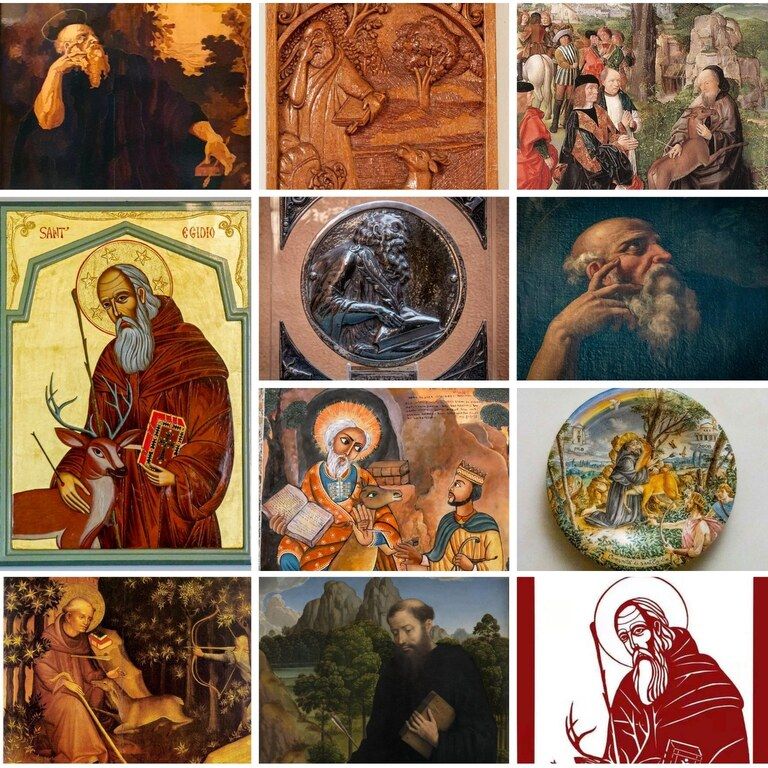
Saint Giles - The Hermit Who Transformed Provence Through Faith and Miracles
Saint Giles was a 6th-7th century Greek hermit, born in Athens into a noble family, who gave up his wealth to live in poverty and devotion to God. His life of prayer, miracles, and evangelization in the Provence region of France made him one of the most venerated saints of the Middle Ages, with his abbey in Saint-Gilles becoming an important center of pilgrimage.
Life and Formation
Giles, also known as Saint Giles, was born around 650 AD in Athens, the son of a wealthy and noble Christian family. From childhood he was instructed in sacred letters and showed a magnanimous disdain for the temporal world, as well as a generous love for the poor and unfortunate.
After the early death of his parents, the devout young man made a radical decision: he gave all his inheritance to the poor and the sick, intending to serve God in voluntary poverty, aspiring only to heavenly treasures. He distributed all his possessions and began living away from the city, in grottos and caves, devoting himself to prayer, fasting, and sacrifices.
Hermit Life and Miracles
The First Miracles
During his life as a hermit, Giles received the special gifts of wisdom, healing, and miracles. One of his first miracles occurred when, while walking through the city, he found a beggar at the door of a church. The man was gravely ill and nearly unclothed, in agony. Giles felt great compassion and covered him with his own cloak. At that very moment, the man rose up completely healed. Such miraculous events brought Giles so much honor and esteem that he decided to leave his home and seek a place where, unknown and free from the fear of receiving vain honors, he could serve the Almighty.
The Journey to France
In 683 AD, Giles traveled to France, settling as a hermit in a forest near Nîmes, in the Provence region. According to the Golden Legend, during that time his only companion was a wild deer, with whom he developed a deep friendship.
The Arrow Incident
His refuge was discovered by henchmen of the Visigothic king who had been secretly pursuing him. According to tradition, an arrow struck Giles's hand while he was trying to protect the deer from the king's hunters. This miraculous event gave rise to a friendship between Giles and the monarch. The king, impressed by the wonders he witnessed, continued to visit him frequently, bringing his physicians to care for the wounds. Giles was left with a leg disability as a result of these events, and came to be invoked as the patron saint of people with disabilities.
Ministry and Work
Foundation of the Monastery
When he saw the people and disciples seeking Saint Giles, the king ordered a monastery and a church to be built so that the saint could attend to everyone more conveniently. Giles was elected abbot and wrote a rule of life based on his own experience of prayer, asceticism, and mysticism. The monastery came to have its own discipline, establishing a model of contemplative and communal life.
Evangelization and Social Transformation
Together with his monks, Giles carried out a great work of evangelization and civilization in the region, now Languedoc. He tilled the land, fertilized the fields that had been uncultivated until then, opened trade routes, and above all preached the Gospel, converting sinners and leading them to penance. His greatest miracle was the conversion of the king himself, for whom Saint Giles had obtained from God, through his prayers, such an effective grace that the monarch confessed his great iniquities and did penance until death.
Growth of the Community
Giles's reputation for holiness grew and he came to have several disciples. His reputation for sanctity spread throughout the region, attracting pilgrims and the faithful. Years later, a settlement arose around the monastery, becoming the city of Saint Giles. The miracles he continued to perform made him famous everywhere.
Legacy and Veneration
Death and Burial
Saint Giles died in 720 AD in his monastery. His tomb became a place of pilgrimage and part of the Way of St. James leading to Spain. The abbey where Saint Giles lived, in the French commune of Saint-Gilles, is a place of pilgrimage and an official stop on the Way of St. James.
Ecclesiastical Recognition
After his death, the monastery was entrusted to the Benedictines, who continued his work of evangelization and civilization. Saint Giles was proclaimed one of the Fourteen Holy Helpers of the Catholic Church, and is especially invoked by people with disabilities and by those suffering from illnesses.
Lasting Influence
The life of Saint Giles exemplifies the transformation that genuine faith and devotion to God can bring about. His choice to abandon worldly riches to serve the poor, his life of prayer and penance, and his miracles of healing and conversion made him a model of holiness for generations of Christians. In every virtue, he was a model for those under his care and encouraged them to follow his example.
Birth
Date: c. 650 AD
Place: Athens, Greece
Death
Date: 720 AD
Place: Monastery of Saint-Gilles, France
Liturgical Feast
September 1
Patronage
- People with disabilities and physical impairments
- The sick
- Pilgrims
Written Works
- Rule of Life of the Monastery (c. 700 AD) - Monastic rule written by Saint Giles based on his experience of prayer, asceticism, and mysticism, which served as the monastery's own discipline
Sources and References
This article was prepared based on the following sources:
- History of Saint Egidio - Catholic Saints and Icons (website)
Comprehensive source on the life, miracles, and legacy of Saint Giles, including details about his first miracles and the founding of the monastery - Aegidius, the Hermit - Wikipedia (website)
Encyclopedia with information about Saint Giles as a 6th-century Catholic hermit saint, his popularity in Provence and Scotland, and his death in 720 AD - Saint Giles, Hermit - September 1 (website)
Source on the life of Saint Giles, his deer companion, and the arrow incident involving the Visigothic king's hunter - SAINT GILES - September 1 - Diocese of Amparo (website)
Information about Saint Giles's noble origin in Athens, his healing miracles, and the construction of the monastery by the king - Saint Giles - Christian Life - Franciscans (website)
Source with details about Giles's journey to France in 683 AD, the miracle of the storm at sea, and his work of evangelization - The Saint Who Fled the Crowds - Father Paulo Ricardo - Father Paulo Ricardo (website)
Analysis of the life of Saint Giles, his desire to escape worldly honors, and the greatest miracle of the king's conversion - Saint Giles | Diocese of Caruaru (website)
Information about Saint Giles, born in the 7th century in Athens, his hermit life in Provence, and the founding of the Abbey of Saint-Gilles