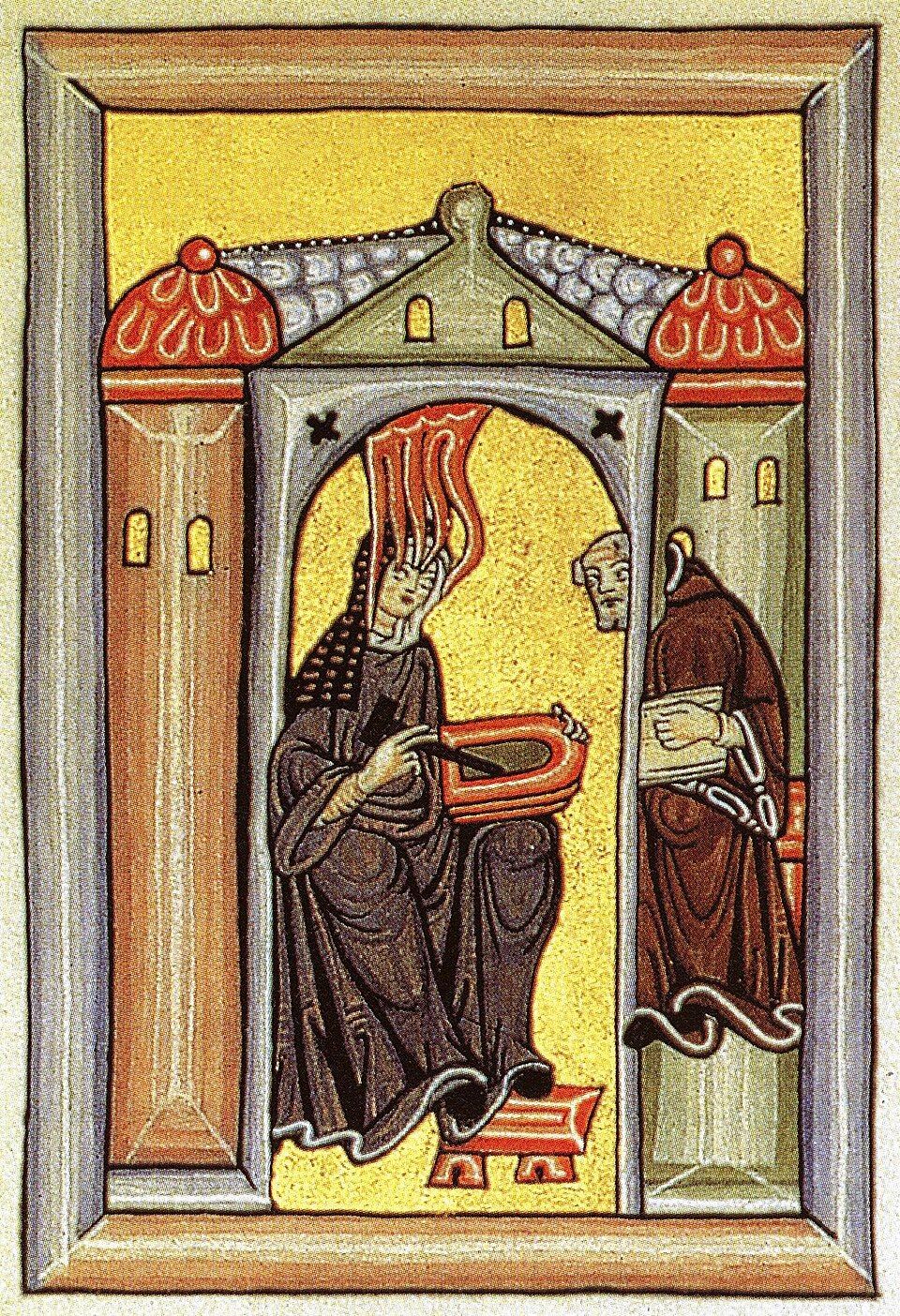
Hildegard of Bingen - Mystic Abbess, Polymath, and Doctor of the Church
Hildegard of Bingen (1098-1179) was a German Benedictine abbess, mystic, theologian, composer, physician, and naturalist who stood out as one of the most multifaceted figures of the Middle Ages, challenging the limitations imposed on women of her time through her visions, theological writings, and scientific contributions.
Life and Formation
Hildegard of Bingen was born in the summer of 1098 in Bermersheim, in the Rhine valley, in the region of Rhineland-Palatinate, in medieval Germany. Born into an aristocratic family as the youngest of ten children, she was destined from a young age for religious life, as was customary at the time for younger daughters of noble families.
She entered the convent of Disibodenberg, where she received religious and intellectual education under the guidance of Jutta, a spiritual mentor who recognized her exceptional talent. In 1136, after Jutta's death, Hildegard was elected magistra (mother superior) of the convent, a position she would hold with great distinction.
Contemplative Life and Mystical Visions
In 1141, at the age of forty-two, Hildegard experienced an intense episode of visions that would shape the course of her life. She received what she considered a supernatural command to record in writing the visions she would henceforth have. Initially hesitant, she consulted Saint Bernard of Clairvaux, one of the great doctors of the Church, who encouraged her to continue with her writings.
During her time at Disibodenberg, Hildegard practiced what is now known as holistic healing, using resonant spiritual energies and natural remedies to maintain health and cure illnesses and injuries. This integrative approach to spirituality and natural medicine would become a characteristic mark of her thought.
Main Theological Works
Between 1141 and 1151, Hildegard completed her first major work, the Scivias (also known as Scire vías Domini or Know the Ways), a theological treatise based on her mystical visions. This work was accompanied by the moral text Ordo Virtutum and the Symphony of Heaven, one of her earliest musical compositions.
Between 1151 and 1158, Hildegard devoted herself to writing her medical works under the single title Liber subtilitatum diversarum naturarum creaturarum (Book on the Natural Properties of Created Things). Later, in the 13th century, this work was divided into two texts: Physica (also known as Liber simplicis medicinae - Book of Simple Medicine), a natural history in nine books, and Causae et Curae (also known as Liber compositae medicinae - Book of Complex Medicine), where she изложited her knowledge about the human body and ways to heal it.
Between 1158 and 1163, she wrote the Liber Vitae Meritorum (Book of the Merits of Life), which expanded and developed themes from her earlier work, addressing the soul's struggle between virtue and vice, the true nature and final reward of both, and the immanence of God's presence and redeeming love.
Between 1163 and 1173-1174, Hildegard wrote her great theological work, the Liber Divinorum Operum (Book of Divine Works), which gathered the themes of her earlier works and elevated them through her new visions and explanations of the nature of divine love (Caritas) and divine wisdom (Sapientia), represented as feminine energies radiating light.
Foundation of Monasteries and Pastoral Ministry
In 1147, Hildegard left Disibodenberg and moved to Rupertsberg with eighteen nuns, where Count Bernard of Hildesheim donated land to them. In this new monastery, Hildegard was particularly prolific in her intellectual and spiritual activities.
In 1165, she founded a second monastery in Eibingen, which she visited regularly twice a week. This foundation demonstrates her leadership ability and her commitment to expanding contemplative religious life.
Preaching Journeys
Remarkably for a medieval woman, Hildegard undertook four preaching journeys, an extraordinary activity for her gender and time:
- First journey (1158-1159): she traveled to Mainz and Würzburg
- Second journey (1160): she traveled to Trier and Metz
- Third journey (1161-1163): she traveled along the Rhine to Cologne
- Fourth journey (1170-1171): she preached in the Swabia region
These preaching journeys caused great admiration and controversy, since it was highly unusual for a woman, especially an abbess, to travel publicly to preach. Hildegard challenged the patriarchal limitations of the medieval Church, although she respected its formal restrictions.
Musical and Linguistic Contributions
Hildegard was also a remarkable composer. She composed the chants titled Symphonia armonie celestium revelationum (Symphony of the Harmony of Celestial Revelations), created for the liturgical needs of her monastic community.
Around 1150, she created the Lingua Ignota (Unknown Language), a unique linguistic system made up of approximately one thousand words and an alphabet of twenty-three letters (Litterae Ignotae). This linguistic creation demonstrates her intellectual brilliance and innovative capacity.
Legacy and Recognition
Hildegard of Bingen is considered one of the most extraordinary women of the Middle Ages. Her contemporaries recognized her as a mystic, theologian, prophetess, writer of theological and medical works, composer, philosopher, scientist, naturalist, and monastic leader. She is often described as the first German biologist, the first physician, and one of the first feminists.
Her concept of Viriditas (greenness or verdancy), the vital force that permeates all creation, became central to her philosophical and theological thought. This integrative notion of spirituality with nature and medicine reflects a holistic vision that was remarkably advanced for her time.
Hildegard died on 17 September 1179, at Rupertsberg Monastery, at the age of eighty-one, leaving an intellectual, spiritual, and scientific legacy that transcended her era and continues to influence scholars, theologians, musicians, and scientists to this day.
Birth
Date: summer of 1098 (16 September 1098)
Place: Bermersheim, Rhine valley, Rhineland-Palatinate, Holy Roman Empire (present-day Germany)
Death
Date: 17 September 1179
Place: Rupertsberg Monastery
Liturgical Feast
17 September
Patronage
- Naturalists
- Physicians
- Composers
- Intellectual women
Written Works
- Scivias (Know the Ways) (1141-1151) - Theological treatise based on mystical visions, accompanied by the moral text Ordo Virtutum and the Symphony of Heaven
- Liber subtilitatum diversarum naturarum creaturarum (Book on the Natural Properties of Created Things) (1151-1158) - Medical work later divided into Physica (Natural History) and Causae et Curae (Problems and Remedies)
- Liber Vitae Meritorum (Book of the Merits of Life) (1158-1163) - Work dealing with the soul's struggle between virtue and vice, and with the presence of God's redeeming love
- Liber Divinorum Operum (Book of Divine Works) (1163-1173/1174) - Great theological work exploring the nature of divine love (Caritas) and divine wisdom (Sapientia)
- Symphonia armonie celestium revelationum (Symphony of the Harmony of Celestial Revelations) (c. 1150 onward) - Liturgical musical compositions for the monastic community
- Lingua Ignota (Unknown Language) (c. 1150) - Unique linguistic system with approximately one thousand words and an alphabet of twenty-three letters
Recommended Books
To deepen your knowledge about this person, we recommend:
- Hildegard of Bingen: Mysticism, Science, and Medicine in the Middle Ages - Various authors
Academic analysis of Hildegard's scientific and medical contributions in medieval context
Sources and References
This article was prepared based on the following sources:
- Hildegarda de Bingen - World History Encyclopedia (website)
World History Encyclopedia with information on life, works, and the concept of Viriditas - Biography of Saint Hildegard of Bingen - ACI Prensa (website)
Detailed biography with chronology of preaching journeys and monastery foundations - Hildegard of Bingen, the Seer - Nueva Tribuna (website)
Article about Hildegard as a seer and her preaching activities - Saint Hildegard of Bingen. Life - Hildegardiana (website)
Specialized source on Hildegard with information about her theological and medical works - Hildegard of Bingen - Wikipedia (website)
Encyclopedia with biographical information, dates, and main works - Saint Hildegard of Bingen: Doctor of the Church - Desde la Fe (website)
Article about Hildegard as a Doctor of the Church and her medical works - Hildegard of Bingen (1098-1179) - lclcarmen1bac (website)
Educational source on Hildegard as the first German biologist, physician, and feminist - Hildegard von Bingen, an Exceptional Woman - Música Antigua (website)
Article about Hildegard's musical and intellectual contributions - Hildegard von Bingen (1098-1179), mysticism, science and medicine in the Middle Ages - Método (website)
Academic analysis of Hildegard's contributions to mysticism, science, and medieval medicine