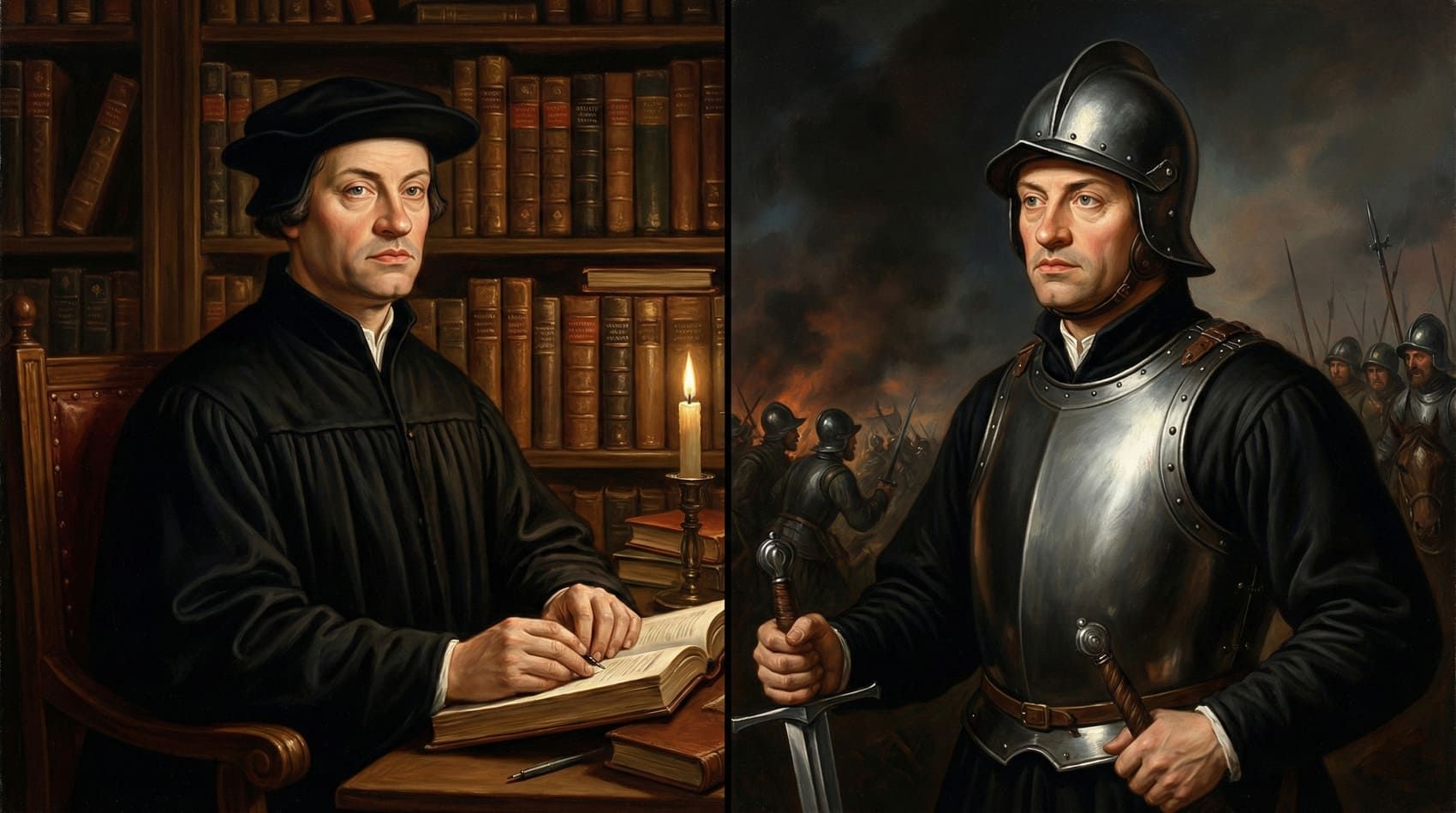
Huldrych Zwingli - The Reformer of Zurich and Founder of the Swiss Reformed Tradition
Huldrych Zwingli (1484-1531) was the leader of the Protestant Reformation in Switzerland and founder of the Swiss Reformed churches. Developing his ideas independently of Martin Luther, Zwingli implemented more radical reforms in Zurich and created the theological foundation that would later influence John Calvin and the Reformed tradition.
Life and Education
Huldrych Zwingli was born on January 1, 1484 in the village of Wildhaus, in the canton of St. Gallen, in the Swiss Alps. He received a humanist education that would prepare him to become one of the most important figures in the European Protestant Reformation.
In 1506, Zwingli began his ministry as a priest, but from a clearly humanist perspective. He devoted himself to the deep study of the New Testament in its original Greek language, and this linguistic knowledge awakened in him the urgent need for reform in the Church. He realized that the ecclesiastical institution of his time had drifted significantly from the early Christian model, making it necessary to restore its original simplicity and doctrine.
His transfer to Einsiedeln in 1516 marked an important turning point in his trajectory. Two years later, in 1518, at age 34, he was elected preacher of the Zurich Cathedral (Grossmünster) by the canton of Zurich. This position would provide him with the necessary platform to begin his reforming work.
The Beginning of the Reformation in Zurich
From 1519 onward, Zwingli began preaching a series of expository biblical sermons that had a strong impact on the community. Unlike Martin Luther, who was a doctor biblicus (doctor of theology), Zwingli reached similar conclusions through the study of Scripture from the perspective of a humanist scholar, developing his own original religious conception.
His first significant break with the Roman Catholic Church occurred in 1522, in the episode known as the Sausage Affair. On that occasion, Zwingli defended a group of citizens who had broken the Lenten fast by eating sausages. The city council, recognizing the importance of the issue, allowed him to present his arguments and organized a public debate between him and a Catholic delegation.
The 67 Articles and the Public Disputations
In 1523, the First Disputation took place, in which Zwingli presented the 67 Articles of Faith (Die 67 Artikel Zwinglis), establishing the theological foundations of the Reformation. In these articles, he stated that:
- Christ is the Church's only authority
- Salvation comes exclusively through faith
- Only the Bible contains the doctrine necessary for salvation
- God forgives whom he wills, regardless of indulgences
After the Second Disputation, also in 1523, Zwingli firmly established himself as the undisputed leader of the Protestant Reformation in Zurich. His ideas about public worship and the sacraments represented an even more radical break with older traditions than the Lutheran movement.
Reforms Implemented
Zwingli's reform was supported by both the magistrate and the population of Zurich, leading to significant changes in civil life and state affairs. Among the main reforms implemented were:
- Abolition of the mass in 1525, replaced by the Lord's Supper
- Introduction of the German language in the liturgy
- Abolition of clerical celibacy
- Removal of all decoration from churches, including depictions of saints and the Virgin Mary
- Secret marriage to Anna Reinhard in 1522
From 1522 onward, Zwingli worked intensely on the Reformation, preparing 67 brief articles of faith that formed the basis of his theology. His preaching led the people of Zurich to purge the churches of all ornamentation, stripping them of traditional representations.
Expansion of the Reformation in the Swiss Confederation
Zwingli's Reformation spread from Zurich to five other Swiss cantons: Bern, Basel, Schaffhausen, and others. In six of the thirteen Swiss cantons, the inhabitants voted to adopt the Reformation. However, the rural cantons remained firmly Catholic and appealed to Austria to attack Zurich, creating growing political and religious tension.
Zwingli developed an ambitious vision for Switzerland: he became convinced that the Swiss Confederation, then a confederation of provinces operating more or less independently, should unite as a Protestant country, following the model of the Christian community described in the biblical book of the Acts of the Apostles.
Theology and Thought
Zwingli's theology was distinguished by its emphasis on rationalist and humanistic foundations. He believed in the essential goodness of human beings, considering that they did not need a series of external impulses to rise to God, since they were capable of doing so by themselves through reason and faith.
In works such as On Divine Justice, he developed a theology founded on the free gift of Grace at a time when indulgences were being sold by the Church. His expository preaching became the heart of his ministry almost from the beginning of his work in Zurich.
Although Zwingli did not leave behind an organized church, his doctrines profoundly influenced Calvinist confessions. He created the theological and intellectual basis on which John Calvin (1509-1564) could continue and develop his own understanding of theology and politics, becoming one of the pillars of the Reformed tradition.
Conflict and Death
Determined to end the danger of imperial intervention and faced with the growing hostility of the Catholic cantons, Zwingli urged the Zurich Council to attack them militarily. His conviction that the forced conversion of Catholics through war was justified led him to accompany the Protestant troops as a chaplain.
On October 11, 1531, during the Second Battle of Kappel, Zwingli was killed in combat near Kappel am Albis. According to historical accounts, his body is believed to have been dismembered and burned by the victorious Catholics.
Legacy and Succession
Despite his premature death, the Zurich Reformation continued under the leadership of his loyal collaborator Heinrich Bullinger, who became his first successor. Shortly afterward, the Helvetic Confession of Faith emerged, one of the classic declarations of Reformed faith that consolidated Zwingli's teachings.
The cantons of Bern, Basel, Zurich, and Schaffhausen remained faithful to the Reformation after his death. In Geneva, the star of another great reformer, John Calvin, would soon rise, continuing and expanding the work begun by Zwingli.
Historical Legacy
Zwingli is often called the third man of the Protestant Reformation, after Luther and Calvin. His passion for Scripture and his determination to live exclusively under its authority became key components of the Reformed tradition that endures to this day.
Switzerland owes its Reformation to Zwingli's teachings, and his influence extended far beyond its borders. Although his life and work are little known in some regions, his contribution to the development of Reformed Protestantism is undeniable and fundamental for understanding sixteenth-century European religious history.
Birth
Date: January 1, 1484
Place: Wildhaus, St. Gallen, Switzerland
Death
Date: October 11, 1531
Place: Kappel am Albis, Switzerland
Written Works
- On Divine Justice - A theological work in which Zwingli developed a theology based on the free gift of Grace, in contrast to the Catholic Church's sale of indulgences
- 67 Articles of Faith (Die 67 Artikel Zwinglis) (1523) - A foundational document that established the bases of the Protestant Reformation in Zurich, presented at the First Disputation of 1523
Recommended Books
To deepen your knowledge about this person, we recommend:
- Huldrych Zwingli: His Life and Work
A comprehensive work on Zwingli's life and work, his theology, and his influence on the Protestant Reformation - The Reformation in Switzerland
A study of the Protestant Reformation in Switzerland with special focus on Zwingli's contribution
Sources and References
This article was prepared based on the following sources:
- 1531 - Swiss Ulrico Zwinglio begins religious reform parallel to Luther (website)
Article about the beginning of Zwingli's Reformation in 1531 and his death in the Battle of Kappel - Huldrych Zwingli (1484 - 1531), the Reformer of Zurich (article)
Academic article about Zwingli's life, theology, and influence on the Protestant Reformation - Ulrico Zwingli - Wikipedia (website)
Encyclopedia with biographical, theological, and historical information about Zwingli - Ulrico Zwingli 1484-1531 - Let's Return to the Gospel (website)
Article about Zwingli's life, his expository preaching, and influence on the Reformation - Zwingli - The Masons of the Reformation (website)
Biographical article about Zwingli as one of the main Protestant reformers - Ulrico Zwingli and 'Lent Refusal and Protection of Freedom' (website)
Article about the Sausage Affair and the beginning of the Protestant Reformation in Switzerland - Ulrico Zwingli: the founder of the Reformed tradition - CPAJ - Mackenzie (website)
Article about Zwingli as founder of the Reformed tradition and his theological influence