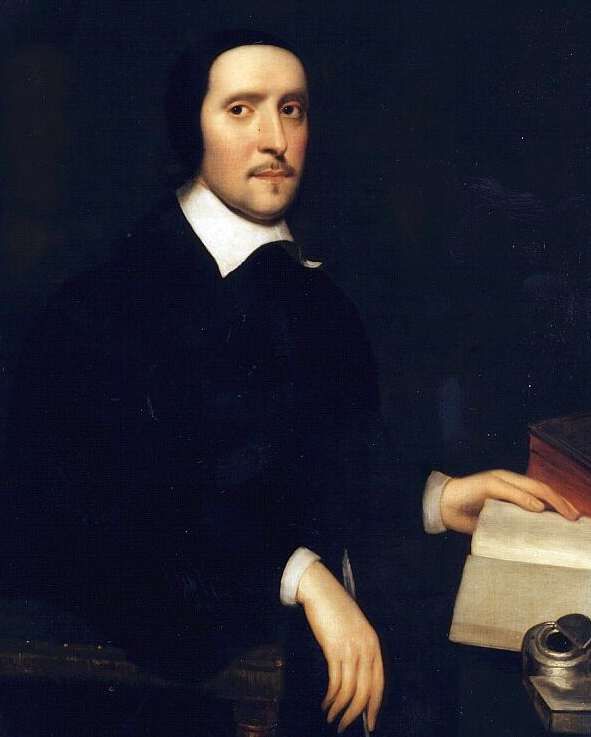
Jeremy Taylor - Bishop of Down and Connor and Master of Christian Devotion
Jeremy Taylor (1613-1667) was a prominent Anglican theologian, devotional writer, and Bishop of Down and Connor in Ireland. Known as the 'Chrysostom of England', he left a lasting legacy through his works on holy living, Christian dying, and freedom of religious conscience.
Life and Education
Jeremy Taylor was born on 15 August 1613 in Cambridge, England, the third son and fourth of six children of Nathaniel Taylor. He studied at Gonville and Gaius College in Cambridge, where he excelled academically. He was ordained a priest in 1633 and quickly rose through the ecclesiastical ranks of the Anglican Church.
During his early years of ministry, Taylor served as a fellow at two Cambridge colleges and later at All Souls' College, Oxford, where he was appointed in 1638. He became rector of Uppingham and gained prominence as an eloquent preacher and brilliant theologian. He was chaplain to Archbishop Laud and King Charles I, demonstrating unwavering loyalty to the royalist cause.
Period of Persecution and Exile (1645-1660)
With the rise of the Puritans to power in 1645, Taylor's life changed dramatically. As a fervent supporter of the monarchy and the Anglican Church, he was deprived of all his ecclesiastical benefices and faced systematic persecution. He was imprisoned three times during the Commonwealth period under Oliver Cromwell.
Forced into exile, Taylor found refuge in Wales, where he became private chaplain to the Earl of Carbery at Golden Grove. This period of retreat, though difficult, was extraordinarily productive literarily. It was during these years that he produced some of his most influential and enduring works.
Restoration and Episcopate (1660-1667)
With the Restoration of the Monarchy in 1660, Taylor's situation was transformed. Instead of being called back to England as he had hoped, he was offered a post as reader in Lisburn, County Antrim, in 1658, through the intercession of his friend John Evelyn. Initially reluctant to share the post with a Presbyterian minister, Taylor eventually accepted and found comfort at his patron's estate in Portmore, Lough Neagh.
On 27 January 1661, Taylor was consecrated Bishop of Down and Connor in a special ceremony at St. Patrick's Cathedral, Dublin, where he was invited to preach the sermon. He was later given the additional responsibility of overseeing the adjacent diocese of Dromore. He was also appointed member of the Irish Privy Council and Vice-Chancellor of the University of Dublin in 1660.
As bishop, Taylor faced significant challenges. His diocese had a predominantly Presbyterian and Roman Catholic population, creating considerable tensions. Within two months of his consecration, he held a diocesan synod at which only two Presbyterian ministers attended, allowing him to declare thirty-six ecclesiastical benefices vacant to be filled by episcopally ordained clergy. Although five Presbyterian ministers eventually submitted to ordination by Taylor, the mutual hostility between the bishop and the expelled ministers remained intense until his death.
Taylor remained an active bishop in his diocese, traveling widely and conducting visitations in 1665 and 1666, as well as attending ecclesiastical courts. In 1661, he commissioned the construction of a new cathedral in Dromore for the diocese. He became discouraged in 1664 when Lord and Lady Conway, who provided him with pleasant company, decided to return to England. In May 1664, he unsuccessfully requested of Bishop Gilbert Sheldon a transfer to an English diocese.
Literary and Spiritual Legacy
Jeremy Taylor is remembered as one of the leading devotional writers in English history and was called 'the Chrysostom of England' for his preaching eloquence. His works exerted a profound influence on generations of Anglican Christians and beyond.
Among his most notable works are:
- A Discourse of the Liberty of Prophesying (1647) - an influential argument for freedom of conscience and freedom of expression in a religious context
- Rule and Exercises of Holy Living (1650) - often cited as Holy Living, a practical guide to godly Christian living
- Rule and Exercises of Holy Dying (1651) - known as Holy Dying, a manual on Christian preparation for death
- The Golden Grove (1655) - a collection of prayers and daily meditations
- Ductor Dubitantium, or the Rule of Conscience (1660) - conceived as a standard manual of casuistry and Christian ethics
- Dissuasion Against Popery - a controversial work against Roman Catholicism
His works were translated into Welsh by Nathanael Jones and continued to be read centuries after his death. Charles Wesley, a century later, reported finding great spiritual benefit in his writings, particularly in Holy Living and Holy Dying.
One of Taylor's prayers for the Visitation of the Sick was included in the Book of Common Prayer (page 316 of the 1928 American edition), demonstrating official recognition of his contribution to Anglican liturgy.
Death and Commemoration
Jeremy Taylor died on 13 August 1667 in Lisburn, Ireland, at the age of 54, after seven years of episcopal ministry. He is commemorated in the liturgical calendars of the Anglican Church and other Anglican churches on 13 August.
His legacy lives on through his theological, devotional, and moral works, which continue to influence Protestant Christian thought. Taylor is remembered not only as a devoted bishop, but as a master of Christian spirituality whose wisdom transcended his time.
Birth
Date: 15 August 1613
Place: Cambridge, England
Death
Date: 13 August 1667
Place: Lisburn, Ireland
Liturgical Feast Day
13 August
Written Works
- A Discourse of the Liberty of Prophesying (1647) - Influential argument for freedom of conscience and freedom of expression in a religious context
- Rule and Exercises of Holy Living (1650) - Practical and devotional guide to godly Christian living, widely read and influential
- Rule and Exercises of Holy Dying (1651) - Manual on Christian preparation for death, spiritual complement to Holy Living
- The Golden Grove (1655) - Collection of prayers and daily meditations for devotional use
- Ductor Dubitantium, or the Rule of Conscience (1660) - Standard manual of casuistry and Christian ethics for the Christian people
- Dissuasion Against Popery - Controversial work against Roman Catholicism
- Sermons (1653) - Collection of theological and spiritual sermons
Recommended Books
To deepen your knowledge of this person, we recommend:
- The Life of Jeremy Taylor, Bishop of Down, Connor, and Dromore - George L. Duyckinck
Classic and comprehensive biography of the life and work of Jeremy Taylor
Sources and References
This article was compiled based on the following sources:
- Dictionary of Irish Biography - Jeremy Taylor (website)
Irish academic source with detailed information about his life, episcopate, and ministry in Down and Connor - Episcopal Church Glossary - Jeremy Taylor (website)
Official Episcopal Church reference with dates, major works, and historical context - Wikipedia - Jeremy Taylor (website)
Encyclopedia with information about his life, ecclesiastical offices, and literary contributions - Anglican Calendar - Jeremy Taylor, Bishop and Theologian (website)
Anglican resource with a chronology of life, major works, and context of persecution during the Commonwealth - Wikipedia Italiano - Jeremy Taylor (website)
Italian-language source with precise dates of birth and death, and information about his works - The Life of Jeremy Taylor, Bishop of Down, Connor, and Dromore - George L. Duyckinck (book)
Complete historical biography of Jeremy Taylor