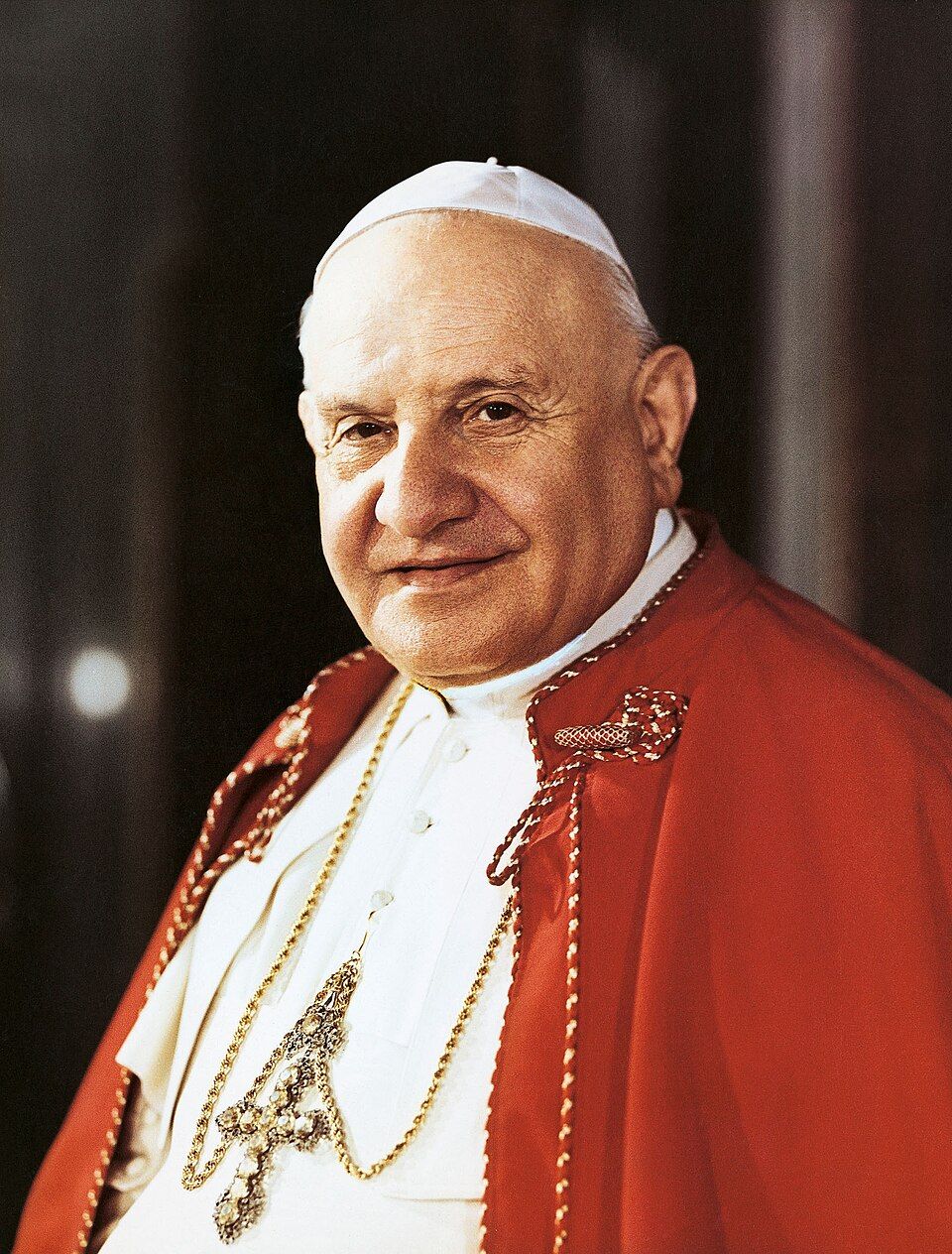
Pope John XXIII - The Good Pope and Reformer of the Second Vatican Council
Angelo Giuseppe Roncalli (1881-1963), known as Pope John XXIII, was the 259th pope of the Catholic Church. Despite his brief pontificate, he profoundly shaped the history of the Church in the 20th century by convening the Second Vatican Council, seeking to adapt the Church to the new times and promote ecumenical dialogue.
Life and Formation
Angelo Giuseppe Roncalli was born on 25 November 1881 in Sotto il Monte, in Lombardy, Italy. He was the fourth of the thirteen children of Giovanni Battista Roncalli and Marianna Mazzola, a family of poor farmers, but with a rich heritage of Christian piety.
From a young age, Angelo showed a religious vocation. In 1892, at eleven years old, he entered the seminary in Bergamo. In 1895, he began writing his spiritual meditations, which later became part of the Giornale dell'anima (Diary of the Soul). In 1900, he was sent to Rome to study theology at the Pontifical Roman Seminary.
On 10 August 1904, at the age of 23, he received priestly ordination after earning a doctorate in Theology. Shortly after his ordination, he was called by Bishop Radini Tedeschi to return to Bergamo, where he worked as his secretary until 1914, absorbing his pastoral vitality and reforming spirit.
Priestly Ministry and Vatican Diplomacy
First Steps in Teaching
After Bishop Tedeschi's death in 1914, Roncalli devoted himself to teaching at the seminary and to the apostolate among members of Catholic associations. During the First World War, in 1915, he was called up as a medical sergeant and appointed military chaplain for wounded soldiers returning from the front lines.
In 1920, Pope Benedict XV appointed him director of the Italian Council of the Society for the Propagation of the Faith, a role in which he demonstrated remarkable organizational ability. He visited many dioceses in Italy, organized several missionary circles, and established contacts with various missionary orders, gaining a better understanding of the dynamics of Catholic missions spread throughout the world.
Bishop and Diplomat
On 3 March 1925, Pope Pius XI appointed Roncalli apostolic visitor in Bulgaria. He received episcopal ordination on 19 March 1925, in Rome, choosing the motto "Oboedientia et pax" (Obedience and Peace). He remained in Bulgaria until 1935, visiting Catholic communities and cultivating respectful relations with other Christian communities. During this period, he acted with great care and charity, relieving the suffering caused by the 1928 earthquake.
In 1935, he was appointed apostolic administrator of the Apostolic Vicariate of Istanbul and apostolic delegate to Turkey and Greece. In this vast region, he worked intensely in service of Catholics, distinguished by his capacity for dialogue and his respectful treatment of Orthodox Christians and Muslims. When the Second World War broke out, he was in Greece, which was devastated by the fighting.
On 23 December 1944, Pope Pius XII appointed him apostolic nuncio in Paris, a position he held for eight years. As the Second World War drew to a close, Roncalli helped prisoners of war, including Germans held in France, and made a significant contribution to normalizing French ecclesial life.
Cardinal and Patriarch of Venice
On 12 January 1953, Pope Pius XII elevated Roncalli to Cardinal-Priest of Santa Prisca. Three days later, on 15 January 1953, he was appointed Patriarch of Venice. In Venice, he continued his ecumenical work, convened a diocesan synod, created approximately 30 parishes, and prioritized contact with priests and Catholic laypeople through various pastoral visits.
Papacy and Reforming Legacy
Election and Beginning of the Pontificate
Angelo Giuseppe Roncalli was elected to the Chair of Peter on 28 October 1958, at the age of 76, succeeding Pope Pius XII. He chose the name John XXIII in honor of Pope John who had ordained him a priest. He became known as "il Papa buono" (the good pope) for his great affability and captivating smile.
Although his pontificate was brief, lasting less than five years until his death on 3 June 1963, he profoundly marked the history of the Church in the 20th century.
The Second Vatican Council
The lasting legacy of John XXIII can be summed up in a few words: the Second Vatican Council. His great project was to convene this ecumenical council with the aim of reflecting on the way the Church communicates its message to the contemporary world. The Second Vatican Council represented an opening of the Church to the new times, seeking to adapt its structures and practices to the realities of the 20th century.
This council promoted ecumenical dialogue, liturgical renewal, the modernization of the Church, and a closer approach to the secular world. The decisions made during Vatican II deeply influenced the Catholic Church in the following decades.
Work for World Peace
John XXIII dedicated himself intensely to promoting world peace. His work for peace and his adaptation of the Church to the new times won the admiration of people of all beliefs and ideologies, transcending religious boundaries.
Canonization and Memory
John XXIII was canonized by Pope Francis on 27 April 2014, in the same ceremony as Saint John Paul II. His liturgical feast is celebrated on 11 October, the date that marks the opening of the Second Vatican Council.
His life exemplifies a path of pastoral service, respectful dialogue with different religious traditions, and commitment to the renewal of the Church. John XXIII remains a central figure in the religious history of the 20th century, reminding us of the importance of compassion, openness to dialogue, and the ability to adapt to the challenges of each era.
Birth
Date: 25 November 1881
Place: Sotto il Monte, Lombardy, Italy
Death
Date: 3 June 1963
Place: Apostolic Palace, Vatican
Liturgical Feast
11 October
Patronage
- Patronage not specified in the sources
Written Works
- Giornale dell'anima (Diary of the Soul) (Written between 1895 and 1963) - Collection of spiritual meditations and personal reflections by John XXIII, begun in 1895 and maintained throughout his life. An important document for understanding his spirituality and thought.
Recommended Books
To deepen your knowledge about this person, we recommend:
- John XXIII: A Life - Various authors
Comprehensive biographies on the life and pontificate of John XXIII, including his role in the Second Vatican Council
Sources and References
This article was prepared based on the following sources:
- Pope John XXIII – Wikipedia (website)
Encyclopedic article with complete biographical information about John XXIII - Biography of Pope John XXIII - eBiografia (website)
Detailed biography of John XXIII's life and religious career - John XXIII - Opus Dei (website)
Article about John XXIII with emphasis on his spirituality and canonization - Saint John XXIII, the Pope of Supreme Pastoral Zeal - Saint of the Day (website)
Biography focused on John XXIII's pastoral zeal and spiritual life - Biography of Pope John XXIII - The Holy See (website)
Official Vatican biography of Pope John XXIII - John XXIII and the Church of the Last 60 Years - IHU (website)
Analysis of John XXIII's legacy and its impact on the contemporary Church - On a day like today, the saint who convened the Second Vatican Council was elected pope (website)
Article about the election of John XXIII and its historical importance - John XXIII: The Pope of Peace and Kindness - Diocese of Taubaté (website)
Diocesan article about the life and legacy of John XXIII