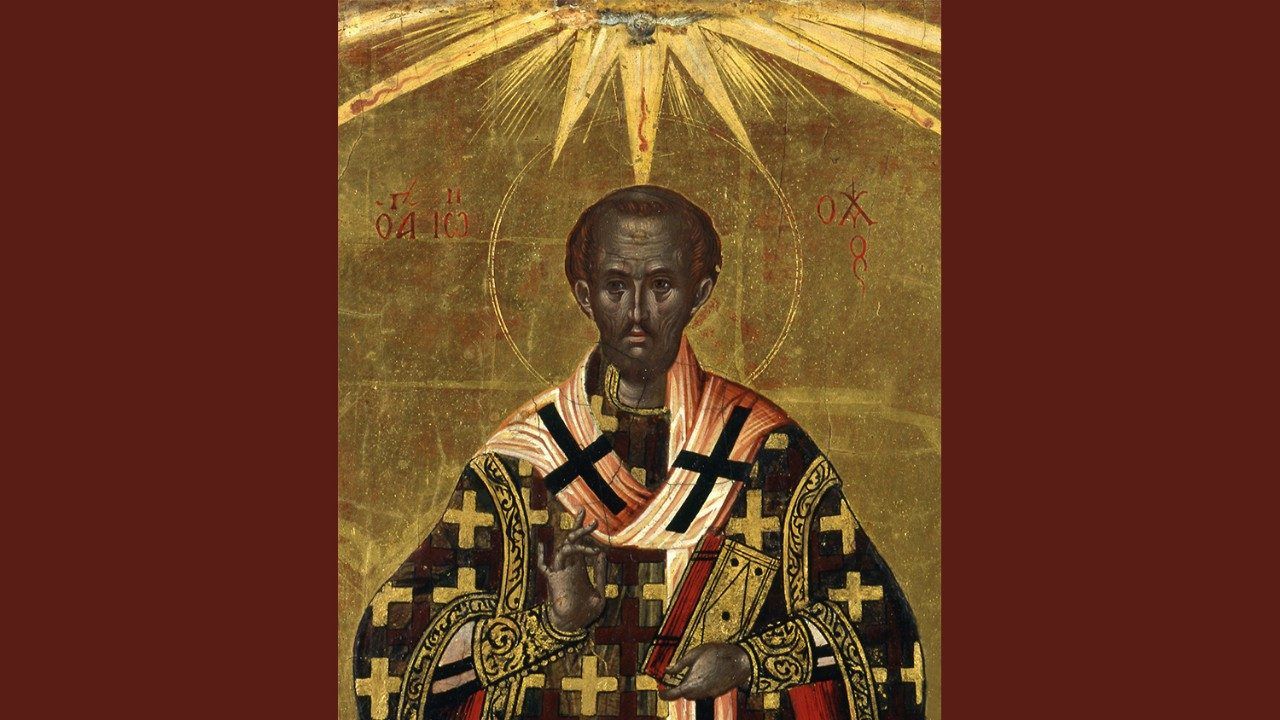
John Chrysostom - The Golden-Mouthed, Archbishop of Constantinople and Doctor of the Church
John Chrysostom (c. 347-407) was an archbishop of Constantinople and one of the most important Church Fathers of the 4th century, known for his powerful homilies, exceptional eloquence, and unwavering defense of Christian morality against political and ecclesiastical corruption.
Life and Formation
John Chrysostom was born around the year 349 in Antioch in Syria, into a wealthy family. Orphaned by his father at an early age, he was raised by his mother, Anthusa, a pious woman who gave him a solid Christian upbringing. From a very young age, he stood out for his keen intelligence and remarkable eloquence, qualities that would mark his entire life.
Educated in an environment of intellectual refinement, John received an excellent rhetorical education. During his youth, he lived a monastic life within his own home, devoting himself to the study of the Scriptures and ascetic practice. Following the theological school of Antioch, he adopted a more literal approach to the Bible, in contrast to the more allegorical interpretation of the Alexandrian School. This methodological choice would deeply influence his preaching and exegetical writings.
Ministry in Antioch
Before his appointment to Constantinople, John developed a significant ministry in Antioch, where he became extremely popular among the people. His reputation as a preacher of extraordinary power and as a defender of the Christian faith grew considerably. He preached long series of messages on biblical books such as Genesis, Matthew, John, and Romans, many of which still survive in the form of commentaries and homilies.
His ability to communicate and his denunciation of abuses committed by political and ecclesiastical leaders already distinguished him as an important prophetic voice in the early Church. The epithet Chrysostom, meaning "golden mouth" in Greek (Χρυσόστομος), would be given to him three centuries later by the Byzantines, in recognition of the extraordinary quality of his oratory.
Appointment to Constantinople
In 397, when he was about fifty years old, the bishopric of Constantinople became vacant. It was a position of great prestige in the capital of the Eastern Roman Empire. Emperor Arcadius chose John for this prominent role. The appointment was made without the powerful eunuch Eutropius knowing, and so discreetly that John had to leave Antioch in hiding, since it was feared that the farewell to someone so popular could provoke a riot among the citizens.
John was so beloved in Antioch that he had to be practically kidnapped in order to be taken to Constantinople. He was eventually consecrated bishop in the capital in 398. The consecrating officiant was Bishop Theophilus of Alexandria. His arrival in the imperial capital marked a significant transformation in his life and in the destiny of the Eastern Church.
Ministry as Patriarch of Constantinople
As patriarch of Constantinople, John carried out pastoral and organizational work that inspired both admiration and astonishment. He undertook rigorous and wide-ranging reforms:
- He promoted rural evangelization, bringing the Christian message beyond the walls of the capital
- He created hospitals to care for the needy and the sick
- He carried out anti-Arian processions under the protection of the imperial police, combating current heresies
- He implemented reforms of austerity in the episcopal palace, which was meant to serve as an example for all
- He encouraged the participation of the faithful in liturgical life
- He promoted the Divine Liturgy, a work considered of great spiritual importance
John did not allow himself to be corrupted by the luxurious atmosphere of the imperial court. He remained steadfast in denouncing injustice, idleness, and vice, even within the clergy. He preached "fiery" sermons with which he punished vices and coldness, issuing severe warnings to idle monks and churchmen too susceptible to the allure of wealth.
He became known as "the almsgiver" because of his deep concern for the poor. He openly criticized Empress Eudoxia and other members of the court for their lavish parties and for living in excess while many poor people suffered. He constantly preached about the need to live a life of moderation, altruism, and service to the needy. He also preached against the revealing clothing of the women of Constantinople, seeking to promote Christian modesty.
Conflicts and Exiles
Although John was loved by the people, his moral integrity and his denunciations of the powerful won him powerful enemies. Empress Eudoxia took John's words as a personal offense, and the patriarch of Alexandria, Theophilus, led a coalition against him. These political and ecclesiastical intrigues resulted in successive exiles.
In 403, John was deposed and removed from the city. However, the public outcry was so intense that it forced his return to Constantinople. This victory, however, was brief. His adversaries renewed the challenge, and on 9 June 404, a new condemnation permanently removed him from the center of the Empire. The former hermit found himself in forced solitude, far from the capital he had tried to reform.
Final Years and Death
During his mandatory exiles, John endured everything with patience and hope, preaching whenever he could. Weakened by the hardships of exile and the privations imposed on him, his health gradually deteriorated. He died on 14 September 407, in Comana in Pontus, during one of his many exiles.
His last words summed up his whole life of dedication and faith:
"Glory be to God for all things"
After his death, the son of Emperor Arcadius, Theodosius the Younger, recognizing John's historical and spiritual importance, ordered the transfer of his remains from the tomb at Comana to Constantinople. His remains arrived in the capital on the night of 27 January 438, amid a triumphant crowd, in posthumous recognition of his spiritual greatness.
Legacy and Influence
John Chrysostom left an extraordinary legacy for the Christian Church. His numerous writings, treatises, and homilies have come down to us in impressive quantity. Among his most important works is "On the Priesthood", considered a masterpiece of priestly spirituality.
Pope Benedict XVI highlighted his importance as one of the great Christian orators and doctors of the Church, especially for his many writings that shaped Christian theology and spirituality. His emphasis on morality, charity, the importance of the Word of God, and ascetic life influenced generations of Christians.
John is venerated as a Saint and Doctor of the Church in the Christian tradition, and is recognized as one of the most important Church Fathers of the 4th century. His life exemplifies the tension between prophetic fidelity and political power, between moral integrity and the pressures of the court, making him an inspiring figure for all who seek to live the Christian faith with authenticity and courage.
Birth
Date: c. 347
Place: Antioch in Syria
Death
Date: 14 September 407
Place: Comana Pontica
Liturgical Feast
13 September (in the Western tradition) and 14 September (the date of his death, celebrated in some traditions)
Patronage
- Orators
- Preachers
- Theology students
Writings
- On the Priesthood - Masterpiece of priestly spirituality dealing with the nature and responsibilities of the priestly ministry
- Commentaries on Genesis - Series of homilies and exegetical commentaries on the book of Genesis
- Commentaries on Matthew - Series of homilies and exegetical commentaries on the Gospel of Matthew
- Commentaries on John - Series of homilies and exegetical commentaries on the Gospel of John
- Commentaries on Romans - Series of homilies and exegetical commentaries on the Epistle to the Romans
- Divine Liturgy - Work considered of great importance for the Eastern Christian liturgy
Recommended Books
To deepen your knowledge of this person, we recommend:
- The Works of Saint John Chrysostom - Various translators
Complete compilation of the works of John Chrysostom, essential for understanding his theological and spiritual thought
Sources and References
This article was prepared based on the following sources:
- João Crisóstomo becomes bishop of Constantinople 398 A.D. - Luiz Antonio Oliveira (website)
Biographical article about John Chrysostom with information about his life, appointment, and main characteristics - Saint John Chrysostom, the golden-mouthed - Minha Biblioteca Católica (website)
Catholic article on the life and work of John Chrysostom, emphasizing his pastoral and charitable reforms - Saint John Chrysostom, Bishop and Doctor of the Church - Via Católica (website)
Detailed biography of John Chrysostom with information about his conflicts with the imperial court and his exiles - Saint John Chrysostom – the 'fiery preacher' - Aliança de Misericórdia (website)
Article on John Chrysostom's ministry as patriarch, highlighting his pastoral activities and reforms - Saint John Chrysostom – bishop and doctor of the Church - Paulus Editora (website)
Biography of John Chrysostom with information about his monastic life, appointment, and death - St. John Chrysostom, bishop and doctor of the Church - Vatican News (website)
Official Vatican article on John Chrysostom, highlighting his role as an inconvenient patriarch and his death in exile - John Chrysostom – Wikipedia - Wikipedia (website)
Encyclopedia with biographical information about John Chrysostom and his historical importance - Saint John Chrysostom, bishop and doctor of the Church - Canção Nova (website)
Article on the life and work of John Chrysostom with emphasis on his family background and ministry