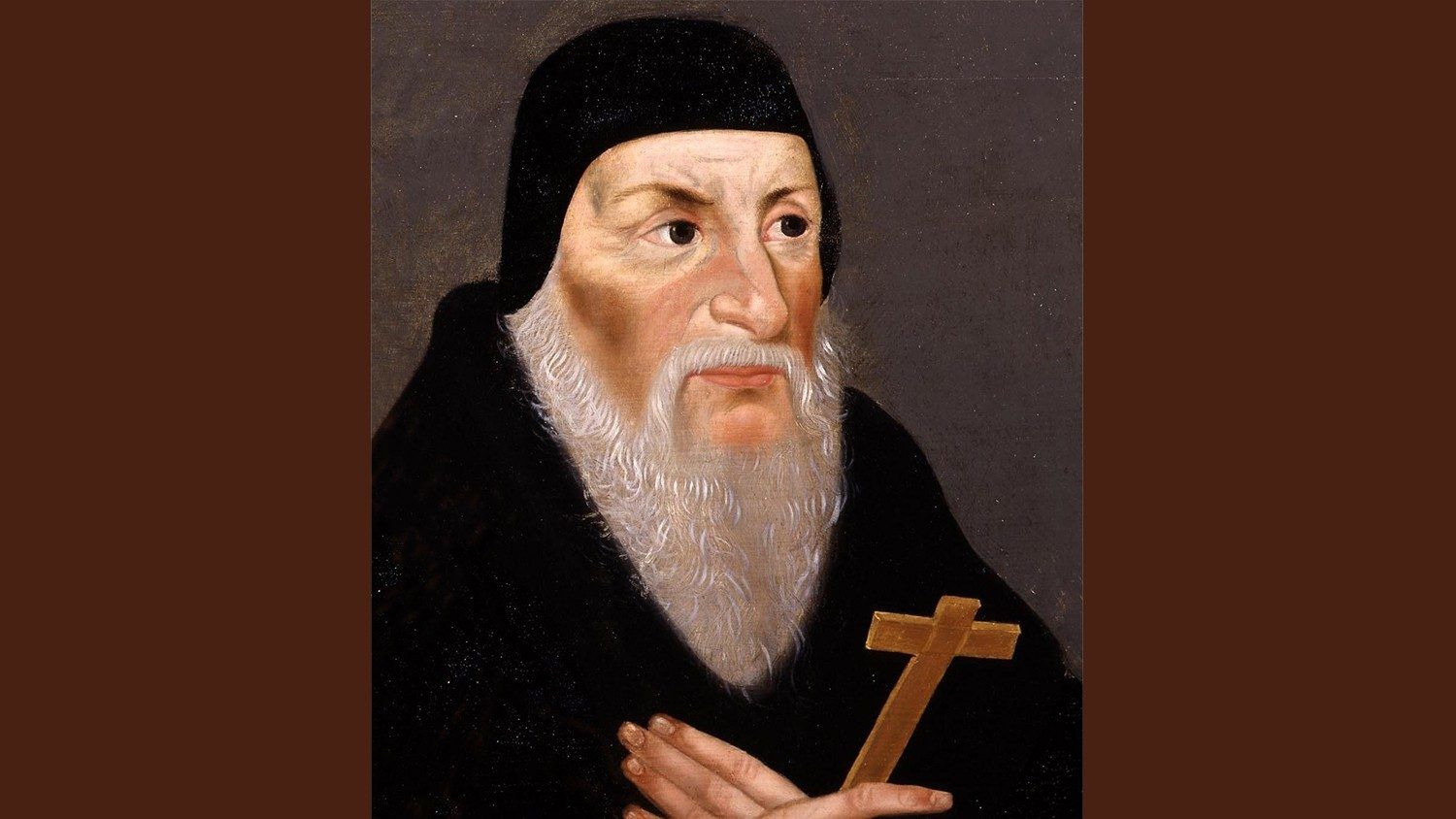
Saint John Fisher - Bishop of Rochester, Cardinal, and Martyr
John Fisher was an English Catholic bishop, humanist, and martyr, executed by Henry VIII in 1535 for refusing to recognize royal supremacy over the Church and for defending papal authority and the marriage of Catherine of Aragon.
Life and Formation
John Fisher was born around 19 October 1469 in Beverley, a town in the county of Yorkshire, in northeast England. The eldest son of Robert Fisher, a merchant, John received a solid education that led him to stand out as a humanist and theologian. He studied at the University of Cambridge, where he graduated in 1491 and earned a doctorate in theology in 1501. His rise was rapid: in 1504, he was appointed Bishop of Rochester, a modest diocese that he administered with exemplary dedication, prioritizing the moral reform of the clergy and charity to the poor.
As chancellor of Cambridge University from 1504, Fisher promoted the study of classical languages and theology, founding Christ's College in 1505 and St. John's College in 1511, with donations from Lady Margaret Beaufort, grandmother of Henry VIII, of whom he was confessor. His friendship with the nobility and the king positioned him as an influential figure at court, but always faithful to the Roman Catholic Church.
Ministry and Conflict with Henry VIII
At the beginning of the reign of Henry VIII, Fisher was a close friend of the monarch and defended orthodox positions against Lutheranism. However, the king's marital crisis in 1527, when Henry questioned the validity of his marriage to Catherine of Aragon, marked the beginning of the conflict. Consulted by the king and Cardinal Wolsey, Fisher publicly defended Catherine in 1529, preaching in her favor in London and publishing theological treatises on indissoluble marriage.
In 1531, Fisher strongly opposed the title of "Supreme Head of the Church and Clergy of England" granted to Henry. With the approval of the Act of Succession in March 1534, which declared the marriage to Catherine null and the marriage to Anne Boleyn valid, Fisher and Sir Thomas More refused the required oath, accepting only the parliamentary succession but rejecting the repudiation of papal authority. Imprisoned in the Tower of London on 13 April 1534, Fisher suffered mistreatment: without proper food, clothing, or a confessor, his weakened health worsened.
The Cardinalate and the Sentence
On 20 May 1535, Pope Paul III appointed him Cardinal-Priest of San Vitale, in the hope of saving him, but this enraged Henry, who forbade the entry of the cardinal's hat into England, declaring that he would send Fisher's head to Rome. Condemned for treason under the Acts of Supremacy and Treason, Fisher was beheaded on 22 June 1535, at 5 a.m., at Tower Hill. His body was left exposed and buried in the church of Allhallows, Barking, later transferred to the chapel of St. Peter ad Vincula, beside More.
"Christian people, I have come here to die for the faith of the Holy Catholic Church of Christ, and I thank God that my stomach has served me well until now, so that I have not yet feared death."
Before dying, he knelt, recited the Te Deum and In te Domine speravi, submitting to the axe with serene courage.
Legacy
Canonized on 19 May 1935 by Pius XI, together with Thomas More, Saint John Fisher is the only English bishop martyred by Henry VIII among the 22 of the time. His resistance symbolizes the defense of the unity of the Church, papal primacy, and the indissolubility of marriage. His execution, on the feast of Saint Alban, the first British martyr, and by beheading like Saint John the Baptist, reinforced the hagiographic parallel. Fisher remains a model for bishops and laypeople faithful in times of persecution.
- Reformer of the clergy and educator at Cambridge.
- Defender of Catholic orthodoxy against the Anglican schism.
- Martyr of conscience, inspiring generations.
Birth
Date: c. 19 October 1469
Place: Beverley, Yorkshire, England
Death
Date: 22 June 1535
Place: Tower Hill, London, England
Liturgical Feast
9 July (Catholic Church); 22 June (some traditions)
Patronage
- Bishops
- Catholic educators
- Victims of royal injustice
Written Works
- Defense of Catherine of Aragon (1529) - Theological treatise defending the validity of Henry VIII's marriage to Catherine against divorce.
Recommended Books
To deepen your knowledge about this person, we recommend:
- Life of Saint John Fisher - Various Catholic historians
Classic biographies based on contemporary documents, highlighting his fidelity.
Sources and References
This article was prepared based on the following sources:
- Saint John Fisher | English Martyr, Cardinal, Reformer - Britannica - Encyclopædia Britannica (website)
Detailed biography with dates and historical context of the martyrdom. - John Fisher - Wikipedia - Wikipedia contributors (website)
Encyclopedic entry with chronology, education, and cardinalate events. - CATHOLIC ENCYCLOPEDIA: St. John Fisher - New Advent - Catholic Encyclopedia (website)
Classic Catholic article with details on imprisonment and execution. - History | Life of Saint John Fisher - St. John Fisher University (website)
Summary of early life and martyrdom.