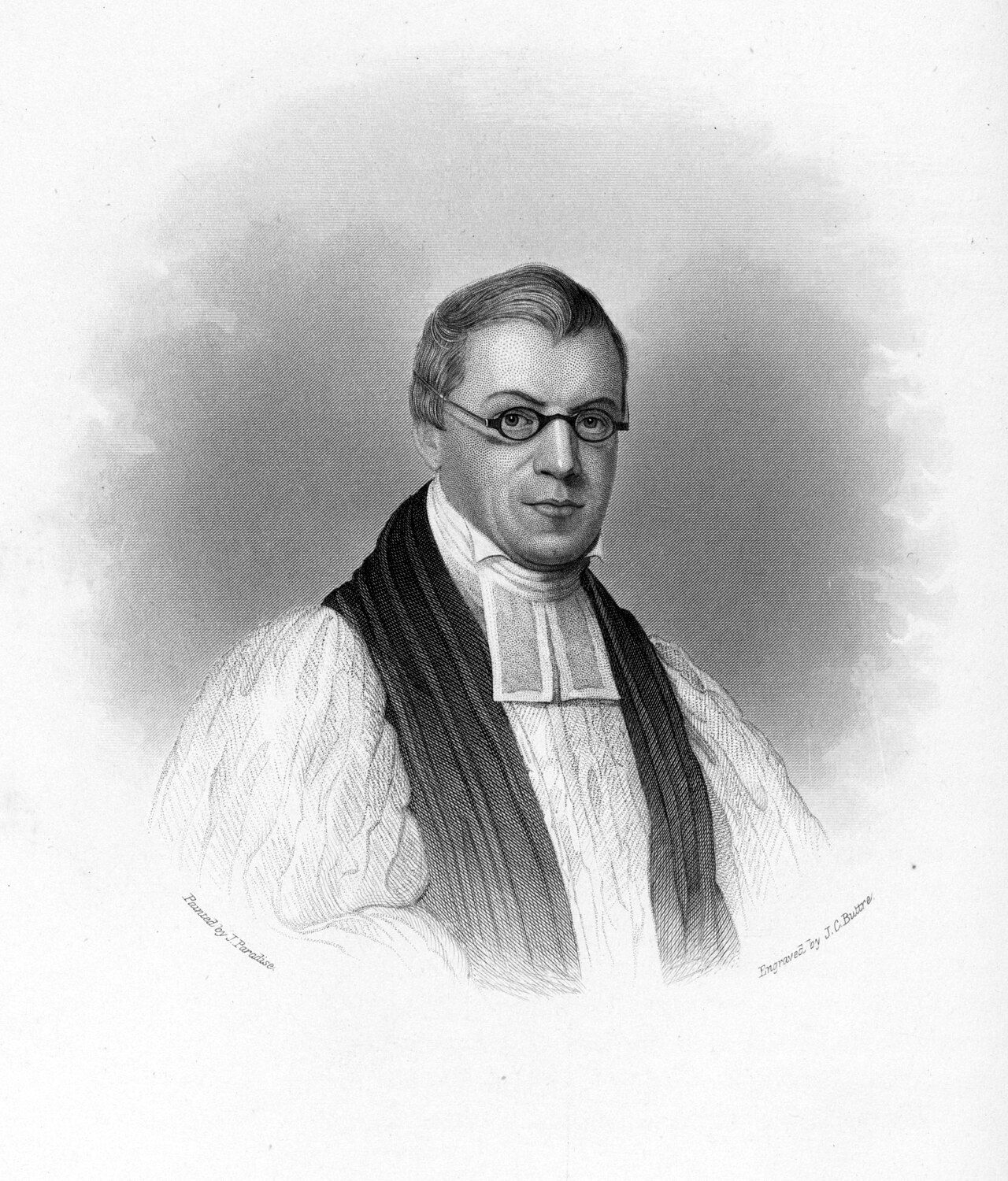
John Henry Hobart - Bishop of New York and Church Reformer (1830)
<p><strong>John Henry Hobart</strong> was the third Episcopal bishop of New York (1816-1830), a tireless leader who revitalized the Episcopal Church in the United States after Independence. Founder of educational institutions and a dedicated missionary, he expanded parishes, defended orthodoxy, and promoted missions among Indigenous and Black communities.</p>
Life and Education
Born on September 14, 1775 in the city of Philadelphia, Pennsylvania, John Henry Hobart was the son of a ship captain. He received his education at the University of Pennsylvania and studied theology under the guidance of Bishop William White of Pennsylvania. Ordained a deacon on June 3, 1798 and a priest on April 5, 1801, Hobart began his ministry in parishes in Pennsylvania, New Jersey, and New York.[1][2][3][4][5][6]
In 1800, he became assistant minister at the influential Trinity Church on Wall Street in New York, under rector Samuel Provoost, the second bishop of New York. His early dedication set him apart as a vigorous defender of the episcopacy and apostolic succession, publicly debating Presbyterian opponents.[1][2][3]
Ministry and Episcopal Work
On May 29, 1811, Hobart was consecrated assistant bishop of New York, with right of succession. Due to Bishop Benjamin Moore's frail health, he effectively governed the diocese for years, formally succeeding him on February 27, 1816. In the same year, he became rector of Trinity Church, the richest and most influential parish in the United States.[1][2][3][5][6]
As bishop, Hobart showed tireless energy in a diocese of nearly 50 thousand square miles, much of it a wild expanse west and north of Albany. In his first four years, he doubled the number of clergy and quadrupled the missionaries. By the time of his death, he had planted churches in nearly every major city in New York, expanded parishes from about 50 to nearly 170, increased the clergy from 26 to 133, and confirmed approximately 15 thousand people. He oversaw missions among the Oneida Indians, helping relocate them to Wisconsin, and was the first to consecrate a Black church in New York, ordaining the state's first Black priest in 1826.[1][2][3][7]
Hobart also took charge of the dioceses of Connecticut and New Jersey during episcopal vacancies, visiting parishes with unprecedented thoroughness. He knew his clergy and their families intimately, forgave weaknesses, encouraged strengths, and met weekly with candidates for ordination.[1][2]
Educational Contributions and Publications
Founder of the Protestant Episcopal Theological Society in 1806 (later the General Theological Seminary, New York), Hobart became professor of pastoral theology and homiletics in 1821. He co-founded Geneva College (renamed Hobart College in 1852, now Hobart and William Smith Colleges). He founded the Protestant Episcopal Tract Society in 1810 and the Protestant Episcopal Press in 1817, editing the Family Bible of the Society for Promoting Christian Knowledge in 1818.[1][2][3][5][7]
A defender of evangelical orthodoxy and apostolic order, he opposed liberalism and free thought. He published episcopal charges such as The Churchman (1819) and The High Churchman Vindicated (1826), distinguishing high church principles from Roman corruptions and Protestant errors.[3][5]
Legacy and Death
Hobart was known for his candor, eloquence as a preacher, and missionary zeal. A beloved pastor of Elizabeth Seton before her conversion to Catholicism, he traveled tirelessly by horseback, carriage, and steamboat, wearing out horses and his own health.[1][2][3][7]
After a long illness—possibly a bleeding ulcer or chronic enteric infection—he died on September 12, 1830, at the age of 54, in Auburn, New York. His funeral, attended by the governor and the mayor of New York, drew three thousand mourners; he was buried beneath the chancel of Trinity Church.[1][2]
"He was tireless as bishop, knowing the clergy intimately, forgiving faults, and encouraging strengths."
His legacy revitalized post-Revolution American Anglicanism, shaping the Episcopal Church through discipline and expansion.[1][8][9]
Birth
Date: September 14, 1775
Place: Philadelphia, Pennsylvania, United States
Death
Date: September 12, 1830
Place: Auburn, New York, United States
Liturgical Feast
September 12
Written Works
- The Churchman (1819) - Episcopal charge to the clergy of Connecticut and New York defending the principles of the Church.
- The High Churchman Vindicated (1826) - Defense of high church principles, distinguishing them from Roman corruptions and Protestant errors.
- Family Bible (editor) (1818) - Edition of the family Bible by the Society for Promoting Christian Knowledge.
Recommended Books
To deepen your knowledge about this person, we recommend:
- Biography in historical Episcopal sources - Various (see sources)
Primary documents and biographies on Episcopal Church websites provide detailed and verifiable accounts of his life.
Sources and References
This article was prepared based on the following sources:
- John Henry Hobart, Bishop of New York and Reformer of the Church - 1830 (website)
Detailed biography covering life, episcopate, foundations, and death. - John Henry Hobart, Bishop of New York, 1830 (website)
Chronological account of formation, ministry, and numerical achievements. - John Henry Hobart - Wikipedia (website)
Encyclopedic entry with dates, works, and educational contributions. - John Henry Hobart | Episcopal Bishop, Theologian, Educator (website)
Authoritative Britannica summary on education, publications, and emphasis on orthodoxy. - Hobart, John Henry - The Episcopal Church (website)
Official Episcopal Church data on ordinations and offices.