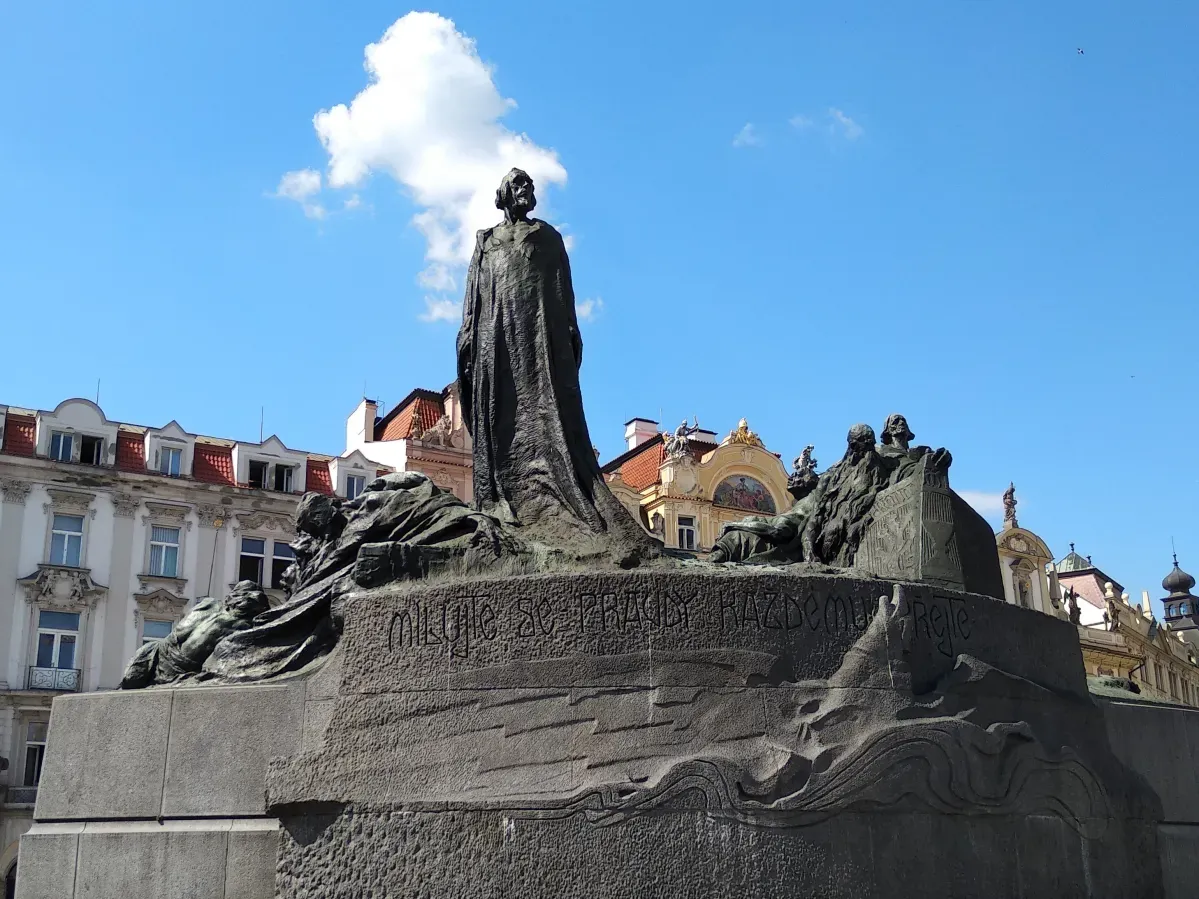
Jan Hus - Reformer and Martyr of the Faith: Forerunner of the Protestant Reformation
Jan Hus was a Czech theologian, thinker, and religious reformer who challenged papal authority and the practices of the Catholic Church in the early 15th century. Condemned for heresy and burned at the stake in 1415, he became one of the main precursors of Protestantism and deeply influenced Martin Luther.
Life and Education
Jan Hus was born around 1369 to 1375 in the small village of Husinec, in southwestern Bohemia, present-day Czech Republic, into a peasant family. He entered the University of Prague, where he earned a Master of Arts degree in 1396. Before embracing the priesthood, Hus had a conversion experience through deep study of the Bible, becoming a strong advocate for reforms in clerical life.
Ministry and Reform Work
Preacher at Bethlehem Chapel
In 1402, Hus was appointed preacher at Bethlehem Chapel in Prague, the center of a Czech reform movement that had begun in the mid-previous century. His eloquence and fervor were so great that the chapel quickly became the center of the reform movement, attracting not only ordinary people, but also influential aristocrats and members of the bourgeoisie.
Influence of John Wycliffe
Hus was a student of the doctrines of John Wycliffe, the English reformer, adopting some of his ideas, but not in a servile way. He accepted only those he considered fully orthodox. Like Wycliffe, Hus taught that the true Church consists only of the elect, whose head is Christ, not the pope.
Main Theological Positions
Hus's sermons and writings were characterized by:
- Affirming that the Bible was the great authority within Christianity and the great model for Christian life, in contrast to the authority of the ecclesiastical hierarchy
- Arguing strongly against indulgences, practices he considered abusive
- Defending that both bread and wine be offered in communion to all believers, in opposition to the Catholic practice of offering only the bread to laypeople
- Preaching in the common language (Czech) in opposition to the untranslated Latin of the time
- Defending a poor Church against the opulence presented by the Catholic Church
- Criticizing the sale of indulgences and clerical corruption
Hus used expressive, popular, and persuasive language, without going beyond the bounds of Catholic orthodoxy in his first years of ministry.
Conflict with the Catholic Church
Excommunication and Exile
The Catholic Church quickly spoke out against Hus's presence at the University. The pope decreed an interdict, banning religious ceremonies in Prague while Hus was in the city. His positions against the sale of indulgences and other criticisms of the Church led him to be accused of heresy. In 1412, Hus was excommunicated.
After his excommunication, Hus left Prague in October 1412 and sought refuge with friends in southern Bohemia. During exile, he wrote numerous treatises in his native language and composed his main work, De ecclesia (On the Church), a softened version of Wycliffe's positions.
The Council of Constance
In 1414, Hus was summoned to the Council of Constance, carrying a safe-conduct given by King Sigismund of Luxembourg so that he could present the reasons for his ideas. Despite this imperial protection, Hus was arrested as soon as he arrived in Constance and held in inhumane conditions during seven months of trial.
Unable to convince the high ecclesiastical dignitaries and refusing to renounce his positions, Hus was condemned for heresy by the Council. Not recognizing the jurisdictional authority of the clergy that condemned him, Hus appealed only to God and Christ, not to a pope or council.
Martyrdom and Death
On 6 July 1415, Jan Hus was burned at the stake in Constance, condemned as a heretic. His ashes were thrown into the river that runs through the city. At approximately 42 years of age, Hus became another in the long list of victims of Christendom's intolerance toward dissenters.
According to historical accounts, before facing the flames, Hus is said to have uttered a memorable prophecy:
"Today you are burning a goose, but in one hundred years you will hear a swan sing, and that swan you will not be able to burn or capture."This prophecy was fulfilled when, 102 years later, Martin Luther would publish his 95 Theses in Wittenberg in 1517.
Legacy and Influence
Forerunner of the Protestant Reformation
After his death, indignation swept Bohemia. In his name, followers revolted against Rome in violent protests that lasted more than a decade, giving rise to the Hussite movement. Hus is recognized as one of the main precursors of Protestantism.
Martin Luther himself recognized Hus as a forerunner of the Protestant Reformation. During the Leipzig Debate, Luther was derogatorily condemned as a "Hussite". He rejected the title at the time, but had time to read Hus's works during a break, returned, and praised the teaching of the condemned Czech reformer. Luther considered himself Hus's "swan" and is often depicted with swans to this day in reference to that prophecy.
Lasting Influence
Hus's ideas about the authority of Scripture, the simplicity of the Church, communion under both kinds, and criticism of ecclesiastical corruption deeply influenced the Protestant reformers of the 16th century. His commitment to the truth of the gospel and his willingness to confront Church authorities set a precedent for the reformers who came after him.
Hus was not a servile follower of Wycliffe's ideas, but an independent thinker who adapted reformist ideas to the Czech context. His life and death testify to his dedication to God's cause and to the dissemination of Scripture in language accessible to ordinary people.
Birth
Date: c. 1369-1375
Place: Husinec, Bohemia (present-day Czech Republic)
Death
Date: 6 July 1415
Place: Constance, southern Germany
Liturgical Feast
6 July
Written Works
- De ecclesia (On the Church) (c. 1413) - His main theological work, a softened version of Wycliffe's positions on the nature of the Church and papal authority
- Various treatises and letters (1412-1415) - Numerous treatises and letters written during his exile, mainly in Czech, defending his reformist positions
Recommended Books
To deepen your knowledge about this person, we recommend:
- A History of the Christian Church - Williston Walker (4th edition)
Reference work that addresses the life and death of Jan Hus in the context of medieval ecclesiastical history
Sources and References
This article was prepared based on the following sources:
- Jan Hus - Voltemos Ao Evangelho (website)
Article about Jan Hus as preacher, political figure, prophet, and martyr, with emphasis on his theological positions - Jan Huss and the Beginnings of the Reformation - Mundo Educação (website)
Educational article about Jan Hus as a Czech priest and theologian who criticized Catholic doctrines - Jan Hus - Wikipedia (website)
Encyclopedia with basic biographical information and historical context about Jan Hus - The Czech reformer Jan Hus - Theology and Art (website)
Article about the life, work, and death of Jan Hus as a religious reformer - Today in History: 1415 – Preacher Jan Hus is burned alive - Opera Mundi (website)
Historical article about the execution of Jan Hus and the context of the Council of Constance - The pre-Reformer Jan Hus and his martyrdom (1415) - IPB (website)
Article about Jan Hus as a precursor of the Protestant Reformation and analysis of his martyrdom - Life and work of João Huss - e-cristianismo (website)
Biography of João Huss with emphasis on his life, work, and reforming influence - John Wyclif and Jan Hus: forerunners of Luther - História do Mundo - Tales Pinto (website)
Comparative article on John Wycliffe and Jan Hus as precursors of Martin Luther