Joseph of Arimathea - The Disciple Who Buried Jesus and Founder of the First British Church
Joseph of Arimathea was an eminent member of the Sanhedrin and a secret follower of Jesus who asked Pilate for permission to bury the body of Christ in his own new tomb, thus fulfilling the prophecy of Isaiah. According to medieval traditions, he became the first evangelizer of Britain.
Life and Historical Context
Joseph of Arimathea was an important biblical figure who lived in the 1st century AD in Jerusalem. He was born in Arimathea, a city in Judea, probably identical to Ramah, the birthplace of the prophet Samuel. He was a wealthy man and a distinguished member of the Sanhedrin, the supreme council of the Jews, and was described as an influential person whom everyone knew and respected in Jerusalem.
According to the gospels, Joseph was a secret disciple of Jesus, motivated by hope in the Kingdom of God. Saint Luke describes him as a "good and honorable person," while Saint Mark emphasizes that he was a man who "summoned up courage" to defend his convictions. His status as a disciple was clandestine, since he feared the Jewish authorities, but his faith would lead him to an extraordinary act of courage.
The Burial of Jesus
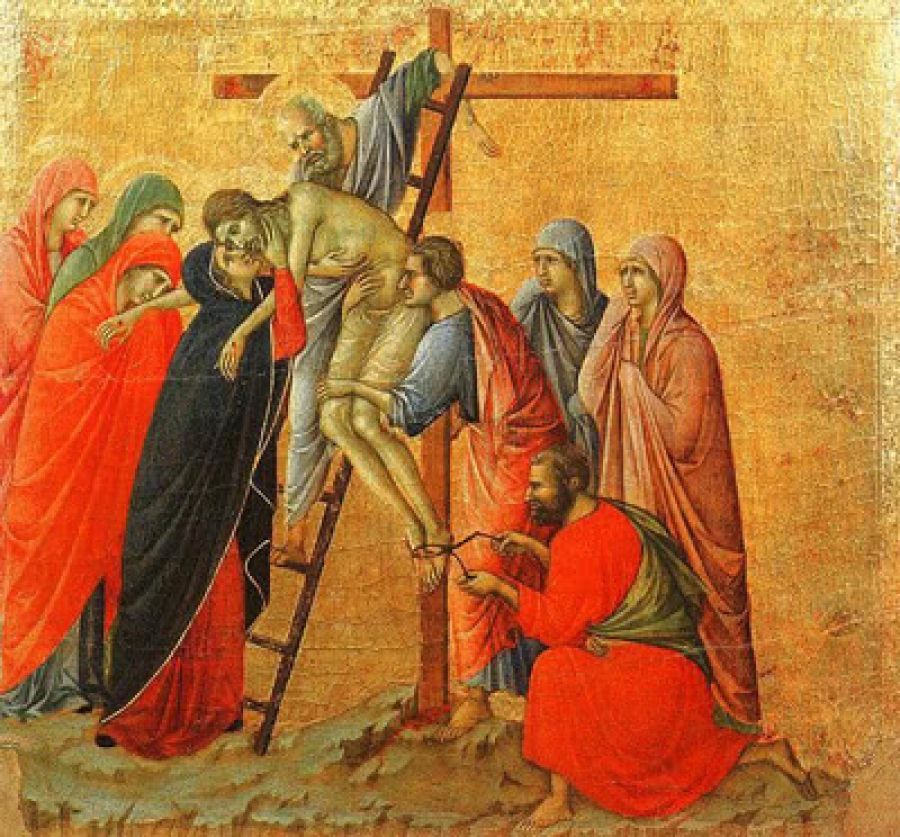
The most significant moment in Joseph's life occurred after the crucifixion of Jesus. When the afternoon of the day of Preparation arrived (the eve of the Sabbath), Joseph appeared before Pilate and requested Jesus' body in order to bury it. This was an extraordinarily courageous act, since it meant siding with a "seditionist" against the Roman Empire, risking his position in the Sanhedrin and his personal safety.
Pilate granted the request, and Joseph, with the help of Nicodemus, took the body down from the cross and wrapped it in linen cloths. They placed Jesus' body in a new tomb, freshly hewn in the rock, near Golgotha in Jerusalem, and sealed the entrance with a large stone. This tomb is identified by Christian tradition as the site where the Basilica of the Holy Sepulchre stands.
Joseph's action fulfilled a prophecy from Isaiah 53:9, spoken centuries earlier: "And they made his grave with the wicked, and with a rich man in his death; although he had done no violence, and there was no deceit in his mouth." This prophetic coincidence confirmed for the early Christians Jesus' identity as the Messiah.
Persecution and Imprisonment
After the resurrection of Jesus, Joseph was imprisoned by the Jews, accused of having taken the body from the tomb. According to apocryphal traditions, he was confined in a tower where he received a vision of the risen Christ and revelations about the Mystery of the Holy Grail. Texts such as the Acts of Pilate (also called the Gospel of Nicodemus) relate that the Jews reproached Joseph and Nicodemus for their pro-Jesus conduct, resulting in their imprisonment.
The apocryphal work Vindicta Salvatoris (4th century?) reports that Joseph was found in a tower where he had been confined to die of hunger, but was fed by a "heavenly food." According to this narrative, he was miraculously freed and returned to Arimathea, where he told how he had been freed by Jesus.
Legacy and Medieval Traditions
From the 4th century onward, legendary traditions emerged that elevated Joseph's figure to epic dimensions. The most famous of these is the British tradition, which states that Joseph arrived in the British Isles in the year 63 AD, settling in Glastonbury. According to William of Malmesbury in his work Deeds of the English Kings, Joseph founded the first British church, consecrated to the Virgin Mary.
Other traditions state that Joseph was a tin merchant who had business in Britain, which would explain his wealth and his later presence in those lands. Some medieval legends even suggest that Joseph took the young Jesus on a business trip to England before his public ministry, thus explaining Jesus' "lost years."
In Glastonbury, legend tells that while Joseph slept, his staff took root and blossomed, marking the sacred site. Glastonbury Abbey became an important center of pilgrimage until its dissolution during the Reformation in 1539. Later, traditions arose identifying Glastonbury as the burial place of King Arthur and Queen Genevieve.
In France, a 9th-century legend says that the patriarch Fortunatus of Jerusalem, in the time of Charlemagne, fled westward carrying the bones of Joseph of Arimathea to the monastery of Moyenmoutier, where he became abbot.
Patronage and Veneration
Catholic tradition recognizes Joseph of Arimathea as the patron saint of embalmers and undertakers, because of his role in Jesus' burial. His figure is also associated with the legends of the Holy Grail, and he is often depicted as the guardian of this sacred object in medieval narratives.
Joseph of Arimathea is the protagonist of the apocryphal Declaration of Joseph of Arimathea, written in the first person, in which he claims responsibility for the taking down and burial of Christ. In this document appear the names of the two thieves crucified with Jesus: Dismas and Gestas.
Historicity
From a historical point of view, scholars agree that Joseph of Arimathea was a real historical figure, although the details of his life beyond Jesus' burial are largely legendary. His role in the Sanhedrin is attested by the canonical gospels, and his request for Jesus' body is considered historically plausible, since there are records of Roman exceptions to the practice of denying bodies of those condemned for crimes of treason.
Some scholars suggest that Joseph may have been an official of the Sanhedrin responsible for burying people who died in Jerusalem during the festivals, rather than a full member of the council. Regardless of this question, his fundamental role in the fulfillment of messianic prophecies and in the history of the early Church remains unquestionable.
Birth
Date: c. 1st century AD.
Place: Arimathea, city of Judea (modern-day Rentis, approximately 10 km northeast of Lydda)
Liturgical Feast
August 31
Patronage
- Embalmers
- Undertakers
- Gravediggers
Recommended Books
To deepen your knowledge about this person, we recommend:
- The Gospel of Nicodemus (Acts of Pilate) - Unknown author (apocryphal) (c. 4th century AD)
Apocryphal text that narrates the imprisonment of Joseph of Arimathea and his miraculous release after the resurrection of Jesus - Vindicta Salvatoris - Unknown author (c. 4th century AD)
Apocryphal work that tells the story of Joseph being found in a tower and fed by heavenly food - Gesta Regum Anglorum (Deeds of the English Kings) - William of Malmesbury (c. 12th century AD)
Medieval source that narrates Joseph of Arimathea's arrival in Britain and the founding of the first British church in Glastonbury
Sources and References
This article was prepared based on the following sources:
- Joseph of Arimathea - Wikipedia, the free encyclopedia (website)
Encyclopedia with information about his life, the burial of Jesus, British traditions, and medieval legends - Joseph of Arimathea - World History Encyclopedia (website)
Academic source on historical identity, role in the Sanhedrin, and British traditions - Saint Joseph of Arimathea (website)
Catholic perspective on the life and role of Joseph in Jesus' burial - Who Was Joseph of Arimathea? (website)
Detailed analysis of historical data, legendary traditions, and apocryphal texts - Joseph of Arimathea: In What Sense Can This Character Be Historical - Antonio Piñero (website)
Critical analysis of Joseph's historicity and academic interpretations of his role - Who Was Joseph of Arimathea? (website)
Evangelical perspective on Joseph's life and fulfillment of prophecy - Saint Joseph of Arimathea (website)
Information about origin, social status, and role in the Sanhedrin - Joseph of Arimathea and Nicodemus, disciples of the Lord (website)
Vatican source on the life and importance of Joseph of Arimathea