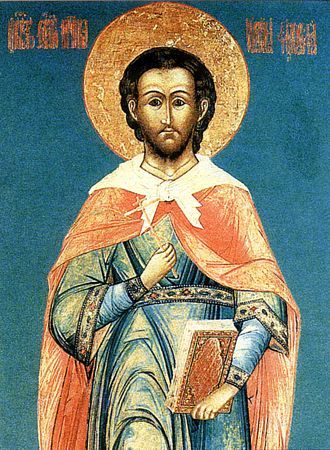
Justin Martyr - Philosopher, Apologist, and Martyr of the Christian Faith
Justin Martyr (c. 100-165 AD) was a 2nd-century Roman theologian, Christian philosopher, and the most important of the Apologist Fathers. Converted to Christianity after a long search for truth in the Greek philosophical schools, he founded a school in Rome to teach the Christian faith and defended persecuted Christians through his Apologies, ultimately being beheaded during the reign of Marcus Aurelius.
Life and Education
Flavius Justinus, known as Justin Martyr, was born around 100 AD in Shechem (present-day Nablus), in the region of Samaria, in the Holy Land. Probably the son of a Latin father and a grandfather with a Greek name, Justin was born into a pagan family and from an early age showed himself to be a passionate seeker of truth.
During his youth, Justin wandered through the various schools of the Greek philosophical tradition, tirelessly seeking to understand the mysteries of existence and the nature of the divine. He studied philosophy systematically, exploring the different currents of ancient Greek thought in his search for supreme wisdom.
Conversion to Christianity
The turning point in Justin's life came when, after a long path of philosophical inquiry, he found in the Christian faith the true wisdom. According to his own account in the Dialogue with Trypho, a mysterious encounter with an old man on the seashore was crucial to his conversion. This old man showed him man's inability to satisfy the longing for the divine by his own strength alone, leading Justin into an existential crisis that finally brought him to faith in Christ.
After his conversion, Justin understood that he had found true philosophy — not as an abstract system of ideas, but as the art of living rightly. He continued wearing the cloak that identified him as a philosopher, but now as a Christian, and began teaching in different cities.
Ministry and Work in Rome
Over time, Justin moved to Rome, where he founded a Christian philosophical school and became an untiring proclaimer of Christ among pagan scholars. In this school, he freely initiated students into the new religion, presenting it as the true philosophy and the path to authentic wisdom.
Justin used his keen intelligence and dialectical skill to defend persecuted Christians. He wrote and spoke about God using the categories and language of philosophers, making the Christian faith accessible and rational to Roman intellectuals. His renown among the city's scholars and philosophers grew significantly.
The Apologies
Justin's most important work consisted of his two Apologies, written approximately between 154 and 161 AD, during the transition from the reign of Antoninus Pius to that of Marcus Aurelius. These works were composed in defense of persecuted Christians and in response to the baseless accusations against the Christian community.
In the First Apology, Justin presents the oldest known description of the celebration of the Eucharist and Christian baptism, offering a crucial witness to the liturgy of the early Church. In this work, he argues forcefully for the superiority of the Christian faith over Greek and pagan philosophy, particularly attacking the slanderers who spread lies about Christians.
In the Second Apology, addressed specifically to Emperor Marcus Aurelius — who was also a philosopher and author of the Meditations — Justin seeks to demonstrate the injustice of the persecutions against Christians and the superiority of the Catholic faith over Greek philosophy.
The Dialogue with Trypho
In addition to the Apologies, Justin wrote the Dialogue with Trypho, a work that presents a debate between Justin and a Jewish character named Trypho. In this dialogue, Justin seeks to evangelize Jews and demonstrates how Christianity represents the fulfillment of the promises of the Old Testament.
Apologetic Method and Argumentation
Justin's argumentation method was based on three main elements: historical reality, fulfillment of prophecy, and superior arguments. He emphasized that Christianity is grounded in the irreducible reality of its historical events, in contrast to the fabulous accounts about pagan deities such as Zeus, Jupiter, and Minerva, for which no historical evidence or documentation existed.
Justin was also the first known Christian writer to cite the Acts of the Apostles and mention the first three Gospels, as well as to quote and paraphrase the letters of Paul and Peter. His testimony is crucial for understanding the status of the New Testament corpus in the 2nd century.
Confrontation with Crescens and Imprisonment
Justin's teaching in Rome brought him widespread notoriety among the city's intellectuals, but it also drew the attention of his opponents. A prominent Cynic philosopher named Crescens, a staunch anti-Christian supported by political power, challenged Justin to a public debate. Crescens' defeat in this dialectical confrontation was fatal for Justin.
After his public defeat, Crescens denounced Justin to the Roman authorities. Ironically, Justin was arrested and accused of being an atheist — that is, of being a subversive and enemy of the state for refusing to worship the Roman gods.
Martyrdom
Justin was brought before the prefect of Rome, Rusticus, who governed between 162 and 168 AD. During the trial, Rusticus demanded that Justin show his faith in the Roman gods and obey the emperors. Justin replied firmly:
We cannot be accused or imprisoned for obeying the commandments of Jesus Christ, our Savior.
When confronted with the threat of a painful death if he did not obey the gods of Rome, Justin responded calmly and with unshakable confidence. When asked whether he supposed that he would go up to heaven to receive some reward, Justin declared:
I do not suppose, but I know and am fully convinced of it.
Around 165 AD, during the reign of Emperor Marcus Aurelius, Justin was beheaded along with six companions: Chariton, Charita, and others. The account of his martyrdom was preserved in the official record of the court of his trial, constituting a valuable historical witness to Christian persecutions in the 2nd century.
Legacy and Historical Importance
Justin Martyr is considered the most important of the Apologist Fathers of the 2nd century and became historically the first of the Church Fathers to succeed the Apostolic Fathers of the earliest times. Although most of his writings have been lost over the centuries, his surviving works remain essential primary sources for understanding the early Church.
His concrete description of the sacramental celebrations of baptism and the Eucharist remains a principal source for the history of the early Church. Justin serves as a crucial witness to the development of the New Testament canon in the 2nd century and to early Christian liturgical practice.
At the First Vatican Council, the bishops desired that Justin be remembered each year by the universal Church, recognizing his fundamental importance for the Christian tradition. His life exemplifies the integration of philosophical reason and Christian faith, showing that Christianity is not contrary to intelligence, but its fulfillment.
Justin's voice continued to echo through the centuries, influencing generations of Christian apologists and remaining a model of rational defense of the faith and courage in the face of persecution.
Birth
Date: c. 100 AD
Place: Shechem (present-day Nablus), Samaria, Holy Land
Death
Date: c. 165 AD
Place: Rome
Liturgical Feast
June 1
Patronage
- Philosophers
- Christian apologists
- Defenders of the faith
Written Works
- First Apology (c. 155-157 AD) - Defense of Christians addressed to Emperor Antoninus Pius, containing the oldest known description of the celebration of the Eucharist and Christian baptism
- Second Apology (c. 161-165 AD) - Additional apology addressed to Emperor Marcus Aurelius, demonstrating the injustice of the persecutions against Christians
- Dialogue with Trypho (c. 154-161 AD) - Apologetic dialogue with a Jew named Trypho, demonstrating how Christianity fulfills the promises of the Old Testament
Recommended Books
To deepen your knowledge about this person, we recommend:
- First Apology of Justin Martyr - Justin Martyr (translation and commentary)
Direct reading of Justin's original work, essential for understanding his defense of the Christian faith and his description of early liturgy - Dialogue with Trypho - Justin Martyr (translation and commentary)
Fundamental work for understanding early Christian apologetics and the dialogue between Christianity and Judaism in the 2nd century
Sources and References
This article was prepared based on the following sources:
- Who was Justin Martyr? - Back to the Gospel (website)
Article about the life, work, and martyrdom of Justin Martyr, with emphasis on his apologetic method - Justin – Wikipedia - Wikipedia (website)
Encyclopedia with basic biographical information, dates, and works of Justin Martyr - Saint Justin, Martyr - Boa Imprensa Agency (ABIM) (website)
Information about Justin's legacy, his works, and importance for the early Church - Saint Justin Martyr - Catholic Lily (website)
Catholic encyclopedia with information about Justin's condemnation and death - St. Justin, philosopher and martyr - Vatican News (website)
Vatican information about Justin as philosopher and martyr, his school in Rome, and confrontation with Crescens - Saint Justin, martyr - National Secretariat of Liturgy (website)
Liturgical and historical information about Saint Justin, including his feast day and martyrdom - An image of Christians according to Justin Martyr (100-165 AD) - History Paths - UFMS (article)
Academic article analyzing the construction of the image of Christians according to Justin Martyr - Saint Justin - Franciscans (website)
Biography of Saint Justin emphasizing his search for truth and foundation of a school in Rome