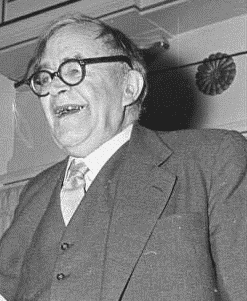
Karl Barth - The Greatest Protestant Theologian of the 20th Century
Karl Barth (1886-1968) was a Swiss Reformed theologian widely regarded as the greatest Protestant theologian of the 20th century. Founder of dialectical theology, he revolutionized theological thought by emphasizing God's sovereignty and divine transcendence, rejecting the dominant liberal theology of his time.
Life and Education
Karl Barth was born on May 10, 1886 in Basel, Switzerland, into a middle-class family. His father, Fritz Barth, was a respected theologian and professor of theology at the University of Bern, which provided the young Karl with a rich and stimulating intellectual environment from childhood.
Barth pursued his university studies at major European academic centers, attending the universities of Bern, Berlin, and Tübingen, completing his training in Marburg. During these formative years, he was influenced by the liberal theology prevalent in 19th-century European Protestantism, particularly the teachings of Adolf von Harnack.
Pastoral Ministry and Theological Transformation
In 1908, Barth was ordained as a pastor in the Reformed Church. His first significant pastorate was in Safenwil, where he served during World War I. It was during this period that he experienced a profound transformation in his theological thought.
Initially preaching according to the teachings of liberal theology, Barth gradually recognized the ethical bankruptcy of liberal Protestant theology when confronted with the real problems faced by members of his congregation. He realized that liberal theology, in trying to reconcile Christianity with modern science and contemporary philosophy, had lost essential elements of the Christian faith.
Theological Revolution: Dialectical Theology
In 1919, Barth published the first edition of Der Römerbrief (The Epistle to the Romans), a work that marked a decisive turning point in his thought and in Protestant theological thought as a whole. This work of biblical exegesis earned him a chair in Reformed Theology at the University of Göttingen and is widely recognized as the beginning of neo-orthodoxy, also known as dialectical theology or theology of crisis.
Barth's theology emphasized the sovereignty of God and the infinite qualitative distinction between God and humanity. He categorically rejected any form of natural theology, arguing that God cannot be known through human reason, nor is he revealed in nature or history. For Barth,
the possibility of knowing God is found in the Word of God and nowhere else.
Barth developed the concept of the wholly other God (Ganz Andere), absolutely transcendent and unknown, who reveals himself exclusively through Jesus Christ. His theology emphasized the paradoxical nature of divine truth, incorporating both God's grace and God's judgment.
Academic Career and Opposition to Nazism
Barth held academic positions at several German universities, including Göttingen, Münster, and Bonn. In 1930, he obtained the chair of Reformed Theology at the University of Bonn, one of the most prestigious theological positions of the time.
With the rise of Nazism in Germany, Barth became a figure of spiritual resistance. In 1934, he was the main inspiration behind the Barmen Declaration, a theological document that proclaimed six theses against Nazi principles, arguing that a genuine Christian could not adhere to Hitler's ideology. Barth was one of the founders of the Confessing Church (Bekennende Kirche), which openly opposed the Nazi regime.
His bold refusal to take the oath of loyalty to Adolf Hitler led to his expulsion from Germany in 1935. He returned to Basel, where he taught theology until his retirement in 1962.
Monumental Work: Church Dogmatics
Barth's most famous and influential work is the Church Dogmatics (Kirchliche Dogmatik), a monumental work of thirteen volumes that he continued developing throughout his life. Begun in 1932, this work remained incomplete at his death, and is one of the greatest works of systematic theology ever written.
In this dogmatics, Barth systematized his fundamental thoughts on revelation and faith, which permeate the entire work. He defines dogmatics as the scientific examination of the content of the words that the church speaks about God. For Barth, the Bible is the testimony that points to the eternal Word of God, and both Scripture and the history of salvation point to the true, absolute, and transcendent revelation of God in Christ.
Legacy and Influence
Barth was an extraordinarily prolific author, having written more than five hundred books, articles, and studies over the course of his life. His influence extended throughout the Christian world, deeply impacting both Protestantism and Catholicism.
After World War II, Barth continued his intellectual and pastoral activity. He spoke at the opening of the World Council of Churches in 1948 and visited Rome after the Second Vatican Council, demonstrating his interest in ecumenical dialogue.
In his personal life, Barth married in 1913 and had five children (four sons and one daughter). Despite his long career as a theology professor in Germany and Switzerland, Barth considered himself, above all, a preacher, whose vocation was to announce the good news of God in Jesus Christ. His theological work was aimed primarily at serving the Church and its mission.
Karl Barth died on December 10, 1968 in his hometown of Basel, at the age of eighty-two, leaving behind a theological legacy that continues to influence contemporary Christian thought.
Birth
Date: May 10, 1886
Place: Basel, Switzerland
Death
Date: December 10, 1968
Place: Basel, Switzerland
Written Works
- Der Römerbrief (The Epistle to the Romans) (1919) - Revolutionary work of biblical exegesis that marked the beginning of dialectical theology and transformed Protestant theological thought
- Kirchliche Dogmatik (Church Dogmatics) (1932-1969) - Monumental thirteen-volume work, one of the greatest works of systematic theology ever written, remaining incomplete at his death
- Die Christliche Dogmatik (The Christian Dogmatics) (1932-1969) - Earlier and related version of Church Dogmatics, with 26 volumes
- Against the Stream (Post-war) - Work that revealed his doubts regarding capitalism and communism
Recommended Books
To deepen your knowledge about this person, we recommend:
- Karl Barth: An Introduction to His Career and the Main Themes of His Theology - Franklin Ferreira
Academic introduction to the life and thought of the Swiss theologian - Karl Barth's Christian Humanism: A Public Theology?
Analysis of Barth's proposal of humanism within his Reformed tradition
Sources and References
This article was prepared based on the following sources:
- Karl Barth – Wikipedia (website)
Encyclopedic article about Karl Barth with biographical and theological information - Theology of Karl Barth – Wikipedia (website)
Specialized article about Barth's theology, its main concepts, and development - Karl Barth: Life and Work - Biblical-Theological (website)
Detailed biography of Karl Barth with a focus on his life and theological work - Karl Barth - CLC Portugal (website)
Biographical profile of Karl Barth with emphasis on his theological influence - 50 years after his death. Theological portrait of Karl Barth (website)
Theological analysis of Karl Barth published 50 years after his death - Karl Barth's Christian Humanism: a public theology? (article)
Academic article on Barth's Christian humanism and his public theology - Karl Barth - an introduction to his career and the main themes of his theology - Franklin Ferreira (article)
Introductory academic article on Karl Barth's life and theological thought