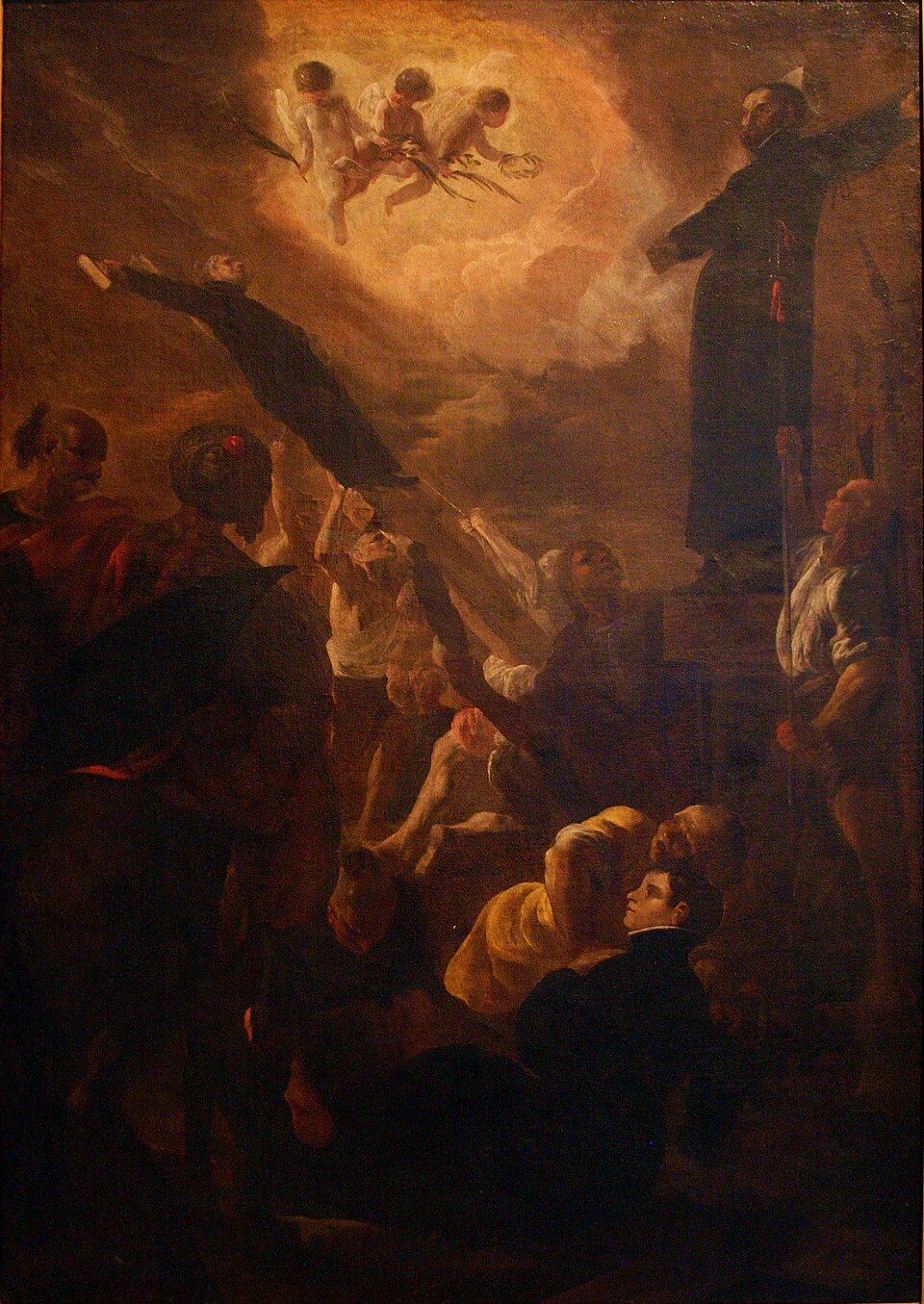
The 26 Martyrs of Japan - The First Canonized of Japanese Christianity
A group of 26 Christians crucified in Nagasaki in 1597 by order of Toyotomi Hideyoshi. Composed of Jesuits, Franciscans, and laypeople, including the Jesuit Paul Miki, they were beatified in 1627 and canonized in 1862, becoming symbols of religious persecution in Japan.
The 26 Martyrs of Japan: Witnesses of the Faith in the Land of the Rising Sun
The 26 Martyrs of Japan constitute one of the most significant groups of Christians martyred during religious persecution in feudal Japan. Crucified on February 5, 1597 in the city of Nagasaki, on Mount Tateyama, these martyrs represent the beginning of a period of intense persecution of Christianity that would last for decades.
Composition of the Group
The group was heterogeneous in its composition, reflecting the diversity of the Christian mission in Japan. It was made up of:
- Twenty Japanese converts, including laypeople, catechists, and three young altar boys (Luis Ibaraki, Anthony, and Thomas Kozaki)
- Five Spaniards, one of Mexican origin
- One Portuguese of Indian origin
- Religious from different orders: Jesuits, Franciscans, and members of the Third Order of Saint Francis
Among the martyrs stood out Saint Paul Miki, a Japanese Jesuit who became the first Japanese Catholic religious to be canonized. Other memorable names include Saint Diego Kisai and Saint Philip of Jesus.
Historical Context and Persecution
Persecution of Christians in Japan intensified under the command of Shogun Toyotomi Hideyoshi, a samurai military leader who began a series of violent actions against Christians starting in 1596. The reasons for this persecution were multiple:
- Differences between the various missionary orders (Jesuits and Franciscans) that had arrived in the country
- Conduct considered inappropriate by some Spanish Christian sailors who arrived in Japan
- Political and religious concerns of the Tokugawa Shogunate regarding foreign influence
The first prisoners were captured on January 2, 1597 in Kyoto, where the Church of Our Lady of the Angels operated, the center of the Franciscan mission. Superior Friar Peter Baptist, together with the priests Martín Loynaz de la Ascensión and Francisco Blanco of Galicia, as well as the cleric Philip of Jesus and the lay brothers Francisco de San Miguel and Gonzalo García, were among the first detained. They were joined by fifteen Japanese converts.
On January 8, 1597, Hideyoshi signed the death sentence decree for 24 of these heroes of the faith, for strictly religious reasons. Two others who accompanied them on the journey were later included, bringing the total to 26 martyrs.
The Martyrdom
The execution took place on Mount Tateyama in Nagasaki, where 26 crosses were erected by order of Hanzaburo Terazawa, brother of the governor of Nagoya. The martyrs were nailed to the crosses and pierced with sword blows. Despite the extreme suffering, they impressed those present with their joy and serenity, demonstrating a profound association with the Passion of Christ.
Paul Miki stood out particularly during his martyrdom. From his cross, he forgave his tormentors and delivered a passionate final sermon, urging everyone to follow Christ in order to be saved. Like Christ in his final moments, Paul invoked God the Father, into whose hands he entrusted his spirit. He reiterated that only in Jesus is there salvation and invited all to follow Christ with joy and to forgive enemies.
Among the martyrs were also two very young teenagers, only eleven and thirteen years old, who showed extraordinary courage in the face of death.
Historical Testimony
The Portuguese missionary Luís Fróis described the martyrdom in detail in his work Relacion del martirio de los 26 cristianos crucificados em Nagasaki el Febrero de 1597. This book was written under the tremendous impression of the cruel event, completed only five weeks after the executions and four months before the author's own death. Fróis's testimony remains one of the most important records of this historical event.
Ecclesiastical Recognition and Canonization
The martyrdom of these 26 Christians was officially recognized by the Catholic Church. They were beatified in 1627 by Pope Urban VIII and canonized on June 8, 1862 by Pope Pius IX (also referred to as Blessed Pius IX in some sources). This formal recognition elevated them to the status of saints of the Catholic Church.
Legacy and Historical Impact
The execution hill became known as Martyrs' Hill and became an important pilgrimage center. Innumerable other Catholics were beheaded or burned alive at this site during the harsh and cruel persecution that lasted four decades.
The martyrdom of the 26 in 1597 marked the beginning of a period of intense persecution that would culminate in the Shimabara Rebellion in 1638, where approximately 37,000 Christians died. In total, between 1597 and 1637, 205 martyrs are recorded in Japan.
Catholics who survived the persecution were forced to hide for 250 years, until the arrival of European missionaries in the 19th century. Despite this long persecution, the Christian faith in Japan survived and reemerged.
Today, the 26 Martyrs of Japan are remembered as symbols of Christian courage and perseverance in the faith. Nagasaki maintains a monument and museum dedicated to the memory of these martyrs, preserving their legacy for future generations.
Birth
Place: Japan
Death
Date: February 5, 1597
Place: Nagasaki, Japan (Mount Tateyama)
Liturgical Feast
February 5
Patronage
- Japan
- Christian martyrs
- Those persecuted for religious reasons
Writings
- Relacion del martirio de los 26 cristianos crucificados em Nagasaki el Febrero de 1597 (1597) - Historical testimony written by the Portuguese missionary Luís Fróis, describing in detail the martyrdom of the 26 Christians. Written five weeks after the events and four months before the author's death.
Recommended Books
To deepen your knowledge about this person, we recommend:
- Relacion del martirio de los 26 cristianos crucificados em Nagasaki el Febrero de 1597 - Luís Fróis (1597)
Essential primary source documenting the martyrdom with firsthand historical details
Sources and References
This article was prepared based on the following sources:
- The 26 Martyrs of Japan – Wikipedia (website)
Encyclopedia with information about the group of martyrs, their composition, date of martyrdom, and canonization - The 26 Martyrs of Nagasaki, Glory of Japanese Christendom (website)
Detailed article about the historical context, imprisonment, condemnation, and execution of the martyrs - The Church remembers Saint Paul Miki and companions, martyrs (website)
Information about Paul Miki and his companions, including details of the martyrdom and context of the persecution - Saint Paul Miki and companion martyrs, patrons of Japan (website)
Biography of Saint Paul Miki and information about the martyrdom of the 26 Christians - Martyrs of Japan – Wikipedia (website)
Information about the various groups of martyrs in Japan, including the 26 of 1597 and the general context of persecution - Martyrs of Japan - Ponto SJ (website)
Information about the 205 martyrs of Japan between 1617 and 1632, with context on the prolonged persecution - Saint Martin of the Ascension - Charism - Franciscans (website)
Information about the Franciscan religious among the 26 martyrs