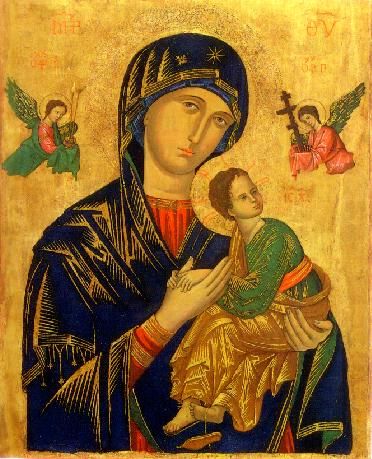
Virgin Mary - Mother of Our Lord Jesus Christ
<p><strong>Mary of Nazareth</strong> was the mother of Jesus Christ, a central figure in Christianity, mentioned in the Gospels as a virgin betrothed to <strong>Joseph</strong>, visited by the Angel Gabriel, and present at key moments in Jesus' life, such as the birth in Bethlehem, the wedding at Cana, and the crucifixion.</p>
Early Life and Annunciation
Mary was a Jewish woman from Nazareth, in Galilee, betrothed to Joseph, a carpenter. According to the Gospel of Luke, the Angel Gabriel was sent by God to her house to announce that the Holy Spirit would come upon her, that she would conceive and give birth to Jesus, the Son of God (Lk 1:26-38).
Galilee, the region where Mary lived, was peripheral, far from the religious center of Jerusalem, occupied by pagan groups until the 2nd century BC, when the Jews regained independence under the Hasmoneans. Mary, as a peasant woman, faced a context of poverty and Roman oppression.
The Journey to Bethlehem and the Birth of Jesus
Mary and Joseph traveled from Nazareth to Bethlehem, Joseph's hometown, for a census ordered by Herod. There, Jesus was born and placed in a manger, visited by shepherds (Lk 2:1-20). The Gospel of Matthew recounts the flight of the Holy Family to Egypt to escape Herod's persecution, returning after his death in 4 BC.
Presence in the Public Life of Jesus
Mary appears in the public life of Jesus at the wedding at Cana in Galilee, where she asks her Son to intervene because there is no wine. Jesus performs his first miracle, turning water into wine (Jn 2:1-12). After that, Mary accompanies Jesus to Capernaum, along with his brothers and disciples.
The Gospel of John mentions her again at the foot of the cross, where Jesus entrusts her to the beloved disciple (Jn 19:25-27). Her name is mentioned 19 times in the New Testament, mainly in Luke and Matthew, which narrate Jesus' conception and childhood.
Historical and Family Context
Mary lived amid uprisings, such as that of Judas the Galilean, in 4 BC, in Sepphoris, near Nazareth, stirring messianic hopes. She was related to Elizabeth, mother of John the Baptist, connecting key figures of early Christianity. Apocryphal traditions, such as the Protoevangelium of James, suggest a birth in Jerusalem, to Joachim and Anne, and dedication to the Temple at age three, but these are not canonical.
- First sorrow: Prophecy of Simeon;
- Second sorrow: Flight into Egypt;
- Third sorrow: Jesus lost in the Temple;
- Fourth sorrow: Meeting on the way to Calvary;
- Fifth sorrow: Death of Jesus on the Cross.
Legacy in Christian Tradition
Patristic sources, such as Ignatius of Antioch and Irenaeus of Lyon, attest to her virginal motherhood. Mary is venerated as the Mother of God, founder of Christianity in some views, living in poverty, oppression, and loss as a young widow. Her life reflects justice and family connection with Jesus, James, and John the Baptist.
'The Lord has magnified your name before all generations, for at the end of time he will manifest in you his redemption to the sons of Israel.'
Traditions indicate that she spent her final years in Magdala, near Jerusalem. Her historicity is confirmed by multiple biblical and apocryphal sources, with Gospel coherence.
Birth
Place: Nazareth, Galilee (probable; tradition suggests Jerusalem)
Liturgical Feast
January 1 (Solemnity of Saint Mary, Mother of God); August 15 (Assumption)
Patronage
- Christians
- Women
- Mothers
- Humanity
Recommended Books
To deepen your knowledge about this person, we recommend:
- Protoevangelium of James - Tradition attributed to James (2nd century AD)
Apocryphal narrative about Mary's childhood and life, including her birth and dedication to the Temple.
Sources and References
This article was prepared based on the following sources:
- Biography of Mary (mother of Jesus) - eBiografia (website)
Biography based on the Gospels, covering life in Nazareth, the Annunciation, the birth, and the miracle at Cana. - Who was the real Virgin Mary, the mother of Jesus in Christianity? - National Geographic Brasil (website)
Historical analysis of Mary as a Jewish woman, the context of uprisings, and her family role. - Mary (mother of Jesus) – Wikipedia (website)
Encyclopedia with biblical references, traditions, and mentions in the Gospels. - The historical sources on Mary: Bible and Apocrypha - Locus Mariologicus (website)
Biblical and apocryphal sources, patristic testimonies on historicity.