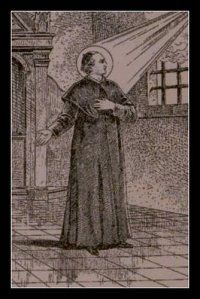
Paulinus of York - First Bishop of York and Missionary to Northumbria
Paulinus was a 7th-century Italian missionary who became the first bishop of York and played a crucial role in the conversion of the kingdom of Northumbria to Christianity. Sent by Pope Gregory I in 601, he accompanied Princess Ethelburga to northern England and converted King Edwin and thousands of his subjects.
Life and Formation
Paulinus was born around 584 in Rome, Italy. In 601, he was sent by Pope Gregory I the Great as part of a second mission of monks to England, with the aim of assisting Saint Augustine of Canterbury in converting the Anglo-Saxons to Christianity. He traveled with Saint Mellitus (who would become the first bishop of London) and Saint Justus (who would become the first bishop of Rochester).
For many years, Paulinus worked in southern England, assisting Augustine and Justus in their missionary efforts. His early ministry was marked by patience and dedication to evangelization in the already Christianized regions of the kingdom of Kent.
Ministry in Northumbria
The Political Opportunity
The turning point in Paulinus's career came in 625, when Edwin, the pagan king of Northumbria, sought the hand of Ethelburga, daughter of the Christian king Aethelbert of Kent, in marriage. Initially, the king of Kent refused, arguing that a Christian princess could not marry a pagan. However, when Edwin promised that Ethelburga would have complete freedom of conscience to practice her faith and that he himself would seriously consider becoming a Christian, the marriage was authorized.
Paulinus was consecrated bishop on 21 July 625 by the Archbishop Justus of Canterbury and traveled north as Ethelburga's chaplain, hoping that the conversion of the Northumbrian people to the gospel would soon follow.
Conversion of King Edwin and Expansion of Christianity
Although Edwin did not convert immediately, his attitude gradually changed. A crucial moment occurred when his pagan high priest, Coifi, converted to Christianity and, in a symbolic act of breaking with paganism, burned down his own temple. In 627, Edwin was baptized together with many of his leading men and court members.
As the first bishop of York, Paulinus began a vigorous missionary campaign throughout Northumbria. With the assistance of his deacon James, he administered baptisms in several places in what would become Yorkshire and Lincolnshire. Over the next six years, Paulinus preached throughout the kingdom of Northumbria, converting thousands of people.
Historical accounts indicate that Paulinus baptized thousands of people in places such as:
- The River Swale near Catterick
- The River Glen near the royal summer residence at Yeavering (near Wooler)
- Holystone near Rothbury
Among his converts was Hilda (baptized around 627), who would become the respected abbess of Whitby. Paulinus also built the first church in York around 627, establishing the episcopal see that would mark the beginning of the recognized succession in the office of Archbishop of York.
Return to Kent and Bishopric of Rochester
Paulinus's ministry in Northumbria was interrupted by the death of King Edwin. In 633, at the Battle of Hatfield Chase (Nottinghamshire), Edwin was defeated and killed by the Anglo-Saxon kings Cadwallon of Gwynedd and Penda of Mercia. With the death of the Christian king, the kingdom returned to paganism and it became dangerous for Ethelburga and her court to remain in Northumbria.
Paulinus, recognizing that there was no future for Christianity in Northumbria without royal support, returned south with the queen, her children, and their belongings, traveling by ship to Kent. He left his deacon James in charge of what remained of the Church in the region.
By the time of his return, Pope Honorius I had sent the pallium (symbol of metropolitan jurisdiction) to Paulinus, not having knowledge of the political change in Northumbria. In 634, Paulinus formally received the pallium and became Archbishop of Rochester.
The elderly Paulinus was then appointed bishop of Rochester, a position he held until his death. He served in this role with dedication, continuing his pastoral ministry until the end of his life.
Legacy and Canonization
Paulinus died on 10 October 644 in Rochester, Kent, at approximately 60 years of age. His death was from natural causes.
Although his ministry in Northumbria was brief (only about six years), Paulinus's impact was profound and lasting. He established the foundations of organized Christianity in the region and created the episcopal structure that would endure. After his death, missionary work in Northumbria was continued by other saints, including Oswald (king of Northumbria) and Aidan (missionary from Iona).
Paulinus is venerated as a saint in the Catholic and Anglican Christian tradition. His liturgical feast day is 10 October. He is considered patron of Rochester, England and the Diocese of Rochester.
His life exemplifies the crucial role of Roman missionaries in the Christianization of Anglo-Saxon England and shows how the Christian faith can take root even in challenging political circumstances. Paulinus's physical description portrays him as a tall man with a slight stoop, black hair, and a thin face, characteristics that made him a memorable figure in his time.
Birth
Date: c. 584
Place: Rome, Italy
Death
Date: 10 October 644
Place: Rochester, Kent, England
Liturgical Feast
10 October
Patronage
- Rochester, England
- Diocese of Rochester
Recommended Books
To deepen your knowledge about this person, we recommend:
- Ecclesiastical History of the English People - Bede (731)
Primary historical source documenting Paulinus's life and ministry in Northumbria, written by a contemporary historian
Sources and References
This article was prepared based on the following sources:
- Paulinus, Bishop of York and Missionary, 644 - For All the Saints - For All the Saints (website)
Detailed article about the life and ministry of Paulinus, including information about his consecration, missionary work, and return to Kent - Saint Paulinus - Britannica - Encyclopaedia Britannica (website)
Reliable encyclopedia with verified biographical information about Paulinus, birth/death dates, and his role in the conversion of Northumbria - Saint of the Day – 10 October – St Paulinus of York (c 584-644) - Anastpaul (website)
Saint biography with information about birth in Rome, death in Rochester, and details about his mission in Northumbria - Paulinus, Missionary, First Archbishop of York - Anglican Resources (website)
Anglican resource with a detailed chronology of Paulinus's ministry, including the Battle of Hatfield Chase and his return to Kent - Paulinus (?-644) October 10th - Northumbria Community - Northumbria Community (website)
Community source with information about Paulinus's baptisms at various locations in Northumbria and his relationship with Hilda of Whitby - Paulinus, missionary to Northumbria - CCEL - Christian Classics Ethereal Library (website)
Christian biographical dictionary identifying Paulinus as the first Christian missionary from Rome to Northumbria - Paulinus, Bishop of York and Missionary, 644 - Commemoration - Daily Office 2019 (website)
Liturgical commemoration page summarizing Paulinus's role in the conversion of King Edwin and Northumbria - Paulinus, First Bishop of York - Exciting Holiness - Exciting Holiness (website)
Source documenting Paulinus's construction of the first church in York around 627