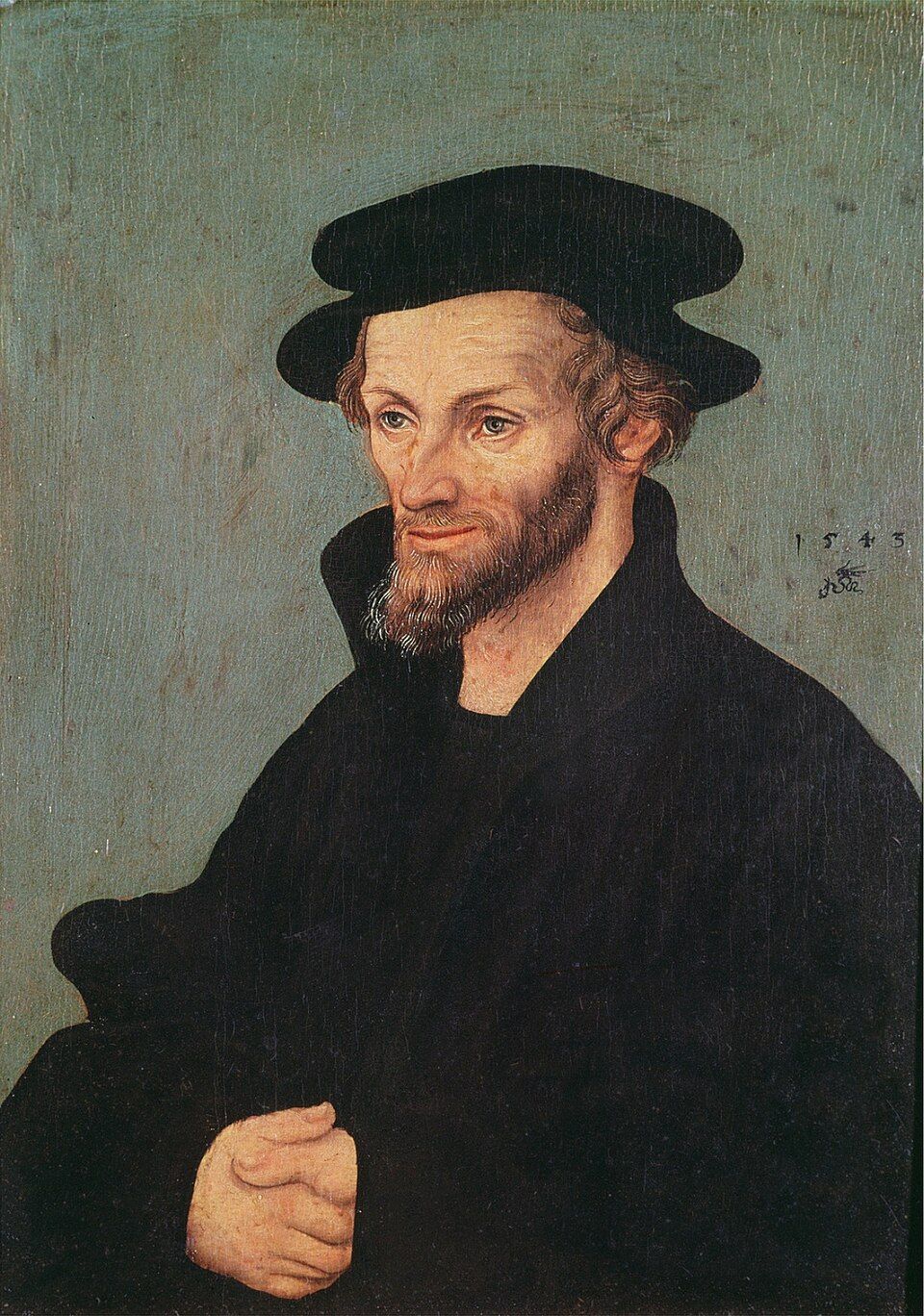
Philipp Melanchthon - Luther's Right Hand and Father of German Education
Philipp Melanchthon (1497-1560) was a German theologian, scholar, and reformer, and a close collaborator of Martin Luther in the Protestant Reformation. Known as the first systematic theologian of Lutheranism, he wrote the Augsburg Confession and revolutionized education in Germany.
Life and Education
Philipp Schwartzerdt, better known as Philipp Melanchthon, was born on 16 February 1497 in Bretten, in southwestern Germany. The son of an armorer, he changed his surname to the Hellenized Melanchthon ("black earth") at the suggestion of his uncle, the humanist Johann Reuchlin. From a young age, he showed intellectual prodigy: at 12, he entered the University of Heidelberg, where he earned a bachelor's degree in 1511, and at 15 he obtained a master's degree from the University of Tübingen.
In 1518, at the age of 21, he was invited to become the first professor of Greek at the newly founded University of Wittenberg. There, he met Martin Luther, who held the chair of Biblical Theology, beginning a friendship and collaboration that would mark history.
Contributions to the Protestant Reformation
In 1519, Melanchthon earned a degree in theology and accompanied Luther to the Leipzig Disputation, publicly defending the authority of Scripture against the Catholic Johann Eck and rejecting transubstantiation. When Luther was exiled to Wartburg Castle in 1521, Melanchthon assumed leadership in Wittenberg.
His most influential work, Loci Communes Rerum Theologicarum (Common Theological Places), published in 1521, was the first Protestant dogmatics text, systematizing Reformation ideas. In 1529, he protested the decisions of the Diet of Speyer, and in 1530, he represented the Lutherans at the Diet of Augsburg, presenting the Augsburg Confession, a conciliatory 28-article document that he largely drafted, surprising even Catholics with its moderate tone.
'Praying for the union of the Churches in Christ and complaining about the rabies theologorum (the rage of theologians).'
After Luther's death in 1546, Melanchthon became the intellectual leader of Lutheranism, seeking conciliation between reformist factions and even with Catholicism, and defending synergism (human cooperation with divine grace), which generated controversy.
Educational Reform and Legacy
Melanchthon was a pioneer in education: he promoted the teaching of the classics, reorganized German universities, and defended free public education. At the Diet of Speyer in 1526, he helped create the first public education system in Germany, consulted by 56 cities. Nicknamed Praeceptor Germaniae ('Teacher of Germany'), he influenced modern curricula.
- Professor of Greek at Wittenberg (1518).
- Professor of Theology (1526).
- Collaborator in the translation of the Bible.
- Skilled negotiator with Roman Catholics.
He died on 19 April 1560 in Wittenberg, praying for the unity of the churches. His legacy as a systematic theologian, educator, and conciliator endures in Protestantism.
Birth
Date: 16 February 1497
Place: Bretten, Germany
Death
Date: 19 April 1560
Place: Wittenberg, Germany
Written Works
- Loci Communes Rerum Theologicarum (1521) - The first Protestant dogmatic theology, systematizing the doctrines of the Reformation.
- Augsburg Confession (1530) - Foundational document of Lutheranism, presented at the Diet of Augsburg.
- Summary of the Renewed Evangelical Doctrine (1524) - Defense of Luther's ideas against the Sorbonne.
Recommended Books
To deepen your knowledge of this person, we recommend:
- Philipp Melanchthon (1497-1560) - Unknown (Globethics)
Detailed analysis of his vocation as an educator and reformer.
Sources and References
This article was prepared based on the following sources:
- Who Was Philip Melanchthon? | GotQuestions.org/Espanol (website)
Concise biography highlighting his relationship with Luther and theological and educational contributions. - Philip Melanchthon - Wikipedia (website)
Detailed encyclopedic entry about his life, works, and death. - Melanchthon Biography - Biografías y Vidas (website)
Chronological summary of studies, works, and role in the Reformation. - The Gentle Lutheran: Philipp Melanchthon | Coalition for the Gospel (website)
Focus on his brilliance and intellectual leadership.