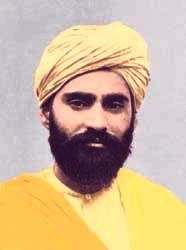
Sadhu Sundar Singh - Indian Evangelist and Teacher of the Faith (1889-1929)
Sadhu Sundar Singh was an Indian Christian missionary born into a Sikh family who revolutionized evangelism in India by presenting Christianity in a contextualized way, using sadhu robes and Indian language. His life and message influenced spiritual leaders such as Mahatma Gandhi and C.S. Lewis, establishing that 'Jesus belongs to India'.
Life and Formation
Sadhu Sundar Singh was born on 3 September 1889 in the Patiala State, Punjab, India, into a wealthy Sikh family. He grew up immersed in the Sikh tradition, being a devout young man until the age of 14-16. His life underwent a radical transformation when, one night in despair after burning a Bible page by page in defiance of his religion, he woke his father before dawn to announce that he had seen Jesus Christ in a vision and heard His voice, declaring that he would follow Christ forever.
Despite his family's pleas, bribes, and threats, Sundar Singh was publicly baptized in 1905 in Simla, in northern India, on his birthday. This act of conversion made him a pariah among his people, leading him to cut off the long hair that every Sikh man kept. His rejection by his family was formalized when his father spoke words of rejection over him.
Ministry and Evangelistic Work
After his conversion, Sundar Singh initially attended a Christian seminary, but left when he refused to abandon his Sikh robes and adopt Western clothes. This decision defined the direction of his ministry: he was convinced that the gospel was not accepted in India because it reached Indians in a foreign form.
In October 1906, Sundar Singh shocked everyone by appearing in a yellow tunic and sadhu turban — the clothing of an ascetic devoted to spiritual practice. He declared:
"I am not worthy to follow in the footsteps of my Lord, but like Him, I do not want a house, I do not want possessions. Like Him, I will belong to the road, sharing the sufferings of my people, eating with those who give me shelter, and telling all men of God's love."
Living in voluntary poverty, without money or possessions, carrying only a New Testament, Sundar Singh traveled through India, Punjab, Kashmir, Afghanistan, and mountainous regions, preaching the message of Jesus Christ in a contextualized way. He became known as "the apostle of bleeding feet" among Christian communities in the north because of his barefoot journeys through rough terrain.
Sundar Singh faced severe persecution: he was imprisoned, stoned for his beliefs, and experienced multiple attempts on his life. On one occasion in Tibet, he was sentenced to death by a chief lama, who threw him into a well covered with a locked iron lid, leaving him to die.
Ministry in Tibet and Mystical Experiences
The mysterious Tibet attracted Sundar Singh from childhood. He made his first preaching trip there in 1908 and, from 1912 onward, decided to preach the gospel for several months each summer in Tibet, Nepal, and the border areas of northern India. Although he faced considerable opposition, the impact of his Tibetan journeys remains uncertain, since Singh kept no written records and traveled unaccompanied.
Sundar Singh was known for his life of intense prayer — he prayed several hours a day — and for long periods of fasting. His long retreats in the Himalayas, often in silence and solitude, produced experiences that he interpreted through the lens of Scripture. He did not present them as alternatives to the Bible, but as confirmations of it. His visions and mystical experiences were compiled in his work Visions of the Spiritual World, presenting a Christ-centered mysticism that resonated far beyond India.
Evangelistic Method and Theological Legacy
Sundar Singh's method revolutionized evangelism in India. He often said that the water of life had been offered in a "Western vessel" when it should have been presented in an "Eastern bowl". His parables often drew from village life and nature, making the gospel accessible without abstraction. His stories, still remembered in Punjab, illustrate how a faith communicated in familiar forms can remain both faithful and transformative.
Sundar Singh also developed a theology of suffering. His barefoot journeys over rough terrain, family rejection, and exposure to persecution shaped a vision of discipleship marked by endurance. He understood suffering not as failure, but as the way of the cross. His life combined intimacy with Christ and engagement with society, showing that prayer fuels mission.
Notably, Sundar Singh was unafraid to defend Christian "universalism". He could never deny all non-Christians the possibility of entering heaven, a progressive theological position for his time.
Influence and Recognition
During his lifetime, Sundar Singh influenced major spiritual leaders, including Mahatma Gandhi and C.S. Lewis. His message and example had global reach. It has been argued that Sundar Singh "did more than any man in the first half of the twentieth century to establish that 'Jesus belongs to India'". He made it clear that Christianity is not an imported, alien, or foreign religion, but is indigenous to Indian needs, aspirations, and faith.
His life demonstrated how the lifestyle and message of the New Testament can be perfectly integrated into the life of a Sikh, Hindu, Jain, or Buddhist sadhu. He remains one of the permanently significant figures in Indian Christianity.
Death and Disappearance
In 1929, Sundar Singh visited Tibet again and was never seen again. He is believed to have died in the foothills of the Himalayas, though his body was never found. His death remains shrouded in mystery, fitting for a life lived in search of the transcendent.
Birth
Date: 3 September 1889
Place: Patiala State, Punjab, India
Death
Date: 1929 (believed)
Place: Foothills of the Himalayas, Tibet (body never found)
Liturgical Feast
1929 (date of his death/disappearance)
Patronage
- Contextualized evangelism
- Mission in Asia
- Integration of Christian faith with Eastern cultures
Written Works
- Visions of the Spiritual World - Compilation of his visions and mystical experiences interpreted through the lens of Scripture, presenting a Christ-centered mysticism
Recommended Books
To deepen your knowledge about this person, we recommend:
- null
Information about recommended books was not found in the available sources
Sources and References
This article was prepared based on the following sources:
- Sundar Singh, Evangelist in India and Teacher of the Faith, 1929 - For All Saints (website)
Detailed biographical article about Sundar Singh, his conversion, ministry, and influence on leaders such as Gandhi and C.S. Lewis - Sundar Singh - Wikipedia (website)
Encyclopedic article with information about his life, conversion, missionary travels, and death - From Punjab to the World: Indian evangelist Sadhu Sundar Singh's Legacy Continues to Shape Global Christianity - Christian Daily (website)
Analysis of Sundar Singh's legacy, his contextualized theology, and influence on global Christianity - Sadhu Sundar Singh, a brief biography - Tentmaker (website)
Concise biography with details about his conversion, life as a sadhu, travels, and universalist theology - 1929 - Sadhu Sundar Singh - Asia Harvest (website)
Detailed account of his life, vision of Christ, adoption of sadhu robes, and ministry in Tibet - Sundar Singh, Evangelist in India and Teacher of the Faith, 1929 - Daily Office 2019 (website)
Brief liturgical biography of Sundar Singh - Life of Sadhu Sundar Singh: A Journey of Faith and Mysticism - Authorea (website)
Academic article on Sundar Singh's life focusing on his journey of faith and mysticism