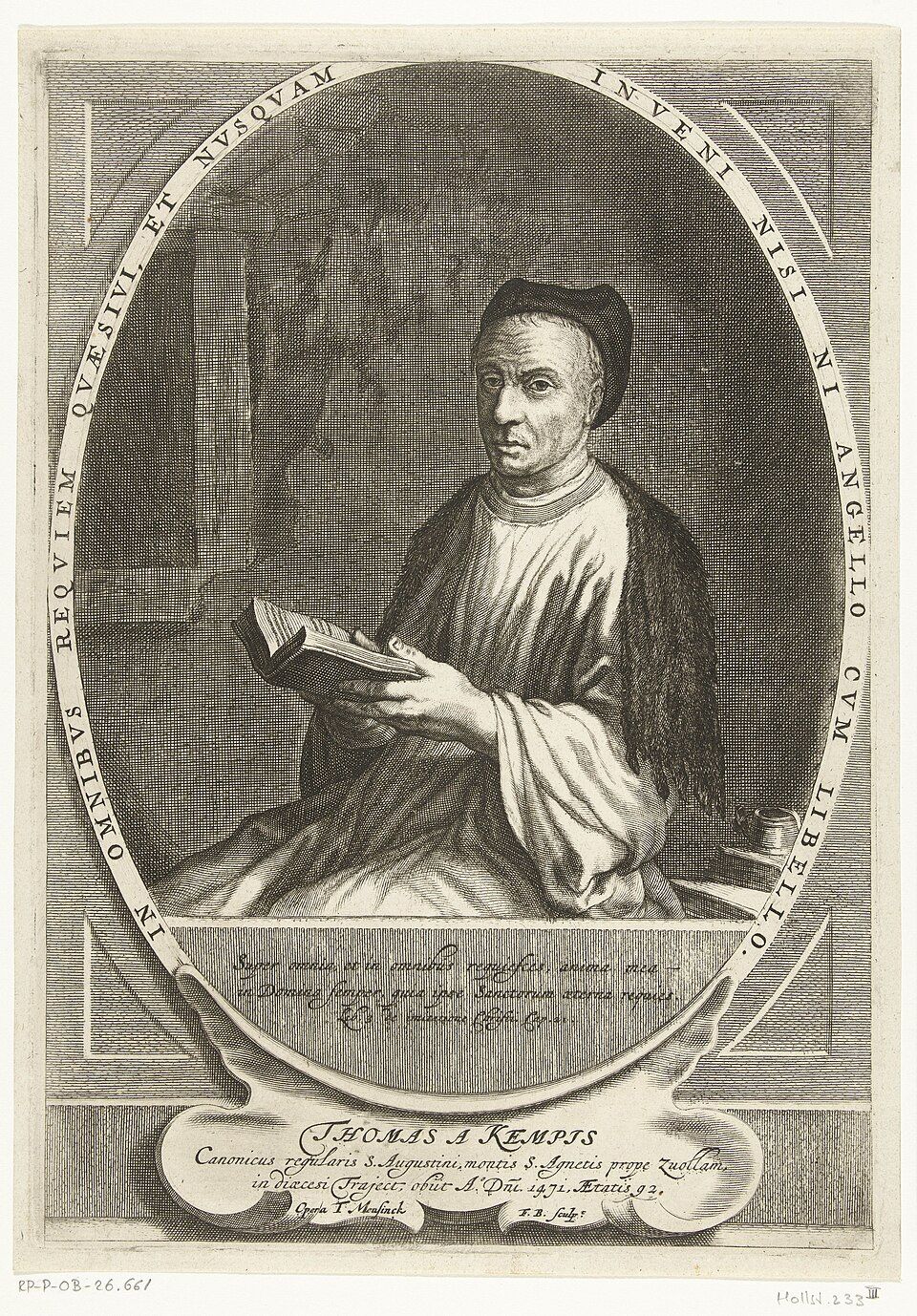
Thomas à Kempis - The Humble Augustinian Monk and Author of The Imitation of Christ
Thomas à Kempis (c. 1380-1471) was a German-Dutch Augustinian canon and author of The Imitation of Christ, one of the most influential works of Christian devotion in history. He devoted his long life to study, prayer, charity, and copying manuscripts, becoming a spiritual leader in his monastery.
Life and Formation
Thomas Hemerken von Kempen, known as Thomas à Kempis or Thomas of Kempis, was born around 1380 in the city of Kempen, located northwest of Cologne, Germany. His paternal surname, Hemerken or Hämmerlein, meant "little hammer" in German, reflecting his origin in a family of craftsmen.
At 13 years of age, Thomas was sent to Deventer, in the Netherlands, to study in the community of the Brothers of the Common Life, an association dedicated to education and care for the poor. There he studied under the guidance of the theologian Florentius Radewyns, who had founded the Windesheim Congregation in 1387, a congregation of regular Augustinian canons who lived in community under vows.
Monastic Life and Ordination
In 1407, Thomas entered the Augustinian monastery of Mount St. Agnes (Agnietenberg), located near Zwolle, in the Netherlands, where he would remain for more than 70 years until his death. He took his vows in 1408 and was ordained a priest in 1413, after overcoming his early doubts and spiritual temptations.
During his first years in the monastery, Thomas quickly became a spiritual leader for the novices, writing pamphlets for the instruction of beginners. In 1429, he was elected vice prior (subprior), but had to leave the monastery temporarily due to popular unrest related to disputes over the episcopal succession of Utrecht. Between 1429 and 1432, Thomas and his companions were exiled, but returned when the situation normalized.
Ministry and Intellectual Work
After his return in 1432, Thomas devoted himself entirely to contemplative life and intellectual work. He became an experienced copyist, an essential profession in the era before the spread of printing. His work as a copyist not only supported him economically, but also allowed him to contribute significantly to the preservation and dissemination of religious knowledge.
Thomas spent his long life of 90 years among:
- Deep study of theology and Christian spirituality
- Prayer and contemplation
- Works of charity and spiritual guidance
- Copying manuscripts with precision and dedication
- Writing devotional and spiritual instructional works
His spiritual philosophy reflected the belief that the reform of the Church, which many were demanding in his time, could be achieved if each person reformed himself.
Legacy and Influence
Thomas à Kempis's most famous work is The Imitation of Christ (Imitatio Christi), a treatise on Christian devotion that became one of the most influential works of Christian literature, surpassed only by the Bible in impact and circulation. The first edition was published in 1472, a year after his death, and for more than 500 years it maintained an average of 6 editions per year — a rare and exceptional case in publishing history.
Thomas died on 25 July 1471 in Zwolle, at the age of 91, after a lifetime devoted to religious and spiritual service. He was buried in the monastery church, although his remains were later transferred to Zwolle after the church was destroyed during the Protestant Reformation.
His contribution to Christian spirituality transcended centuries, influencing generations of Christians through his writings on contemplative life, the imitation of Christ, and the pursuit of spiritual perfection through humility, prayer, and charity.
Birth
Date: c. 1380
Place: Kempen, near Cologne, Germany
Death
Date: 25 July 1471
Place: Zwolle, Netherlands (Agnietenberg)
Liturgical Feast
30 August
Written Works
- The Imitation of Christ (Imitatio Christi) (1472 (first published edition)) - A Christian devotional work that became one of the most influential in Christian literature, second only to the Bible. It deals with contemplative life, imitation of Christ, and the pursuit of spiritual perfection.
- Prayers and Meditations on the Life of Jesus Christ (1661 (Spanish translation)) - A work translated by Francisco de Borja, Prince of Esquilache, published in Brussels.
- Soliloquy in the Soul (18th century (translation by Pedro Velarde)) - A work of spiritual meditation translated into Spanish by Pedro Velarde.
Recommended Books
To deepen your knowledge about this person, we recommend:
- The Imitation of Christ - Thomas à Kempis (Multiple editions since 1472)
The author's masterpiece, essential for understanding his spirituality and influence in the Christian tradition.
Sources and References
This article was prepared based on the following sources:
- Tomás de Kempis - Wikipedia - Wikipedia (website)
Encyclopedia with detailed biographical information, dates, alternative names, and historical context. - Thomas à Kempis - Britannica - Encyclopaedia Britannica (website)
Authoritative biography with verified information on birth, death, main works, and influence. - Tomás de Kempis - EWTN - EWTN (website)
Catholic source with information on life, priestly ordination, and spiritual legacy. - Tomás de Kempis: imitator of Christ - Coalición por el Evangelio - Coalición por el Evangelio (website)
Article on historical context (Black Death) and Thomas à Kempis's monastic life. - Brother Thomas of Kempis and The Imitation of Christ - Religión en Libertad - Religión en Libertad (website)
Detailed article about life, ordination, temporary exile, and death of Thomas à Kempis. - Kempis, Thomas - PHTE - PHTE - Universitat Pompeu Fabra (website)
Academic source with information on life, spiritual philosophy, and published works. - Biography of Thomas of Kempis - BuscaBiografías - BuscaBiografías (website)
Brief biography with birth dates, studies, entry into the monastery, and ordination. - The Imitation of Christ - Tomas de Kempis - Tu Fe Católica - Tu Fe Católica (website)
Catholic source with information on birth, death, education, and founders of the spiritual community.