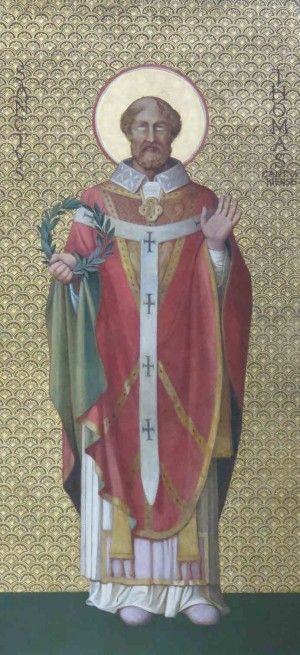
Thomas Becket - Archbishop of Canterbury and Martyr of the Church
Thomas Becket was Archbishop of Canterbury between 1162 and 1170, known for his unwavering defense of the rights of the Church against the royal power of Henry II. Canonized in 1173, he became one of the most venerated saints of the Middle Ages, with hundreds of thousands of pilgrims visiting his tomb in search of miraculous cures.
Life and Education
Thomas Becket was born on 21 December 1119 or 1120 in Cheapside, London, the son of Gilbert and Matilda, who had moved to England from Normandy. Gilbert was a prosperous merchant who provided his son with a quality education, rare for the time.
After returning to England as an educated young man, Thomas entered the service of Theobald of Bec, Archbishop of Canterbury, who entrusted him with several important missions to Rome. Theobald also sent him to Bologna, in Italy, and to Auxerre, in France, to study canon law. His efficiency and zeal deeply impressed the archbishop, who rewarded him with the post of Archdeacon of Canterbury and the headmastership of Beverley school, as well as benefices in other important churches.
Career as Chancellor
Distinguished by his competence and dedication, Theobald recommended Thomas to King Henry II of England for the important post of chancellor of the realm, which he held for seven years, from 1155 to 1162. During this period, Thomas was a courtier, living a worldly and secular life, faithfully serving the interests of the English crown.
Henry II was sovereign of a vast empire that included not only England, but also Ireland, Wales, and exerted strong influence over the Duchy of Brittany. After his marriage to Eleanor of Aquitaine, he became sovereign of most of southern France, making him one of the most powerful men of his time. However, Henry II had a fatal ambition: to govern the Church in England as the supreme authority.
Elevation to the Archbishopric and Spiritual Transformation
In 1162, after Theobald's death, King Henry II rewarded Thomas by making him Archbishop of Canterbury, expecting him to continue prioritizing royal government over the Church. Thomas, who was only a deacon at the time, was ordained priest on 2 June 1162 and, a day later, on 3 June 1162, was consecrated bishop by Henry of Blois, Bishop of Winchester, and by the other suffragan bishops of Canterbury.
During this period, a profound transformation took place in Thomas Becket. The courtly man, worldly and devoted to royal interests, became an ascetic entirely dedicated to God and the Church. His days as a courtier belonged to the past. As the highest authority of the Church in England, Becket proved unwavering under the King's pressure.
Conflict with the Crown
The conflict between Henry II and Thomas Becket intensified when the king tried to impose the Constitutions of Clarendon, a series of 'customs' that, in practice, made the King of England the highest authority of the Church in that country. Henry wanted to be the absolute lord of his domains, both Church and State, and sought to strip special privileges from the English clergy, which he considered obstacles to his authority.
Becket refused to accept these new rules and procedures governing the powers of State and Church. After a public trial, Thomas fled in November 1164, sailing into exile in a small boat from Sandwich without baggage. He remained in exile for more than five years, supported by Pope Alexander III, never yielding to the King's demands.
The Pope and the archbishop had disagreements, especially when the Pope sent legates in 1167 with authority to act as arbiters of the conflict. Resentful of this limitation on his jurisdiction, and firm in his principles, Becket did not submit to the Pope's envoys, since his position obliged him to loyalty both to the English crown and to the Church.
Reconciliation and Martyrdom
After years of conflict, there was a reconciliation between Henry II and Thomas Becket. The archbishop was able to return to Canterbury and recover his former dignity. However, peace was not perfect, as there were unresolved tensions between the King and the Archbishop.
One night, while dining with his nobles, Henry II, frustrated by Thomas's continued resistance, expressed his despair and, perhaps jokingly, asked whether there was no one in England who could rid him of this troublesome priest. A group of the King's nobles, having heard this remark, took it seriously. They went to Canterbury Cathedral where they found the Archbishop.
On 29 December 1170, Thomas Becket was martyred inside the cathedral. His death instantly turned him into a martyr of the Church, a symbol of resistance against the secular power that sought to dominate religion.
Canonization and Legacy
Two years after his death, on 21 February 1173, Pope Alexander III canonized Thomas Becket, officially endorsing his growing cult. He is venerated as a saint and martyr by the Catholic Church and the Anglican Communion.
Between his death in 1170 and the destruction of his shrine in 1538, hundreds of thousands of pilgrims visited the main sites associated with Becket in search of blessings or cures: the site of the martyrdom, the first burial place in the crypt, the shrine in the Chapel of the Trinity, and the surrounding miracle windows. Becket gained a reputation as a great healer, and countless miraculous cures were attributed to him.
Thomas Becket has a stronger personal identification with Canterbury Cathedral than any other individual in history. His life and death exemplify the perennial conflict between temporal and spiritual power, making him a central figure in medieval religious history.
Birth
Date: 21 December 1119 or 1120
Place: London, England
Death
Date: 29 December 1170
Place: Canterbury, England
Liturgical Feast
29 December
Patronage
- Canterbury
- Defenders of the rights of the Church
Recommended Books
To deepen your knowledge about this person, we recommend:
- Thomas Becket: Murder and Making of a Saint - Not specified
British Museum exhibition on the life and legacy of Thomas Becket, including a detailed timeline of his life
Sources and References
This article was prepared based on the following sources:
- Tomás Becket – Wikipedia - Wikipedia (website)
Encyclopedia with complete biographical information about Thomas Becket, his career as chancellor and archbishop, conflict with Henry II - Thomas Becket - Wikipedia - Wikipedia (website)
English article with details about the life, career, spiritual transformation, and death of Thomas Becket - A timeline of Thomas Becket's life and legacy - British Museum (website)
Detailed timeline of Thomas Becket's life, his canonization and legacy, including the destruction of his shrine in 1538 - Becket, Thomas (biography) - Canterbury Archaeology (website)
Biography of Thomas Becket as statesman and archbishop, his identification with Canterbury Cathedral and legacy as a healing saint - St. Thomas Becket | Biography, Facts, Death, Patron Saint - Britannica (website)
Encyclopedia Britannica with information about the life, career, and death of St. Thomas Becket - The martyrdom of Saint Thomas Becket, Archbishop of Canterbury - YouTube (website)
Video in Portuguese about the martyrdom of Saint Thomas Becket, his friendship with Henry II, spiritual conversion, and conflict with the crown - Story of Thomas à Becket - St. B Church (website)
Narrative about the life of Thomas à Becket, his elevation to the archbishopric and martyrdom - Becket, Saint Thomas - Lírio Católico (website)
Catholic encyclopedia with information about Saint Thomas Becket, martyr and Archbishop of Canterbury