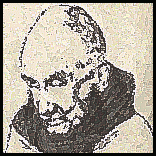
Thomas Merton - Trappist Monk, Theologian, and 20th-Century Mystic
Thomas Merton (1915-1968) was an American Trappist monk, theologian, writer, poet, and mystic who became one of the most influential figures in 20th-century Catholic spirituality. Converted to Catholicism in 1938, he lived 27 years at the Abbey of Gethsemani in Kentucky, where he stood out as a contemplative, peace activist, and promoter of interreligious dialogue.
Life and Formation
Thomas Merton was born on 31 January 1915 in Prades, in French Roussillon. He grew up in an environment of Protestant family tradition, but from an early age felt drawn to Catholic liturgy. His academic formation was marked by studies at Cambridge University in England and later at Columbia University in New York, where he completed his doctoral thesis on The Nature and Art in William Blake.
During his university years at Columbia, Merton was a passionate intellectual, fascinated by the works of James Joyce and D.H. Lawrence, and sympathetic to communism in the context of 1930s New York. However, his intellectual and spiritual life underwent a profound transformation when he discovered Catholicism through the liturgy of a Catholic church. Influenced by his readings of Saint Augustine, particularly his Confessions, and by the Imitation of Christ, as well as by the guidance of his literature professor Mark Van Doren, Merton decided to convert.
Conversion to Catholicism
In November 1938, Merton received baptism and, on 16 November 1938, was confirmed in the Church of Corpus Christi. His conversion marked a turning point in his life. He himself wrote:
Before converting to Catholicism, I was a bit crazy, full of impatience, boredom, and sorrow. When I became Catholic, I ceased to be bored or restless, in any natural sense.
After his conversion, Merton felt an inner call to religious life. Initially, he tried to enter the Franciscan Order in New York, but was rejected by the Franciscans, who were scandalized by his troubled past. Not discouraged, Merton found welcome at St. Bonaventure University, founded by the Franciscans in Olean, New York, where he worked as a professor. During this period, he renounced the remnants of an unruly life and immersed himself deeply in prayer and spirituality, entering the Third Order of St. Francis (Secular Franciscans).
Monastic Life at Gethsemani
On 10 December 1941, Merton arrived at the Abbey of Our Lady of Gethsemani, a community of monks belonging to the Cistercian Order of the Strict Observance (Trappists), the most austere monastic order in the Roman Catholic Church. This abbey, located near Bardstown in Kentucky, would be his home for the next 27 years.
On 19 March 1947, Merton made his solemn vows, binding himself permanently to monastic life. In 1949, he was ordained a priest, receiving the religious name Father Louis. During his years at Gethsemani, Merton became a contemplative writer and a poet of great influence.
Challenges and Spiritual Transformation
Immediately after his priestly ordination in 1949, Merton faced a long and terrible depression that would profoundly mark his monastic life. The causes included physical and spiritual fatigue, a lack of time for contemplation, a lack of privacy in daily Trappist life, and the contrast between the roughness of the community and his refined spirit as a university intellectual. Merton often tried to escape this reality through the typewriter, channeling his anguish into his literary work.
Despite these challenges, or perhaps because of them, Merton became a thinker who challenged the certainties of his time. During his 27 years at Gethsemani, he opened himself to dialogue with other religions, supporting causes such as pacifism and anti-racist movements. Paradoxically, Merton was a contemplative man who was also very inclined toward meetings and relationships with people. He even became novice master, dealing with religious members of other traditions, various authors, and their editors.
Ministry and Intellectual Work
Writer and Contemplative Poet
Merton became one of the most influential American Catholic authors of the 20th century. His autobiography, The Seven Storey Mountain, published in 1948, became a classic of spiritual literature, narrating his life and spiritual journey from his birth to his entry into monastic life. The title is inspired by the circles representing the seven deadly sins in Dante's Purgatory, but the work does not recount extraordinary events; instead, it presents how Divine Providence guides Merton through ordinary life to find his way toward God.
Peace Activism and Social Justice
In the 1960s, Merton emerged as a prophetic voice in the American Catholic Church. According to Father Daniel Berrigan, Merton became the conscience of the peace movement of the 1960s. He identified race and peace as the two most urgent issues of his time, becoming a strong supporter of the nonviolent civil rights movement, which he called
certainly the greatest example of Christian faith in action in the social history of the United States.
Interreligious Dialogue
One of Merton's most notable characteristics was his openness to dialogue with other religious traditions. In 1959, he met the Nicaraguan priest and poet Ernesto Cardenal when he arrived at the monastery. Merton encouraged Cardenal to create a Christian community in Hispanic America, inspiring the founding of Solentiname, a community on the islands of the archipelago of the same name in Nicaragua's Great Lake. This community, which Cardenal described as having Merton as its spiritual founder, was versatile and welcoming, including people of all religions and even non-religious but spiritual people, unlike traditional and archaic monasteries.
Legacy and Death
Thomas Merton died on 10 December 1968 in the province of Samut Prakan, Thailand, where he had traveled to take part in an interreligious meeting. His premature death at 53 ended a life of deep spiritual search and intellectual contribution.
Merton is remembered as a man of prayer, a thinker who challenged the certainties of his time and opened new horizons for souls and for the Church; he was also a man of dialogue, a promoter of peace among peoples and religions. His influence extended beyond the monastery walls, impacting generations of Catholics and Christians who sought an authentic spirituality engaged with the social issues of their time.
Merton committed himself, from beginning to end, to the knowledge of God. He did not want to know about God; he wanted to encounter God. His life and work continue to inspire students of spirituality, peace activists, and those who seek to integrate contemplation with social action.
Birth
Date: 31 January 1915
Place: Prades, France
Death
Date: 10 December 1968
Place: Samut Prakan Province, Thailand
Written Works
- The Seven Storey Mountain (1948) - Spiritual autobiography that narrates Merton's journey from his birth to his entry into monastic life. It became a classic of Catholic spiritual literature.
- Holy Week - A work of spiritual reflection on the meaning of Holy Week in the Christian tradition.
Recommended Books
To deepen your knowledge about this person, we recommend:
- The Seven Storey Mountain - Thomas Merton (1948)
Merton's own autobiography, essential for understanding his spiritual and intellectual journey.
Sources and References
This article was prepared based on the following sources:
- Thomas Merton - Wikipedia (Spanish) (website)
Encyclopedia with complete biographical information about Thomas Merton, including dates, places, and historical context. - Thomas Merton - Wikipedia (English) (website)
Encyclopedia with detailed information about Thomas Merton's life, formation, and work. - Searching in the world and in God (Thomas Merton & Ernesto Cardenal) (article)
Article about the relationship between Thomas Merton and Ernesto Cardenal, and Merton's influence on the founding of Solentiname. - Thomas Merton, a great writer but a poor monk (article)
Article that addresses Merton's life, his conversion, post-ordination depression, and his complex spiritual journey. - The spiritual journey of Thomas Merton (article)
Article that analyzes Merton's spiritual itinerary, his intellectual formation, and philosophical influences. - Thomas Merton's Life and Work (website)
Official chronology of Thomas Merton's life and work, with information about his influence on the peace movement of the 1960s. - Why My Generation Loved Thomas Merton (article)
Article reflecting on Thomas Merton's legacy and influence on later generations.