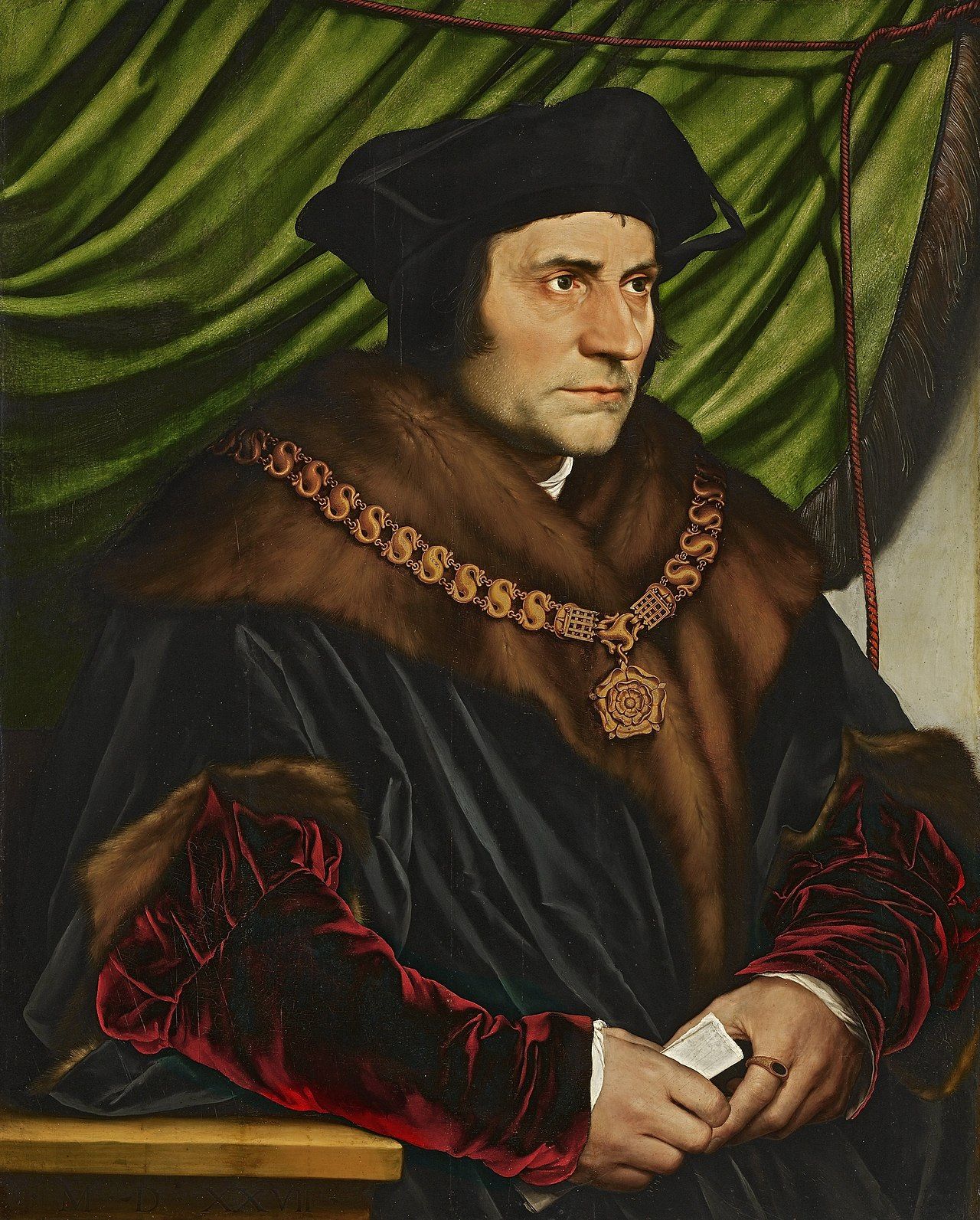
Thomas More - Martyr of the Faith and Defender of Conscience (1478-1535)
Sir Thomas More was an eminent jurist, political philosopher, Renaissance humanist, and English statesman who became a martyr of the Catholic Church after refusing to recognize King Henry VIII as supreme head of the Church of England, and was executed for treason in 1535.
Life and Education
Thomas More was born on February 7, 1478 in London, the son of John More, a respected judge. From a young age, he showed exceptional intellectual aptitude and dedication to study. He attended Oxford University, where he studied Latin and Greek, followed by legal studies. At twenty-six, he married Joan Colt, with whom he had three children.
More was deeply influenced by Renaissance humanism. In 1499, he met the illustrious humanist Erasmus of Rotterdam, an encounter that profoundly shaped his intellectual and spiritual formation. For a time, he lived as a converse at the Carthusian monastery in London, where he devoted himself to contemplative life and to the study of philosophy and theology, although he eventually returned to secular life.
Legal and Political Career
More established himself as a lawyer and quickly gained a reputation as the finest English jurist of his time. From 1510 to 1518, he served as one of the two undersheriffs of London. In 1517, at the age of thirty-nine, he entered fully into the king's service under Henry VIII, being admitted to the monarch's Privy Council.
His political career rose rapidly. In 1521, he was knighted. He became a trusted figure of the king, who valued him for his intelligence and loyalty. More collaborated with Henry VIII on the writing of Defense of the Seven Sacraments against the theses of Martin Luther, a work for which the Pope granted the king the title of Defender of the Faith. In 1529, after the fall of Cardinal Thomas Wolsey, More was appointed Lord Chancellor of England, the second most important position in the kingdom.
Intellectual Work: Utopia
More's masterpiece is Utopia, published in 1516 and revised in 1518. Written in Latin under the full title Libellus vere aureus, nec minus salutaris quam festivus, de optimo rei publicae statu deque nova insula Utopia (A truly golden little book, no less beneficial than pleasant, about the best state of a commonwealth and about the new island Utopia), this work is a sociopolitical satire that describes a fictional society on an imaginary island.
The work began while More was a diplomatic envoy in the Netherlands in May 1515. He initially wrote the introduction and the description of the society (which would become the second part), and upon returning to England, completed the philosophical dialogue. The work was finished in September 1516 and delivered to Erasmus of Rotterdam.
In Utopia, More presents ideals of a commonwealth ruled by an elected prince, surrounded by a council of wise men, a structure intended to make tyranny impossible. The work reflects political concerns that More would later face as Lord Chancellor, particularly questions about absolute power and the limits of royal authority.
Conflict with Henry VIII and Downfall
The relationship between More and Henry VIII deteriorated when the king sought to annul his marriage to Catherine of Aragon in order to marry Anne Boleyn. The Pope refused to grant the annulment, leading Henry VIII to break with Rome and establish the Church of England, with himself as supreme head.
More, as a devout Catholic and a man of conscience, could not accept this rupture. He refused to recognize Henry VIII as Supreme Head of the Church of England or to support the annulment of the royal marriage. On May 16, 1532, he resigned as Lord Chancellor, officially citing health problems, but in reality as a protest against the Act of Supremacy. Although he tried to live discreetly in his house in Chelsea, his silent refusal was understood by both the king and his subjects as disapproval.
Imprisonment, Trial, and Martyrdom
When More refused to take the Oath of Supremacy, required by the Act of Succession, he was arrested and imprisoned in the Tower of London in 1534. During his fifteen months of imprisonment, despite preparing for death, he continued to write spiritual works and meditations.
His trial, held on July 1, 1535, cannot be considered fair even by the legal standards of the time. He was sentenced to death for treason. On July 6, 1535, he was executed by beheading at Tower Hill. His death was marked by dignity and courage: according to reports, he asked the executioner to help him up the scaffold step, saying that he would come down on his own.
After his death, his head was displayed for a month on London Bridge as a warning to traitors. Later, his daughter Margaret Roper managed to remove the head by bribery, and it was taken down from the bridge.
Legacy and Canonization
Thomas More is venerated by the Catholic Church as a saint and martyr. He was canonized on June 22, 1935 by Pope Pius XI, exactly four hundred years after his death. Pope John Paul II, in 2000, proclaimed him patron of politicians and statesmen, recognizing his moral integrity and refusal to compromise his conscience for power.
More is celebrated not only as a historical figure, but as an example of fidelity to faith and conscience. His life demonstrates the conflict between loyalty to the state and loyalty to moral and religious conscience. His work Utopia continues to influence political and social thought. His correspondence and spiritual writings, particularly those composed in prison, reveal a man of profound spirituality and philosophical reflection.
More's martyrdom took place in the context of religious persecution during Henry VIII's reign, a period in which many Catholics were executed for refusing to accept royal supremacy over the Church. More remains a symbol of peaceful resistance to tyranny and fidelity to the principles of conscience.
Birth
Date: February 7, 1478
Place: London, England
Death
Date: July 6, 1535
Place: Tower Hill, London, England
Liturgical Feast
June 22
Patronage
- Politicians
- Governants
- Jurists
- Lawyers
Written Works
- Utopia (1516 (revised in 1518)) - More's masterpiece, a sociopolitical satire that describes a fictional society on an imaginary island, reflecting humanist ideals and criticism of monarchical absolutism
- Defense of the Seven Sacraments (collaboration with Henry VIII) (1521) - Theological work against the theses of Martin Luther, for which the Pope granted Henry VIII the title of Defender of the Faith
- Spiritual Writings and Meditations (1534-1535) - Works composed during his imprisonment in the Tower of London, reflecting deep spirituality and philosophical reflection
Recommended Books
To deepen your knowledge about this person, we recommend:
- A Man for All Seasons - Robert Bolt (1960)
Play that dramatizes the life of Thomas More and his conflict with Henry VIII, offering a humanist perspective on his martyrdom - The Life and Death of Sir Thomas More - William Roper (More's son-in-law) (16th century)
Contemporary biography written by an eyewitness, providing firsthand accounts of More's life and death
Sources and References
This article was prepared based on the following sources:
- The Arrest and Execution of Sir Thomas More in 1535 (website)
Information about Thomas More's life, career, and execution, including his role as Chancellor and opposition to Henry VIII - Utopia (book) - Wikipedia (website)
Detailed analysis of the work Utopia, its historical context, composition, and political-philosophical meaning - Thomas More - Czech Wikipedia (website)
Biography in Czech with information about birth, death, canonization, and major works - St. John Fisher and Thomas More (website)
Information about Thomas More and his fellow martyr John Fisher, details about imprisonment and execution - Biography: Thomas More (website)
Biography in Czech with a chronology of life, education, political career, and death - Thomas More (website)
Information about canonization in 1935 and proclamation as patron of politicians in 2000 - Thomas More (1478-1535) (website)
Biographical summary with information about education and appointment as Lord Chancellor - Thomas More - Katopedia (website)
Catholic encyclopedia with information about Thomas More as jurist, politician, and martyr