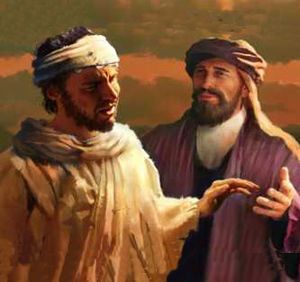
Timothy, Titus, and Silas - The Apostle Paul’s Closest Companions
Three key Christian figures who accompanied the Apostle Paul on his missionary journeys and evangelistic ministry. Timothy, Titus, and Silas were essential collaborators in the expansion of early Christianity and recipients of important Pauline epistles.
Introduction
Timothy, Titus, and Silas were the closest companions of the Apostle Paul during his missionary journeys and evangelistic ministry. These three men played crucial roles in the expansion of early Christianity, serving as Paul’s representatives in the churches, carrying his letters, and strengthening the emerging Christian communities.
Silas - The Companion of the Second Missionary Journey
Life and Background
Silas was a Jew who became one of Paul’s earliest companions. He replaced Barnabas as Paul’s partner on the second missionary journey, after the disagreement between Paul and Barnabas over the inclusion of Mark in the mission.
Ministry with Paul
Silas accompanied Paul through Syria and Cilicia, strengthening the local churches. Together, they traveled through Asia Minor to Troas, from where they went on to Macedonia. In Philippi, Silas and Paul were imprisoned and flogged after expelling a demon from a young woman who was being exploited as a fortune-teller. Both remained in prison, where they experienced a divine miracle that resulted in the conversion of the jailer and his family.
When persecution in Thessalonica forced Paul to flee to Athens, Silas remained in Macedonia with Timothy to strengthen the Christians of that region. Later, Silas rejoined Paul in Corinth, where they continued their evangelistic work.
Timothy - Paul’s Spiritual Son
Origin and Calling
Timothy was a young man from Lystra in Lycaōnia, the son of a mixed marriage: his mother was Jewish and his father was Gentile (Greek). He had an excellent reputation in the region when Paul met him during the second missionary journey. Impressed by his faith and character, Paul invited him to accompany him and Silas in their evangelistic missions.
Development of the Ministry
Timothy quickly became a trusted coworker of Paul. During the journeys through Macedonia, Paul left him in Berea together with Silas to strengthen the local Christians. Later, Paul sent him alone to Thessalonica to check on the condition of the young church and confirm it in the faith. Timothy returned with good news about the Thessalonians and worked with Paul in the evangelization of Corinth.
Paul had such confidence in Timothy that he sent him as his representative to churches about which he was concerned. Timothy also brought Paul news from the Christian communities when Paul was in prison. The apostle included him as an equal partner in his greetings to the churches, as seen in his letters to the Philippians, the Thessalonians, and Philemon.
Relationship with Paul
Paul called Timothy
"my true son in the common faith"and considered him a fellow worker. The apostle wrote two letters addressed specifically to Timothy - 1 Timothy and 2 Timothy - in which he offered pastoral guidance and spiritual encouragement. Timothy accompanied Paul until the end of his ministry, taking part in several phases of his apostolic work.
Titus - The Apostle to the Gentiles
Origin and Characteristics
Titus, like Luke, was not Jewish but Greek. He was an important coworker of Paul, though mentioned less often in biblical accounts than Timothy and Silas. Paul had great confidence in Titus and considered him a spiritual son.
Missions and Responsibilities
Titus was sent by Paul to Corinth with the specific task of bringing that stubborn Christian community back to obedience. His mission was delicate and important, reflecting the trust Paul placed in his leadership ability and pastoral discernment. Paul wrote a letter addressed specifically to Titus - the Epistle to Titus - in which he gave instructions on church organization and the selection of leaders.
Legacy and Historical Importance
Contribution to Early Christianity
Timothy, Titus, and Silas were fundamental to the consolidation of the early Christian churches. They not only accompanied Paul on his missionary journeys, but also served as his representatives in the communities, strengthening the believers’ faith and organizing the emerging church structures.
Model of Discipleship
Paul’s relationship with these three men exemplifies the power of Christian discipleship. Paul trained other leaders, passing on what he had received from Barnabas, creating a chain of transmission of apostolic knowledge and faith that would extend beyond his generation.
Written Testimony
The Pauline epistles addressed to Timothy and Titus - known as the Pastoral Epistles - became fundamental documents for the organization and doctrine of the Christian Church. These letters offer guidance on church leadership, the selection of bishops and deacons, and pastoral instructions that continue to influence Christian practice to this day.
Recommended Books
To deepen your knowledge about this person, we recommend:
- The Holy Bible - Acts of the Apostles - Various authors (1st century)
Historical account of Paul’s missionary journeys and his companions, including Timothy, Titus, and Silas - 1 Timothy, 2 Timothy, and Titus - Apostle Paul (1st century)
Pastoral epistles addressed to Paul’s companions, containing instructions on church leadership and Christian doctrine
Sources and References
This article was prepared based on the following sources:
- Timothy and Titus, Paul’s Closest Collaborators - Pope Benedict XVI (website)
Papal audience on Paul’s companions, with a detailed analysis of their lives and ministries - Lesson 12 - Paul’s Friends and Coworkers - Sunday School (website)
Study on Paul’s companions with information about Silas, Timothy, Titus, and other collaborators - What Can We Learn from What the Bible Says About Paul and Timothy - Got Questions (website)
Analysis of the relationship between Paul and Timothy, including his role as apostolic representative - The Story of Paul of Tarsus (Apostle of Jesus) - Bible Online (website)
Complete biography of Paul with details about his missionary journeys and companions - Who Were Paul’s Companions in the Founding - aBiblia.org (website)
Information about Paul’s companions in his evangelistic missions - Timothy’s Father, Mother, and Grandmother - Ultimato Jovem (website)
Study on Timothy’s family background and his relationship with Paul - Timothy — A Bible Example of Faith - Jehovah’s Witnesses (website)
Analysis of Timothy’s life as an example of faith and Christian discipleship - Acts 15:36-18:22 NIV-PT - Bible Gateway (website)
Biblical text of Paul’s missionary journeys with Silas and Timothy