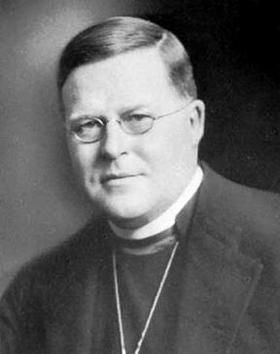
William Temple - Archbishop of Canterbury and Teacher of the Faith in 1944
William Temple (1881-1944) was an influential English Anglican priest who served as Archbishop of Canterbury from 1942 to 1944, becoming a leader of the ecumenical movement and an advocate for social and educational reform during World War II.
Life and Education
William Temple was born on 15 October 1881 in Exeter, Devonshire, England, the son of Frederick Temple, who also became Archbishop of Canterbury (1896-1902). His education was marked by academic excellence and family religious influence.
Temple studied at Oxford and later taught philosophy at Queen's College, Oxford between 1904 and 1910. After guidance from the Oxford theologians Henry Scott Holland and Burnett Hillman Streeter, he was ordained deacon on 20 December 1908 at Canterbury Cathedral and ordained priest on 19 December 1909.
In 1916, he married Frances Anson. During his early years of ministry, he served as rector of St. James, Piccadilly in London (1914-1917) and as a Canon of Westminster (1919-1921).
Ministry and Pastoral Work
Temple became Bishop of Manchester in 1921, a post he held until 1929. During this period, he consolidated his reputation as a spiritual leader and social reformer. In 1929, he was promoted to Archbishop of York, a position he held until 1942.
One of his great legacies was his leadership in the Life and Liberty Movement, an unofficial movement aimed at stimulating changes in the governance of the Church of England. This movement resulted, in 1919, in the creation of the Church Assembly through an Act of Parliament, which for the first time gave lay people a voice in ecclesiastical governance.
Ecumenical Leadership and Missionary Movement
Temple was a prominent figure in the worldwide Christian movement. In 1910, at the age of 28, he served as a steward at the Edinburgh World Missionary Conference, where he accompanied missionary leaders. His prominence in the worldwide missionary movement grew significantly at the 1928 Jerusalem meeting of the International Missionary Council.
In 1938, he was elected chair of the interim committee of the World Council of Churches, then in the process of formation. His vision and commitment to the worldwide Christian movement were memorably expressed in his enthronement sermon in Canterbury in 1942, when he spoke of the "world-wide fellowship of Christians" resulting from the missionary enterprise as "the great new fact of our era".
Archbishop of Canterbury (1942-1944)
In March 1942, Archbishop Cosmo Gordon Lang retired. Despite right-wing political attempts to block Temple's succession, the widespread expectation and desire that Temple should succeed Lang prevailed. Prime Minister Winston Churchill, responsible for appointing the new archbishop, was well aware of Temple's political views, but accepted that he was the leading candidate, describing him as "the only half-crown article in a sixpenny bazaar".
Temple was enthroned at Canterbury Cathedral on 23 April 1942. During his brief tenure as Archbishop, he faced the challenges of World War II and used his office to influence society through wartime radio broadcasts and newspaper articles.
Theological Thought and Social Reform
Temple was a robust thinker whose social theology engaged with the challenges of modern industrial society. His most iconic work is Christianity and Social Order (1942), published during his tenure as Archbishop of Canterbury.
In this book, Temple outlined the contours of the Welfare State with his call for universal access to:
- Medical care
- Education
- Decent housing
- Appropriate working conditions
- Democratic representation
Temple's vision of a post-war society that reflected the innate dignity of every person created in the image of God (imago Dei) was enormously influential on William Beveridge, impacting the 1942 Beveridge Report, which led to the establishment of the Welfare State in 1945.
Temple was also an advocate of the Education Act of 1944, which provided free education for all children. He believed that human freedom depended on society as a whole, particularly on the state having a positive role through education to equip people properly for a purposeful and creative life.
Legacy and Death
Despite his brief tenure as Archbishop of Canterbury, lasting only two and a half years, Temple left a lasting impact on the Church and society. His funeral was held at Canterbury Cathedral on 31 October 1944 and was led by Archbishop Lang, together with Cyril Garbett, Archbishop of York, and Hewlett Johnson, Dean of Canterbury.
Temple was the first Archbishop of Canterbury to be cremated. His ashes were buried in the cloister of Canterbury Cathedral, beside his father's tomb.
When he died at the height of his powers, the worldwide Church lost one of its greatest twentieth-century advocates of mission and Christian unity. His legacy continues to influence theological thought, social reform, and the ecumenical movement to this day.
Birth
Date: 15 October 1881
Place: Exeter, Devonshire, England
Death
Date: 26 October 1944
Place: Westgate-on-Sea, Kent, England
Liturgical Feast Day
6 November
Written Works
- Christianity and Social Order (1942) - Iconic work outlining Temple's vision for a post-war society based on human dignity and the image of God, significantly influencing the British Welfare State
Recommended Books
To deepen your knowledge about this person, we recommend:
- William Temple: His Life and Letters - Frederic Iremonger
Authorized biography of Temple by his official biographer, offering deep insight into his life, thought, and influence
Sources and References
This article was prepared based on the following sources:
- Temple, William (1881-1944) | History of Missiology (website)
Academic biography focused on his contribution to the worldwide missionary movement and the ecumenical movement - William Temple (bishop) - Wikipedia (website)
Comprehensive encyclopedic article with a detailed chronology of his life and ecclesiastical career - Archbishop William Temple (website)
Information from the William Temple Foundation about his life, thought, and influence on social reform - William Temple | Anglican Church, Primacy, Social Reform | Britannica - The Editors of Encyclopaedia Britannica (website)
Encyclopaedia Britannica with verified information about his life, career, and contributions - History of Archbishop Temple (website)
History from Archbishop Temple School about the life and legacy of William Temple - November 6 - William Temple - The Feast Days (website)
Liturgical and biographical information about William Temple as a feast-day figure - William Temple, Archbishop of Canterbury and Teacher of the Faith (website)
Liturgical commemoration with biographical information about William Temple - William Temple | The Gifford Lectures (website)
Information about the Gifford Lectures and William Temple's intellectual influence