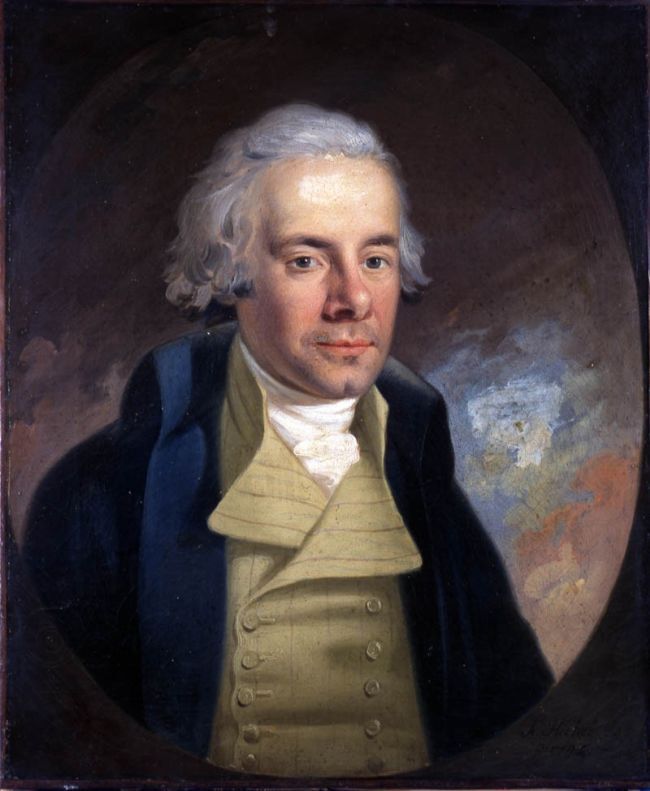
William Wilberforce - Prophet of Abolition and Social Reformer (1759-1833)
William Wilberforce was a British politician and leader of the abolitionist movement who devoted his life to eradicating the slave trade and slavery in the British Empire, driven by his evangelical faith and his conviction that all men are equal.
Life and Education
William Wilberforce was born on 24 August 1759 in Kingston upon Hull, Yorkshire, England, the son of Robert Wilberforce, a very wealthy and respected merchant. He began his political career in 1780, representing Hull in Parliament, and later became Independent Member of Parliament for Yorkshire from 1784 to 1812.
In 1784-1785, Wilberforce underwent a profound religious conversion experience, becoming an evangelical Anglican. This transformative moment marked the beginning of his lifelong commitment to social and moral reform. His spiritual counselor became John Newton, a former slave trader who had repented and converted to Christianity, and who had been the pastor of the church Wilberforce attended in childhood.
Prophetic Calling and Mission
On 28 October 1787, Wilberforce clearly understood his divine calling. According to his own records, he declared:
"The Most High God has set before me two great objectives: the suppression of the slave trade and the reformation of manners"
This moment marked the beginning of his prophetic struggle against slavery. That same year, 1787, Wilberforce came into contact with Thomas Clarkson and a group of activists against the transatlantic slave trade, including Granville Sharp, Hannah More, and Charles Middleton. They persuaded him to embrace the cause of abolition, turning him into one of the leading English abolitionists.
Parliamentary Campaign for the Abolition of the Slave Trade
From 1787 onward, Wilberforce led the parliamentary campaign against the British slave trade for twenty years. In 1789, he introduced 12 resolutions against the slave trade and delivered a speech that many newspapers of the time considered among the most eloquent ever given in the House of Commons. Although supported by Prime Minister William Pitt, Charles Fox, and Edmund Burke, the resolutions were not turned into law at that time.
Despite the threats he received and fierce opposition, Wilberforce continued his relentless battle. His determination and parliamentary eloquence made him a central figure in the abolitionist movement. In 1807, after two decades of struggle, the House of Commons approved the abolition of the slave trade by 267 votes to 283, accompanied by applause and cheers for Wilberforce. The law came into force on 1 January 1808.
Expansion of the Fight for the Abolition of Slavery
However, Wilberforce understood that abolishing the trade was not enough. Slavery itself continued in British territories. From 1816 onward, he introduced a series of bills requiring the compulsory registration of enslaved people, with details about their country of origin, allowing the detection of the illegal importation of foreign slaves.
Later in 1816, he began publicly denouncing slavery itself, although he did not demand immediate emancipation, believing that incremental changes would be more effective. In 1823, he helped organize and became vice-president of the Society for the Mitigation and Gradual Abolition of Slavery Throughout the British Dominions (commonly called the Anti-Slavery Society).
Philanthropic and Reforming Legacy
Beyond his fight against slavery, Wilberforce was a wide-ranging social reformer. In 1787, he helped found the Proclamation Society, a society for the "reformation of manners" aimed at suppressing the publication of obscenities. He founded more than sixty philanthropic organizations throughout his life, mentoring leaders and offering generous financial support.
In 1798, he founded the Church Missionary Society for missionary work, and in 1803, the Bible Society. Along with others, Wilberforce co-founded the world's first animal welfare organization, the Society for the Prevention of Cruelty to Animals (later the Royal Society for the Prevention of Cruelty to Animals).
Wilberforce also took part in campaigns for limited parliamentary reform, such as the abolition of "rotten boroughs" and the redistribution of Commons seats to growing cities, although he feared such measures might go too far.
Final Victory and Death
After withdrawing from the House of Commons in 1825, transferring parliamentary leadership of the abolitionist movement to Thomas Fowell Buxton, Wilberforce continued his philanthropic work. His vast fortune was consumed by his social improvement efforts.
On 26 July 1833, while already on his deathbed, Wilberforce received the news that the Slavery Abolition Act had passed the House of Commons, abolishing slavery throughout the British Empire. Three days later, on 29 July 1833, William Wilberforce died in London. He was buried in Westminster Abbey, beside his friend William Pitt the Younger.
Prophetic Witness
William Wilberforce is remembered as a prophetic witness who, driven by his evangelical faith, confronted one of the greatest injustices of his time. His conviction that all men are equal and his refusal to accept slavery as morally acceptable, despite massive opposition, exemplify the power of a conscience formed by Christian faith. His life shows how genuine religious conviction can transform social and political structures, leaving a legacy that transcends centuries.
Birth
Date: 24 August 1759
Place: Kingston upon Hull, Yorkshire, England
Death
Date: 29 July 1833
Place: London, England
Patronage
- Abolitionists
- Social reformers
- Animal welfare
Written Works
- A Practical View of the Prevailing Religious System of Professed Christians (1797) - An important work in which Wilberforce presents his view of evangelical Christianity and its practical application to Christian life and social reform
Recommended Books
To deepen your knowledge about this person, we recommend:
- William Wilberforce: A Life - Not specified in the sources
Comprehensive biography of Wilberforce's life and work
Sources and References
This article was prepared based on the following sources:
- William Wilberforce (1759-1833), abolitionist and reformer (website)
Italian article about Wilberforce as an abolitionist and reformer, with quotations from his words and context for his work - William Wilberforce - Wikipedia (English) (website)
Comprehensive encyclopedic article about Wilberforce's life, political career, and contributions - William Wilberforce - Britannica (website)
Reference biography from Britannica with information about his life, religious conversion, and abolitionist campaign - William Wilberforce - Wikipedia (Italian) (website)
Italian article with a detailed chronology of his parliamentary campaign and legislative victories - "Am I not a man and a brother?" - Osservatore Romano (website)
Osservatore Romano article about Wilberforce, his divine calling, and his deathbed moment upon receiving news of abolition - WILBERFORCE, William - Enciclopedia Italiana (website)
Italian encyclopedic entry with information on his parliamentary life and philanthropic works - Letters in history: William Wilberforce against slavery (website)
Article about Wilberforce's historical correspondence, including his 1808 letter to President Thomas Jefferson - William Wilberforce – a faith that changed the world (website)
Article about how Wilberforce's faith transformed the world through his abolitionist work